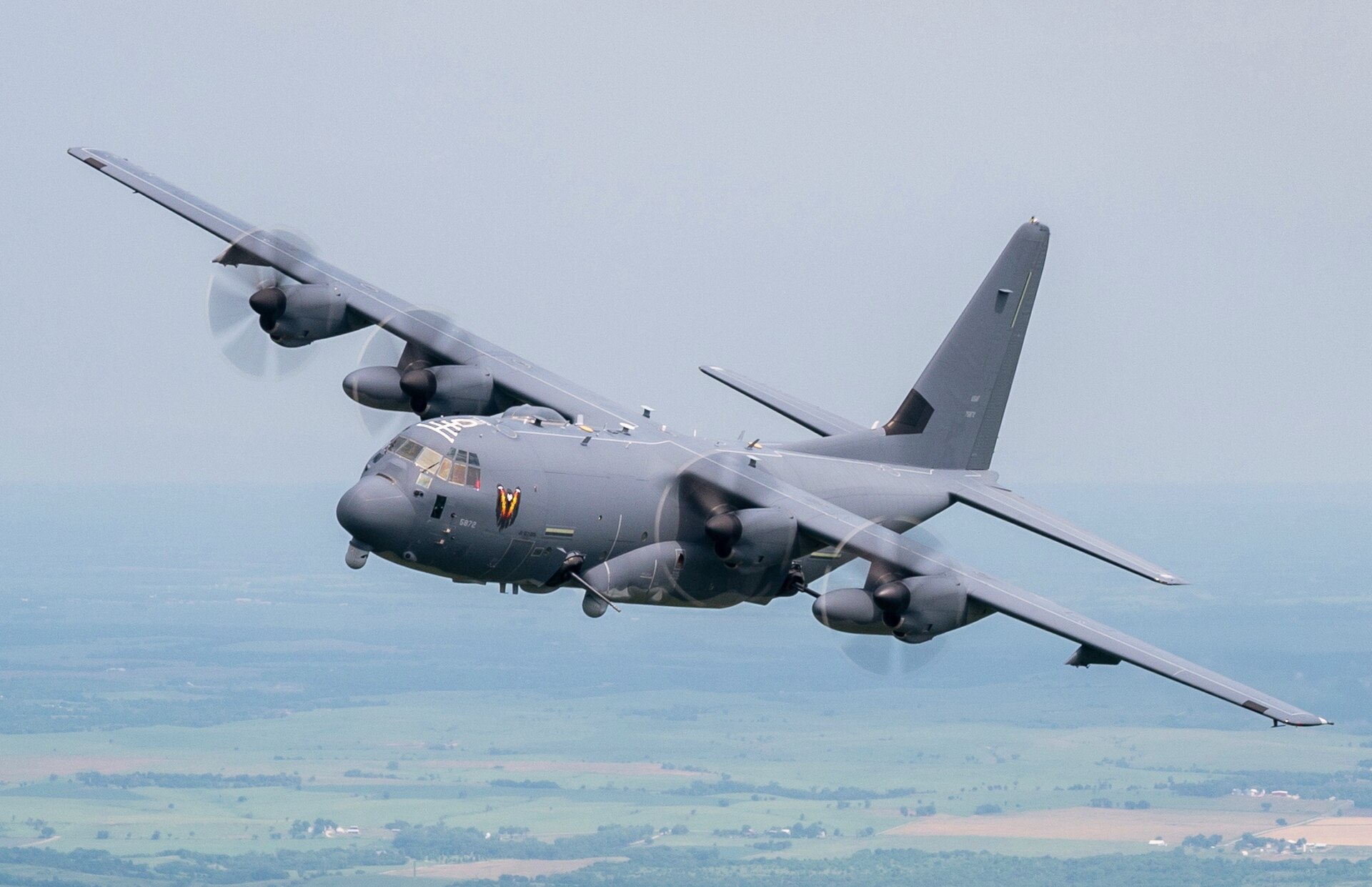
Performance and mechanical data are combined here for a faster, more compact read. Values describe the represented model or nearest clearly identified source variant.
Performance and mechanical specifications for AC-130 Gunship
Primary role
Close-air-support gunship
Crew
About 9, mission dependent
Configuration
Side-firing precision-attack gunship
Powerplant
4 × Rolls-Royce AE 2100D3 turboprops
Top speed
300 mph
Ceiling
25,000 ft
Published range
2,200 mi
Length
97 ft 9 in
Wingspan
132 ft 7 in
Max weight
≈164,000 lb
02 · SERVICE CHRONOLOGY
FROM ORIGIN TO LEGACY.
A dated sequence follows the airframe from development through operational use and later evolution. The number of milestones follows the story rather than a fixed template, and each note explains why the event mattered—not only what happened.
ORIGIN
The first operational AC-130 conversion brought heavier weapons and greater endurance to the gunship mission pioneered by the AC-47. [1]
DEVELOPMENT
Gunships paired persistent orbiting flight with increasingly sophisticated sensors and precision weapons. Their effectiveness depended on air superiority and careful coordination with forces on the ground. [1]
SERVICE HISTORY
AC-130s played a major role in interdiction over Southeast Asia, combining sensors, lateral-firing weapons, and long loiter time against traffic moving at night. [1]
CONTEXT & LEGACY
The AC-130J generation combined the C-130J airframe with precision weapons, modern sensors, and updated fire control. [1]
03 · ARCHIVAL IMAGE
THE AIRFRAME IN CONTEXT.
A documented photograph or archival reference connects the interactive model to a real airframe, operation, or preserved example.
A short, rights-screened motion record adds sound, movement, and operational scale without autoplaying or delaying the interactive model.
AC-130 air-to-air view00:08
Short air-to-air footage of an AC-130; the specific gunship sub-variant is not identified.
VARIANT NOTE Related-family footage is identified here and is not presented as the exact modeled variant.
REUSE NOTE Embedded without modification. Commercial editorial reuse remains subject to the source record, non-endorsement, trademark, privacy/publicity, and third-party-rights limitations.
The appearance of U.S. Department of War (DoW) visual information does not imply or constitute DoW endorsement.
A short, attributed line restores a human voice to the technical record. Period statements and later recollections are identified by the date label and accompanied by a source link.
“The gunship is there when the ground force needs it most.”
Bradley HeitholdU.S. Air Force lieutenant general and AFSOC commander
Heithold emphasized persistence and direct coordination rather than treating the AC-130 as a conventional bomber.
Focused facts connect the airframe's systems to the way it was built, flown, or used.
01
Orbit geometry
Side-firing weapons let the aircraft circle a target while keeping its armament pointed inward.
02
Sensor-to-fire loop
Electro-optical, infrared, navigation, and fire-control systems are integrated for sustained precision support.
03
Crew coordination
Pilots, navigators, sensor operators, and weapon crews work as a single airborne firing team.
07 · HISTORICAL FIELD NOTE
WHY IT MATTERS.
The Hercules airframe became a persistent gun platform, orbiting targets while delivering precisely directed fire from side-mounted weapons. Sensors, fire-control systems, and long endurance let the crew observe a battlefield and repeatedly engage from a banked orbit, making the gunship especially valuable for close support and special operations. [1]
Reference figures vary by variant, payload, configuration, altitude, test method, and source. Values here are an editorial orientation—not operational or flight-planning data.
Each numbered citation links to an operator, national museum, manufacturer, or established research institution. The scope note tells you exactly what that source supports, and each entry includes its retrieval date.
Where the represented model and source variant differ, the scope is labelled rather than silently treated as an exact match. Read the editorial policy, report a correction through the legal notice, or review 3D-model provenance in the attribution directory.