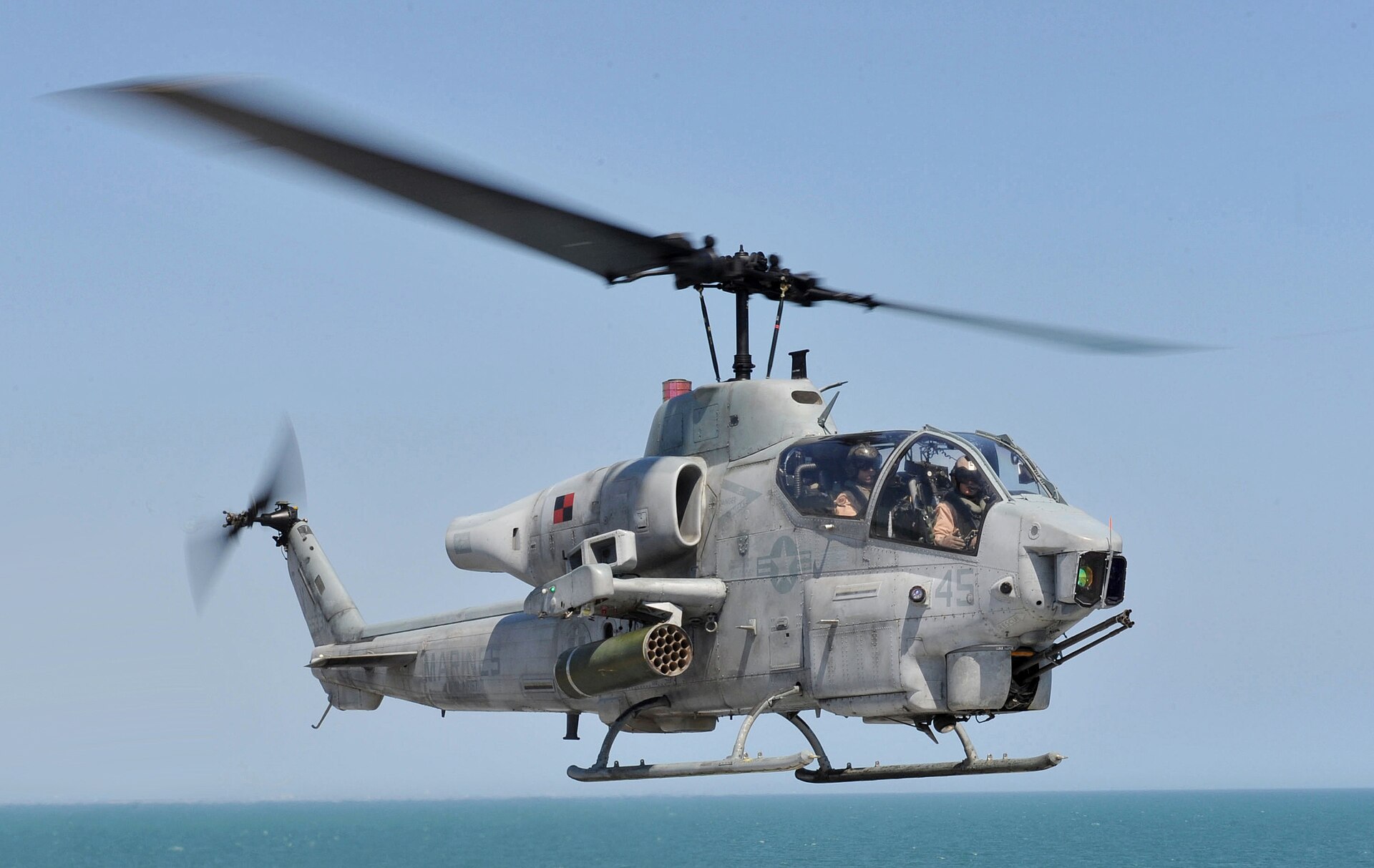
Performance and mechanical data are combined here for a faster, more compact read. Values describe the represented model or nearest clearly identified source variant.
Performance and mechanical specifications for AH-1W Super Cobra
Primary role
Attack helicopter
Crew
2
Configuration
Tandem-seat attack helicopter
Powerplant
2 × General Electric T700 turboshafts
Top speed
219 mph
Ceiling
12,200 ft
Published range
370 mi
Fuselage length
≈45 ft
Rotor diameter
48 ft
Max weight
≈14,750 lb
02 · SERVICE CHRONOLOGY
FROM ORIGIN TO LEGACY.
A dated sequence follows the airframe from development through operational use and later evolution. The number of milestones follows the story rather than a fixed template, and each note explains why the event mattered—not only what happened.
ORIGIN
The original single-engine Cobra prototype flew after Bell adapted proven Huey components to a narrow attack airframe. [1]
DEVELOPMENT
The twin-engine AH-1W became the Marine Corps standard Cobra and served until replacement by the AH-1Z. [1]
SERVICE HISTORY
Marine Cobras provided armed escort and close support from ships and austere bases in the Gulf and Iraq. Their compact shipboard footprint kept the basic Cobra arrangement useful long after its Vietnam-era origin. [1]
CONTEXT & LEGACY
The U.S. Marine Corps retired the AH-1W after 34 years of service, completing its transition to the four-bladed AH-1Z Viper. [1]
03 · ARCHIVAL IMAGE
THE AIRFRAME IN CONTEXT.
A documented photograph or archival reference connects the interactive model to a real airframe, operation, or preserved example.
A short, rights-screened motion record adds sound, movement, and operational scale without autoplaying or delaying the interactive model.
AH-1W SuperCobra deck landing03:30
An AH-1W lands aboard USS Makin Island.
REUSE NOTE Embedded without modification. Commercial editorial reuse remains subject to the source record, non-endorsement, trademark, privacy/publicity, and third-party-rights limitations.
The appearance of U.S. Department of War (DoW) visual information does not imply or constitute DoW endorsement.
A short, attributed line restores a human voice to the technical record. Period statements and later recollections are identified by the date label and accompanied by a source link.
“It is a pilot's aircraft—responsive, agile and built around the mission.”
Stephen R. LightfootU.S. Marine Corps Cobra pilot
Lightfoot's description reflects the narrow, direct attack-helicopter logic retained by the Super Cobra.
Focused facts connect the airframe's systems to the way it was built, flown, or used.
01
Marine power
Two engines improved performance and over-water assurance compared with early single-engine Cobras.
02
Wing stores
Stub wings unload the rotor in forward flight and carry missiles, rockets, or external fuel.
03
Flexible turret
A chin-mounted three-barrel cannon can be aimed independently of the helicopter's direction of travel.
07 · HISTORICAL FIELD NOTE
WHY IT MATTERS.
The twin-engine Super Cobra brought guided weapons and maritime durability to the long-serving Cobra attack-helicopter family. Its narrow tandem fuselage reduced frontal area, while shipboard compatibility and a mix of cannon, rockets, and missiles made it a close-support partner for Marine expeditionary forces. [1]
Reference figures vary by variant, payload, configuration, altitude, test method, and source. Values here are an editorial orientation—not operational or flight-planning data.
Each numbered citation links to an operator, national museum, manufacturer, or established research institution. The scope note tells you exactly what that source supports, and each entry includes its retrieval date.
Where the represented model and source variant differ, the scope is labelled rather than silently treated as an exact match. Read the editorial policy, report a correction through the legal notice, or review 3D-model provenance in the attribution directory.