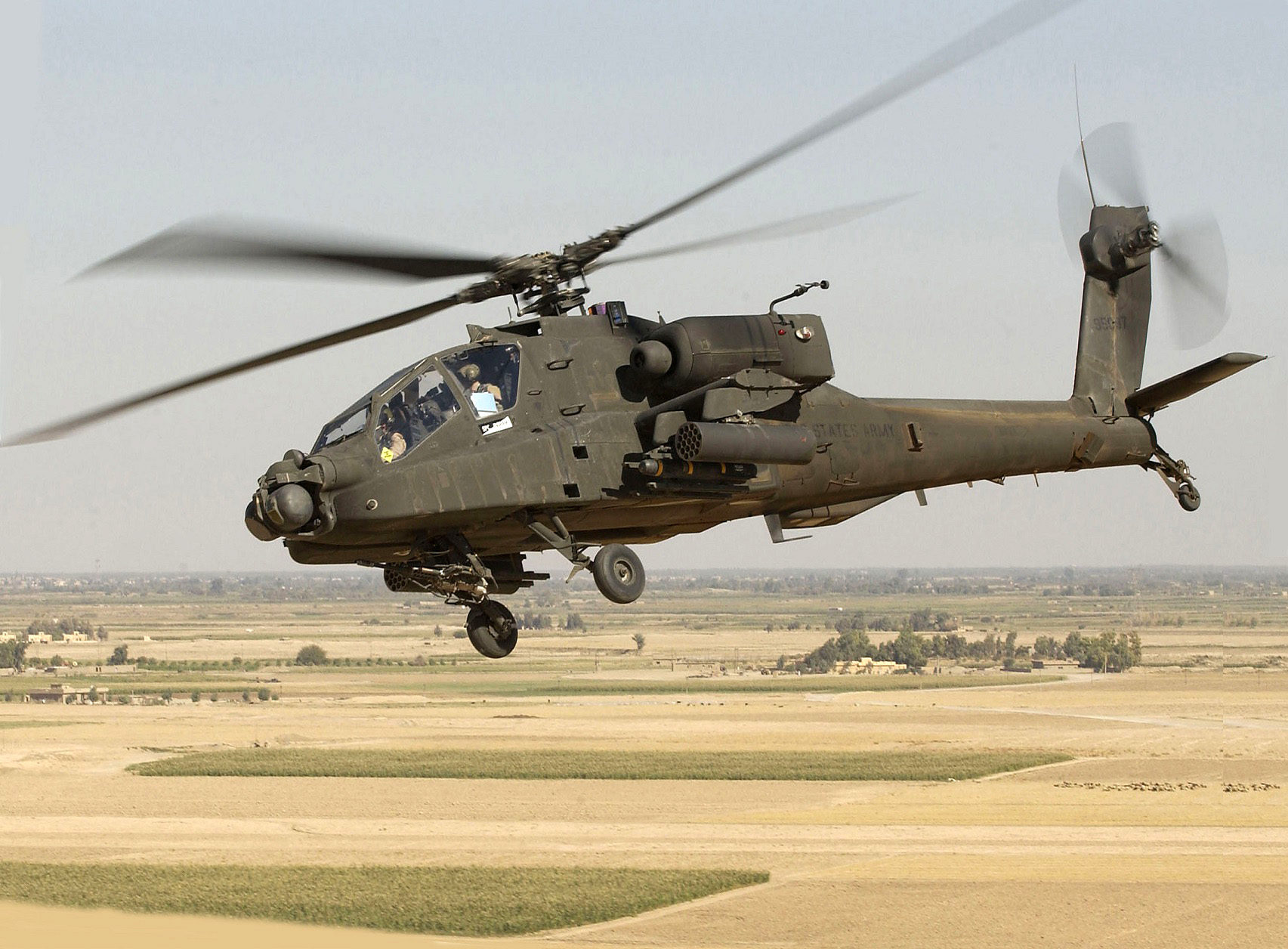
Performance and mechanical data are combined here for a faster, more compact read. Values describe the represented model or nearest clearly identified source variant.
Performance and mechanical specifications for AH-64D Apache Longbow
Primary role
Attack helicopter
Crew
2
Configuration
Tandem-seat sensor-equipped attack helicopter
Powerplant
2 × General Electric T700 turboshafts
Top speed
182 mph
Ceiling
21,000 ft
Published range
300 mi
Overall length
58 ft 2 in
Rotor diameter
48 ft
Max weight
≈23,000 lb
02 · SERVICE CHRONOLOGY
FROM ORIGIN TO LEGACY.
A dated sequence follows the airframe from development through operational use and later evolution. The number of milestones follows the story rather than a fixed template, and each note explains why the event mattered—not only what happened.
ORIGIN
The YAH-64 prototype flew during the Army competition for a survivable anti-armor helicopter. [1]
DEVELOPMENT
The AH-64D entered service with the Longbow radar option, digital networking, and extensive avionics changes. [1]
SERVICE HISTORY
The first production AH-64D was delivered with the redesigned avionics architecture associated with Longbow radar, digital communications, and coordinated attack. [1]
CONTEXT & LEGACY
Combat operations drove continuing changes to sensors, communications, tactics, and survivability. The Longbow concept matured from an anti-armor system into a networked reconnaissance-and-attack platform. [1]
03 · ARCHIVAL IMAGE
THE AIRFRAME IN CONTEXT.
A documented photograph or archival reference connects the interactive model to a real airframe, operation, or preserved example.
A short, rights-screened motion record adds sound, movement, and operational scale without autoplaying or delaying the interactive model.
AH-64D test flight00:05
A five-second flight study of the exact AH-64D Longbow variant.
REUSE NOTE Embedded without modification. Commercial editorial reuse remains subject to the source record, non-endorsement, trademark, privacy/publicity, and third-party-rights limitations.
The appearance of U.S. Department of War (DoW) visual information does not imply or constitute DoW endorsement.
A short, attributed line restores a human voice to the technical record. Period statements and later recollections are identified by the date label and accompanied by a source link.
“The capabilities the AH-64 will give the division are virtually endless.”
Franklin WorshamU.S. Army captain and Apache commander
Worsham was describing the Longbow Apache's reconnaissance, networking, and attack potential during a unit transition.
Focused facts connect the airframe's systems to the way it was built, flown, or used.
01
Crew arrangement
The pilot occupies the rear cockpit and the copilot-gunner sits forward with separate controls and displays.
02
Gun integration
The 30 mm chain gun can be cued by helmet sight or targeting sensors.
03
Survivable systems
Separated engines, armored crew areas, and redundant systems support continued flight after damage.
07 · HISTORICAL FIELD NOTE
WHY IT MATTERS.
The Longbow Apache couples an armored tandem cockpit with advanced sensors and precision weapons for day, night, and adverse-weather attack. Its mast-mounted radar can search while much of the helicopter remains masked by terrain, and its distributed sensors let the crew identify, prioritize, and engage targets under difficult battlefield conditions. [1]
Reference figures vary by variant, payload, configuration, altitude, test method, and source. Values here are an editorial orientation—not operational or flight-planning data.
Each numbered citation links to an operator, national museum, manufacturer, or established research institution. The scope note tells you exactly what that source supports, and each entry includes its retrieval date.
Where the represented model and source variant differ, the scope is labelled rather than silently treated as an exact match. Read the editorial policy, report a correction through the legal notice, or review 3D-model provenance in the attribution directory.