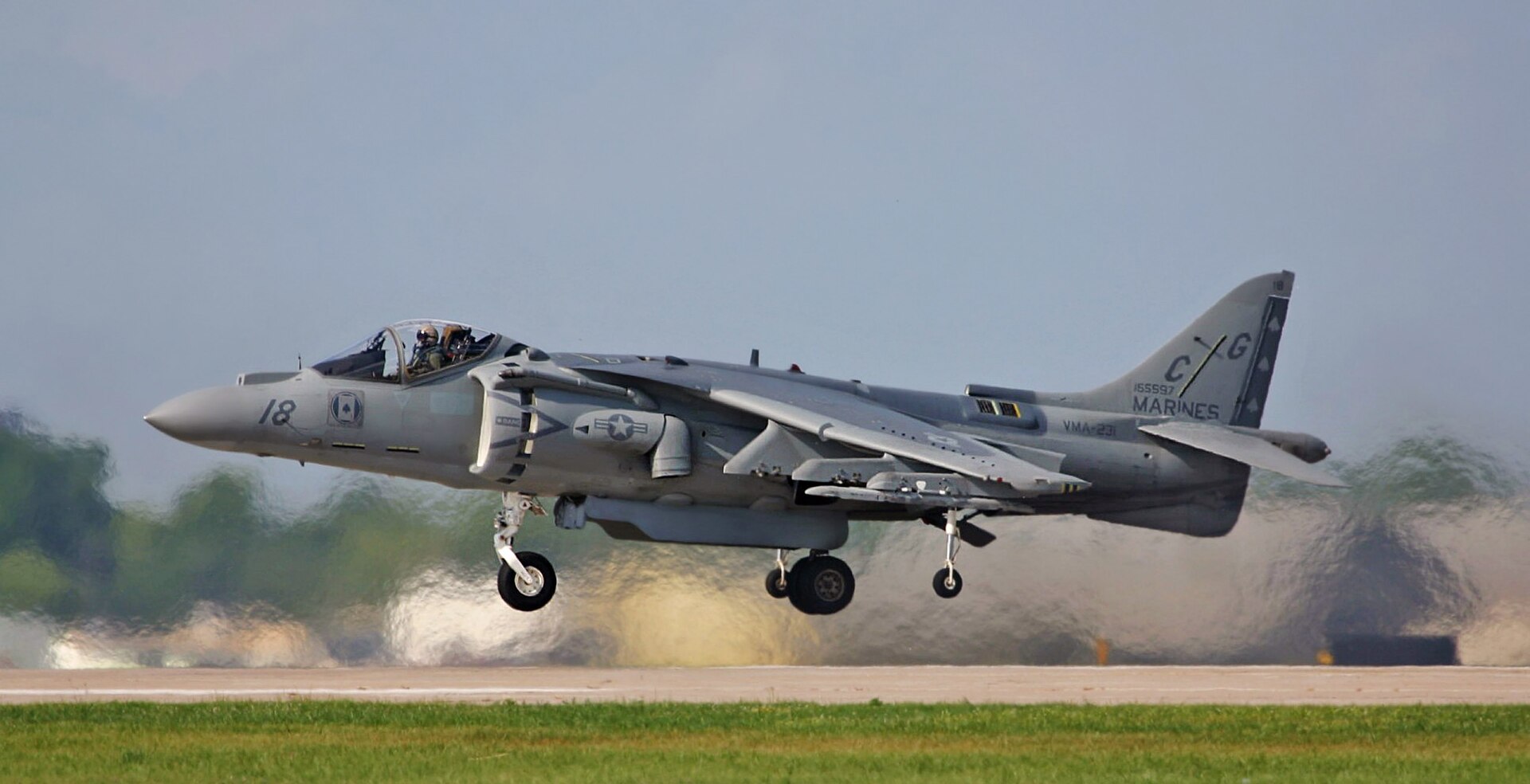
Performance and mechanical data are combined here for a faster, more compact read. Values describe the represented model or nearest clearly identified source variant.
Performance and mechanical specifications for AV-8B Harrier II
Primary role
STOVL attack aircraft
Crew
1 pilot
Configuration
Vectored-thrust V/STOL attack aircraft
Powerplant
1 × Rolls-Royce F402 Pegasus turbofan
Top speed
673 mph
Ceiling
50,000 ft
Published range
1,378 mi
Length
46 ft 4 in
Wingspan
30 ft 4 in
Max weight
≈31,000 lb
02 · SERVICE CHRONOLOGY
FROM ORIGIN TO LEGACY.
A dated sequence follows the airframe from development through operational use and later evolution. The number of milestones follows the story rather than a fixed template, and each note explains why the event mattered—not only what happened.
ORIGIN
The first advanced Harrier development flew with a larger composite wing and redesigned intake and cockpit. [1]
DEVELOPMENT
Night Attack and radar-equipped versions expanded the design beyond its original daylight close-support focus. [1]
SERVICE HISTORY
Expeditionary operations in the Gulf, Balkans, Afghanistan, Iraq, and against ISIS showed the advantage of flexible basing. They also underscored the training discipline demanded by vertical and short takeoff operations. [1]
CONTEXT & LEGACY
Marine AV-8Bs operated from amphibious ships and forward sites during the invasion of Iraq, using short-takeoff flexibility to keep strike sorties close to the ground campaign. [1]
03 · ARCHIVAL IMAGE
THE AIRFRAME IN CONTEXT.
A documented photograph or archival reference connects the interactive model to a real airframe, operation, or preserved example.
A short, rights-screened motion record adds sound, movement, and operational scale without autoplaying or delaying the interactive model.
AV-8B Harrier II flight demonstration00:30
An AV-8B demonstrates its distinctive flight envelope.
REUSE NOTE Embedded without modification. Commercial editorial reuse remains subject to the source record, non-endorsement, trademark, privacy/publicity, and third-party-rights limitations.
The appearance of U.S. Department of War (DoW) visual information does not imply or constitute DoW endorsement.
A short, attributed line restores a human voice to the technical record. Period statements and later recollections are identified by the date label and accompanied by a source link.
“We operated right off of the ship, which was definitely a good experience.”
Adam FaulU.S. Marine Corps captain and AV-8B pilot
Faul connected the Harrier's short-field capability to the practical freedom of operating close to embarked forces.
Focused facts connect the airframe's systems to the way it was built, flown, or used.
01
Hover control
Reaction-control jets at the nose, tail, and wing tips provide authority when airflow over the controls is weak.
02
Shipboard method
A ski-jump launch can trade deck run for useful takeoff weight without a catapult.
03
Water injection
Water injection temporarily increases available thrust during demanding takeoff and landing conditions.
07 · HISTORICAL FIELD NOTE
WHY IT MATTERS.
Vectoring engine thrust lets the Harrier operate from short runways and amphibious ships while supporting troops close to the front. The ability to redirect exhaust through rotating nozzles provides remarkable basing flexibility, but vertical flight consumes fuel rapidly and demands careful management of weight, temperature, and control response. [1]
Reference figures vary by variant, payload, configuration, altitude, test method, and source. Values here are an editorial orientation—not operational or flight-planning data.
Each numbered citation links to an operator, national museum, manufacturer, or established research institution. The scope note tells you exactly what that source supports, and each entry includes its retrieval date.
Where the represented model and source variant differ, the scope is labelled rather than silently treated as an exact match. Read the editorial policy, report a correction through the legal notice, or review 3D-model provenance in the attribution directory.