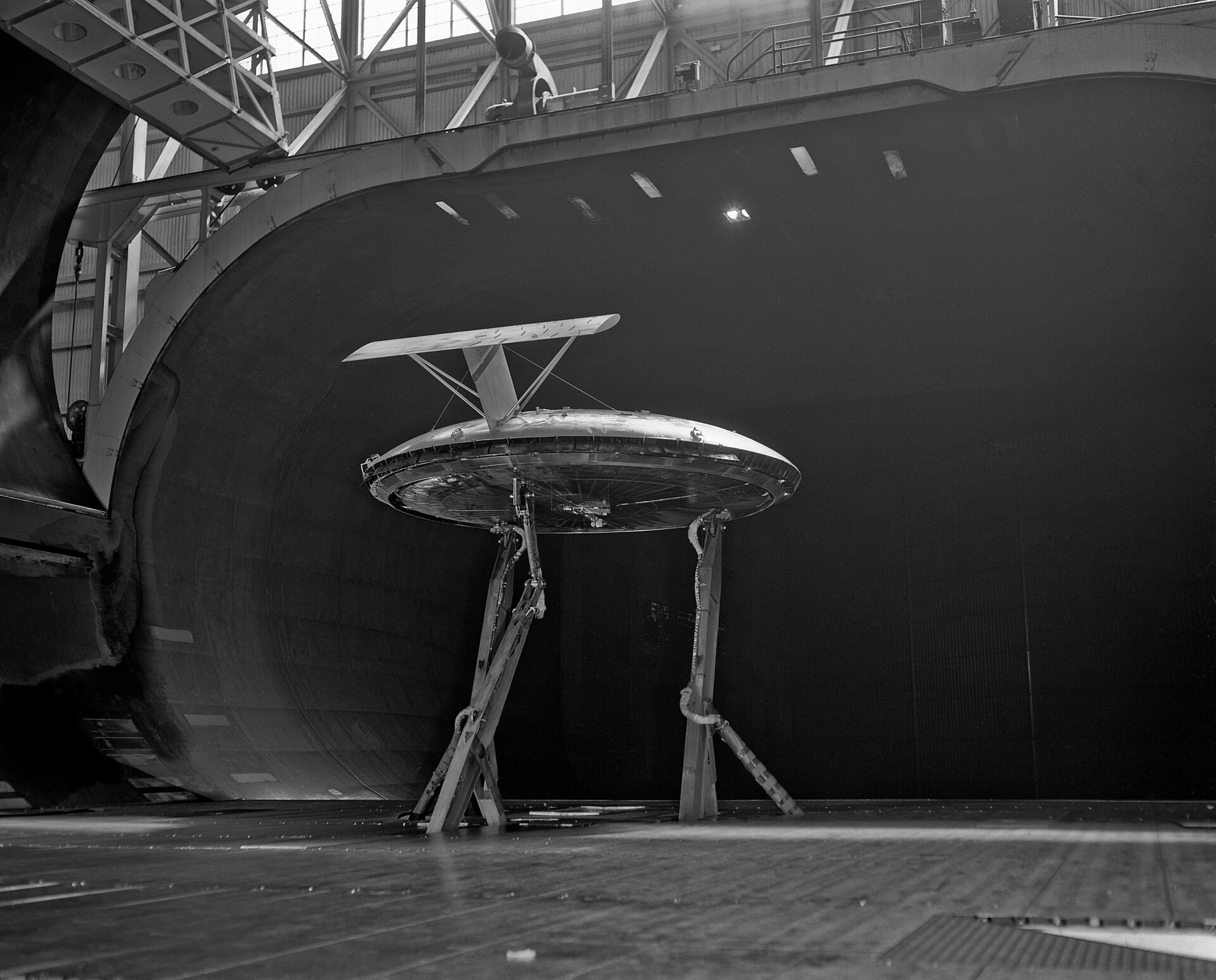
Performance and mechanical data are combined here for a faster, more compact read. Values describe the represented model or nearest clearly identified source variant.
Performance and mechanical specifications for Avro Canada VZ-9 Avrocar
Primary role
VTOL research aircraft
Crew
2
Configuration
Ground-effect VTOL demonstrator
Powerplant
3 × Continental J69 turbojets
Top speed
35 mph demonstrated
Ceiling
3 ft demonstrated
Published range
Test program
Length
18 ft diameter
Wingspan / rotor
Circular planform
Weight
≈5,650 lb gross
02 · SERVICE CHRONOLOGY
FROM ORIGIN TO LEGACY.
A dated sequence follows the airframe from development through operational use and later evolution. The number of milestones follows the story rather than a fixed template, and each note explains why the event mattered—not only what happened.
ORIGIN
John Frost's Avro team explored disc-shaped aircraft concepts. [1]
DEVELOPMENT
U.S. military funding turned the idea into a VTOL demonstrator. [1]
SERVICE HISTORY
Free-flight tests revealed instability outside close ground effect. [1]
SERVICE HISTORY
The program ended after missing its speed, altitude, and control goals. [1]
Focused facts connect the airframe's systems to the way it was built, flown, or used.
01
Ground-effect trap
Its air cushion worked close to the surface but did not yield stable free flight.
02
Hubcapping
Test crews used this term for a violent oscillation near the edge of ground effect.
03
Control method
Rim vanes redirected turborotor airflow for lift and forward motion.
05 · HISTORICAL FIELD NOTE
WHY IT MATTERS.
The disc-shaped Avrocar tried to turn a central turbo-rotor into both lift system and propulsion source. Ground effect helped it hover, but instability and inadequate thrust prevented the high-speed, high-altitude performance originally imagined. Its value lies in what its tests revealed about ambitious VTOL concepts. [1]
Reference figures vary by variant, payload, configuration, altitude, test method, and source. Values here are an editorial orientation—not operational or flight-planning data.
Each numbered citation links to an operator, national museum, manufacturer, or established research institution. The scope note tells you exactly what that source supports, and each entry includes its retrieval date.
Where the represented model and source variant differ, the scope is labelled rather than silently treated as an exact match. Read the editorial policy, report a correction through the legal notice, or review 3D-model provenance in the attribution directory.