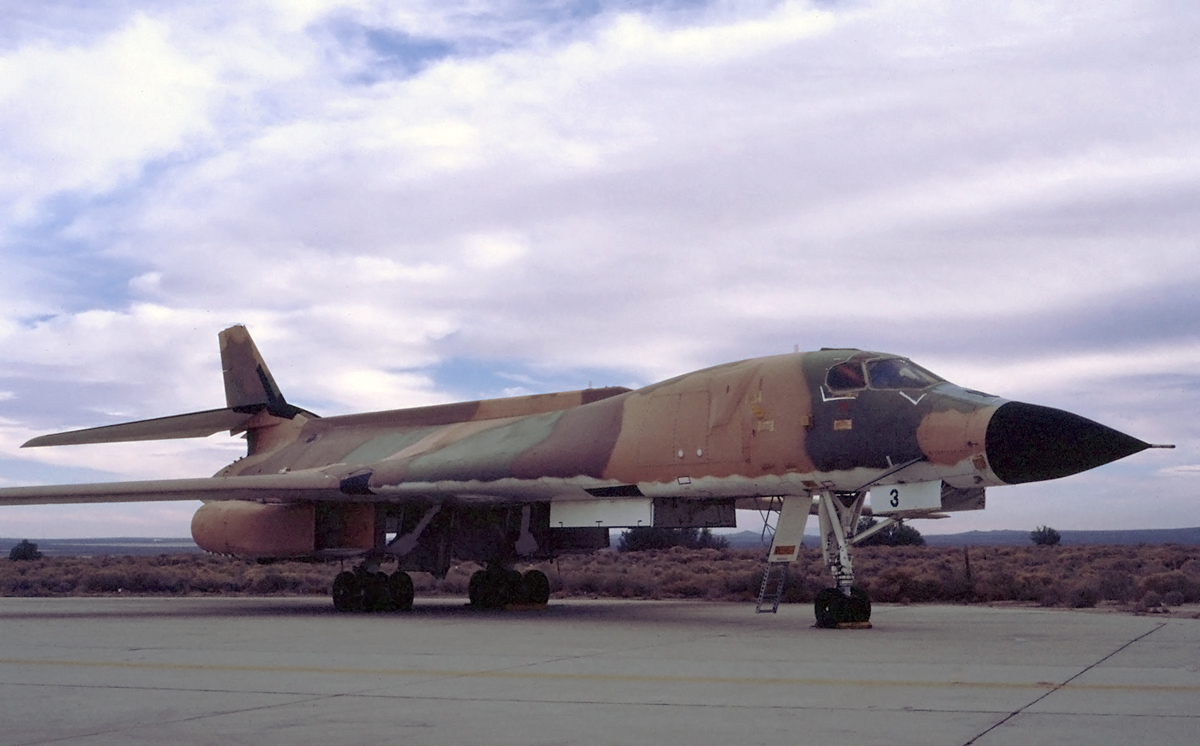
Performance and mechanical data are combined here for a faster, more compact read. Values describe the represented model or nearest clearly identified source variant.
Performance and mechanical specifications for B-1A Lancer
Primary role
Supersonic bomber prototype
Crew
4
Configuration
Mach 2 variable-sweep bomber prototype
Powerplant
4 × General Electric F101 turbofans
Top speed
Mach 2.2
Ceiling
60,000 ft
Published range
6,000 mi
Length
150 ft 2 in
Wing spread
136 ft 8 in
Max weight
≈395,000 lb
02 · SERVICE CHRONOLOGY
FROM ORIGIN TO LEGACY.
A dated sequence follows the airframe from development through operational use and later evolution. The number of milestones follows the story rather than a fixed template, and each note explains why the event mattered—not only what happened.
ORIGIN
The first B-1A flew with variable geometry and high-altitude speed central to the original requirement. [1]
DEVELOPMENT
The program was cancelled, then its test aircraft and research informed the lower-altitude, reduced-signature B-1B redesign. [1]
SERVICE HISTORY
The B-1A production plan was cancelled after four prototypes had been ordered, leaving the aircraft as a flight-test program until strategic priorities changed in the next administration. [1]
CONTEXT & LEGACY
Reagan-era revival produced the B-1B, retaining the broad configuration while emphasizing low-altitude penetration and reduced radar signature. The A models served as test assets rather than operational bombers. [1]
03 · ARCHIVAL IMAGE
THE AIRFRAME IN CONTEXT.
A documented photograph or archival reference connects the interactive model to a real airframe, operation, or preserved example.
A short, rights-screened motion record adds sound, movement, and operational scale without autoplaying or delaying the interactive model.
Mission profile: B-1B Lancer00:43
Related-variant footage: the operational B-1B is shown, not the earlier B-1A prototype represented by this record.
VARIANT NOTE Related-family footage is identified here and is not presented as the exact modeled variant.
REUSE NOTE Embedded without modification. Commercial editorial reuse remains subject to the source record, non-endorsement, trademark, privacy/publicity, and third-party-rights limitations.
The appearance of U.S. Department of War (DoW) visual information does not imply or constitute DoW endorsement.
A short, attributed line restores a human voice to the technical record. Period statements and later recollections are identified by the date label and accompanied by a source link.
“The B-1 was designed to put a lot of weapons a long way from home.”
Thomas StaffordU.S. Air Force general and test-pilot adviser
Stafford's description connects the A prototype's performance goals with the bomber mission retained by the later B-1B.
Focused facts connect the airframe's systems to the way it was built, flown, or used.
01
High-speed concept
The B-1A was shaped for high-altitude flight near Mach 2 before strategy shifted toward low-level penetration.
02
Escape capsule
Early prototypes used a crew module that separated as a unit in an emergency.
03
Variable sweep
Movable wings reconciled runway needs with efficient cruise and high-speed flight.
07 · HISTORICAL FIELD NOTE
WHY IT MATTERS.
The B-1A was the original high-altitude, Mach 2 version of the variable-sweep bomber programme that later produced the B-1B. Four prototypes explored a blend of intercontinental range, supersonic speed, and low-level penetration before strategy and cost concerns cancelled the version in 1977. [1]
Reference figures vary by variant, payload, configuration, altitude, test method, and source. Values here are an editorial orientation—not operational or flight-planning data.
Each numbered citation links to an operator, national museum, manufacturer, or established research institution. The scope note tells you exactly what that source supports, and each entry includes its retrieval date.
Where the represented model and source variant differ, the scope is labelled rather than silently treated as an exact match. Read the editorial policy, report a correction through the legal notice, or review 3D-model provenance in the attribution directory.