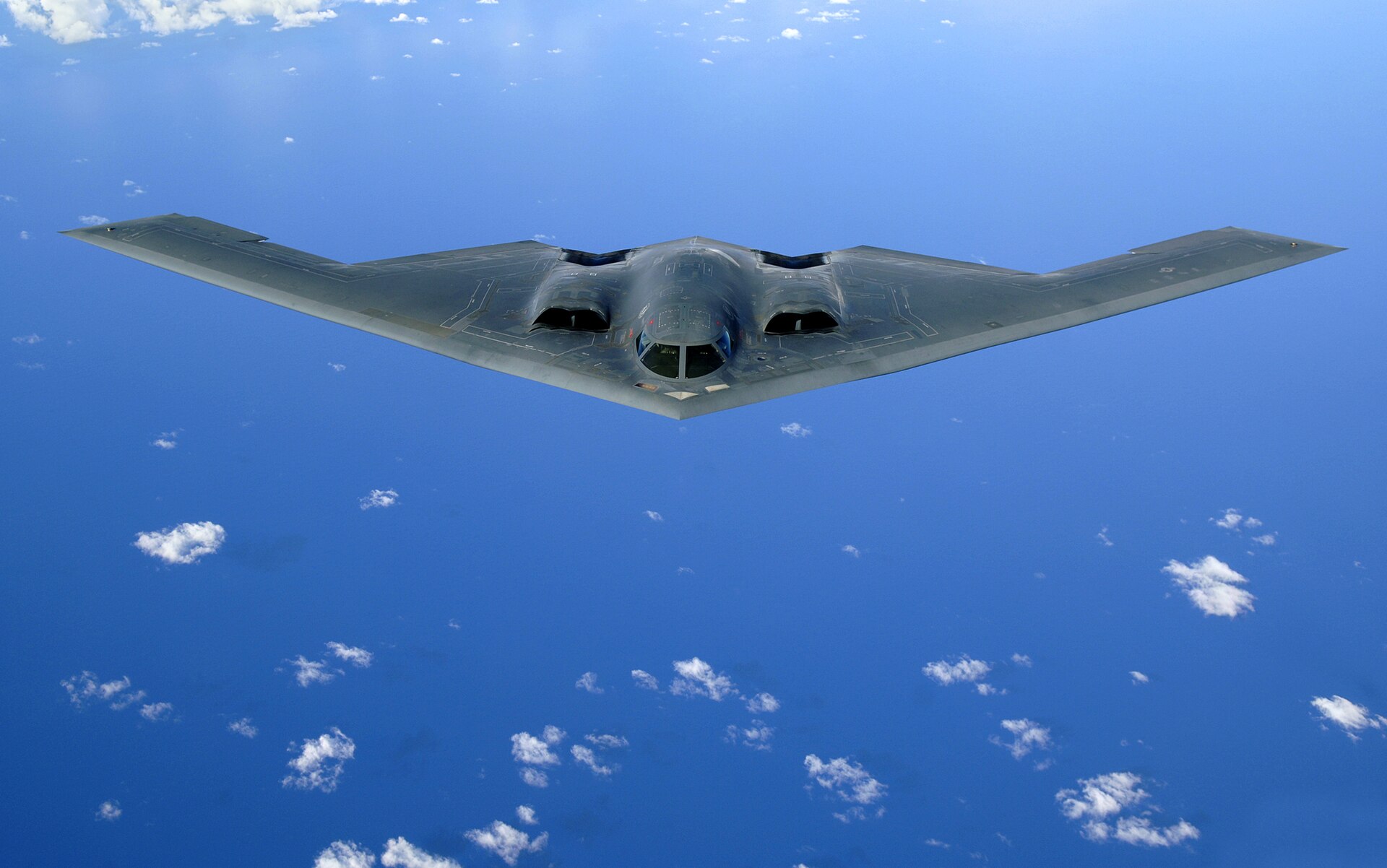
Performance and mechanical data are combined here for a faster, more compact read. Values describe the represented model or nearest clearly identified source variant.
Performance and mechanical specifications for B-2 Spirit
Primary role
Stealth strategic bomber
Crew
2
Configuration
Low-observable flying-wing bomber
Powerplant
4 × General Electric F118 turbofans
Top speed
Mach 0.95
Ceiling
50,000 ft
Published range
6,000+ mi
Length
69 ft
Wingspan
172 ft
Max weight
336,500 lb
02 · SERVICE CHRONOLOGY
FROM ORIGIN TO LEGACY.
A dated sequence follows the airframe from development through operational use and later evolution. The number of milestones follows the story rather than a fixed template, and each note explains why the event mattered—not only what happened.
ORIGIN
The first B-2 flew from Palmdale to Edwards after a development program conducted largely out of public view. [1]
DEVELOPMENT
Combat missions over Yugoslavia demonstrated long-range precision strike from the continental United States. [1]
SERVICE HISTORY
B-2s flew their first combat missions during the Kosovo campaign, striking from the United States with aerial refueling and returning after sorties lasting more than 30 hours. [1]
CONTEXT & LEGACY
Afghanistan, Iraq, and later missions demonstrated global-range strike supported by tankers and extensive mission planning. The small fleet makes maintenance, basing, and availability as consequential as individual aircraft performance. [1]
03 · ARCHIVAL IMAGE
THE AIRFRAME IN CONTEXT.
A documented photograph or archival reference connects the interactive model to a real airframe, operation, or preserved example.
A short, rights-screened motion record adds sound, movement, and operational scale without autoplaying or delaying the interactive model.
B-2 Spirit takeoff00:13
A short takeoff study of the B-2 Spirit.
REUSE NOTE Embedded without modification. Commercial editorial reuse remains subject to the source record, non-endorsement, trademark, privacy/publicity, and third-party-rights limitations.
The appearance of U.S. Department of War (DoW) visual information does not imply or constitute DoW endorsement.
A short, attributed line restores a human voice to the technical record. Period statements and later recollections are identified by the date label and accompanied by a source link.
“It is an airplane that changes the calculus of any adversary.”
Timothy RayU.S. Air Force general and Global Strike commander
Ray emphasized the strategic effect of combining low observability, range, and payload in a small fleet.
Focused facts connect the airframe's systems to the way it was built, flown, or used.
01
Tailless control
Split drag rudders, elevons, and digital flight controls replace a conventional vertical and horizontal tail.
02
Buried propulsion
Four engines sit within the wing to reduce exposed shapes and shield hot exhaust.
03
Two-person crew
Automation allows a pilot and mission commander to operate an intercontinental heavy bomber.
04
Internal payload
Two weapons bays carry conventional or nuclear stores without interrupting the smooth external surface.
07 · HISTORICAL FIELD NOTE
WHY IT MATTERS.
The Spirit’s blended flying-wing shape, radar-absorbing materials, and global range let it penetrate defended airspace for long-range strategic strike missions. With no vertical tail and few conventional reference shapes, the aircraft depends on sophisticated flight controls and meticulous surface maintenance to preserve both stability and low observability. [1]
Reference figures vary by variant, payload, configuration, altitude, test method, and source. Values here are an editorial orientation—not operational or flight-planning data.
Each numbered citation links to an operator, national museum, manufacturer, or established research institution. The scope note tells you exactly what that source supports, and each entry includes its retrieval date.
Where the represented model and source variant differ, the scope is labelled rather than silently treated as an exact match. Read the editorial policy, report a correction through the legal notice, or review 3D-model provenance in the attribution directory.