Performance and mechanical data are combined here for a faster, more compact read. Values describe the represented model or nearest clearly identified source variant.
Performance and mechanical specifications for B-25 Mitchell
Primary role
Medium bomber
Crew
5 typical
Configuration
Twin-engine medium bomber
Powerplant
2 × Wright R-2600 radial engines
Top speed
272 mph
Ceiling
24,200 ft
Published range
1,350 mi
Length
52 ft 11 in
Wingspan
67 ft 7 in
Max weight
≈35,000 lb
02 · SERVICE CHRONOLOGY
FROM ORIGIN TO LEGACY.
A dated sequence follows the airframe from development through operational use and later evolution. The number of milestones follows the story rather than a fixed template, and each note explains why the event mattered—not only what happened.
ORIGIN
The first B-25 flew as American planners expanded medium-bomber production before direct U.S. entry into the war. [1]
DEVELOPMENT
Sixteen B-25Bs launched from USS Hornet for the Doolittle Raid, proving the type could depart a carrier under exceptional conditions. [1]
SERVICE HISTORY
Beyond the Doolittle Raid, B-25s served in low-level attack, anti-shipping, and conventional bombing across several theaters. Field and factory modifications made the medium bomber unusually adaptable. [1]
CONTEXT & LEGACY
The U.S. Air Force retired its last B-25s after nearly two decades of combat, training, transport, and staff use; other nations and civil operators continued flying the type. [1]
03 · ARCHIVAL IMAGE
THE AIRFRAME IN CONTEXT.
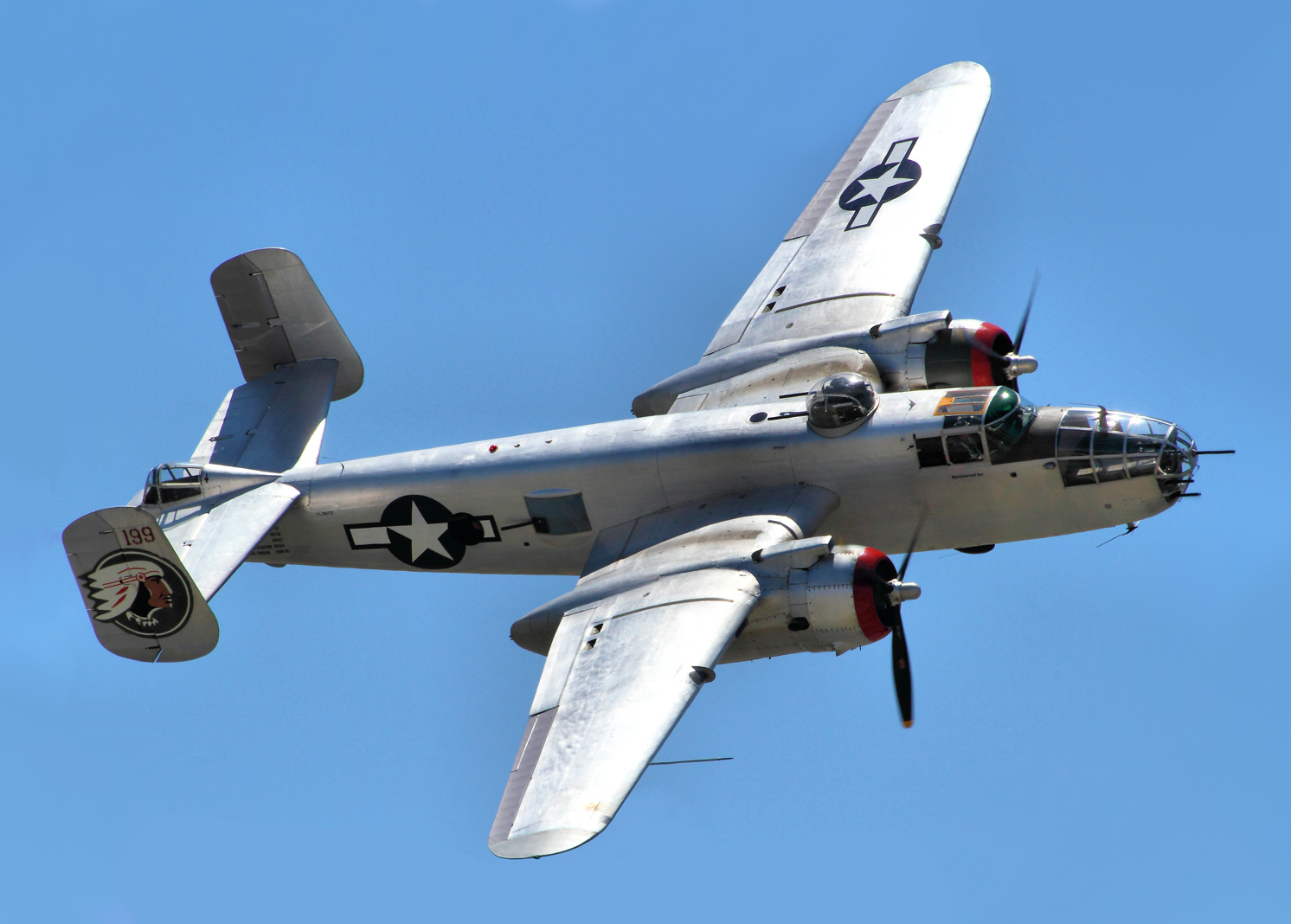
A documented photograph or archival reference connects the interactive model to a real airframe, operation, or preserved example.
B25 Mitchell - Chino Airshow 2014 (14033501440)2014-05-04 19:55 · Airwolfhound from Hertfordshire, UKWikimedia Commons · CC BY-SA 2.0 · Accessed 29 August 2026VIEW ORIGINAL FILE & RIGHTS RECORD ↗
04 · ARCHIVAL FOOTAGE
THE AIRFRAME IN MOTION.
A short, rights-screened motion record adds sound, movement, and operational scale without autoplaying or delaying the interactive model.
Warbirds of World War II — B-25 Mitchell00:59
A concise official heritage profile of the B-25 family.
REUSE NOTE Embedded without modification. Commercial editorial reuse remains subject to the source record, non-endorsement, trademark, privacy/publicity, and third-party-rights limitations.
The appearance of U.S. Department of War (DoW) visual information does not imply or constitute DoW endorsement.
A short, attributed line restores a human voice to the technical record. Period statements and later recollections are identified by the date label and accompanied by a source link.
“The Japanese people had been told they were invulnerable ... an attack would cause confusion and fear.”
James H. DoolittleRaid commander
Doolittle explained the psychological purpose of launching B-25s from USS Hornet against Japan.
Focused facts connect the airframe's systems to the way it was built, flown, or used.
01
Twin-tail layout
Two vertical tails kept overall height manageable and gave the rear gunner a clearer field of fire.
02
Interchangeable noses
Glass bombardier sections, solid gun noses, and field modifications adapted the bomber to very different missions.
03
Low-level evolution
Pacific units developed heavily armed strafer versions for attacks on shipping and airfields.
07 · HISTORICAL FIELD NOTE
WHY IT MATTERS.
The versatile Mitchell served in every major theater of World War II and became famous after the 1942 Doolittle Raid launched from USS Hornet. Adaptable to bombing, strafing, reconnaissance, and anti-shipping work, it demonstrated how a sound medium-bomber airframe could be reshaped around widely different combat needs. [1]
Reference figures vary by variant, payload, configuration, altitude, test method, and source. Values here are an editorial orientation—not operational or flight-planning data.
Each numbered citation links to an operator, national museum, manufacturer, or established research institution. The scope note tells you exactly what that source supports, and each entry includes its retrieval date.
Where the represented model and source variant differ, the scope is labelled rather than silently treated as an exact match. Read the editorial policy, report a correction through the legal notice, or review 3D-model provenance in the attribution directory.