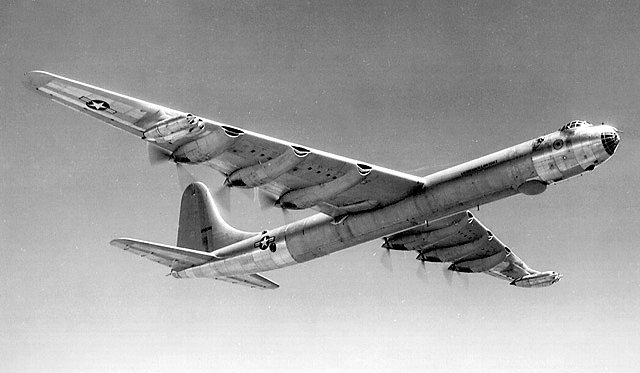
Performance and mechanical data are combined here for a faster, more compact read. Values describe the represented model or nearest clearly identified source variant.
Performance and mechanical specifications for B-36 Peacemaker
Primary role
Intercontinental strategic bomber
Crew
15 typical
Configuration
Mixed-power intercontinental strategic bomber
Powerplant
6 × R-4360 radials plus 4 × J47 turbojets
Top speed
435 mph
Ceiling
45,700 ft
Published range
10,000 mi
Length
162 ft 1 in
Wingspan
230 ft
Max weight
≈410,000 lb
02 · SERVICE CHRONOLOGY
FROM ORIGIN TO LEGACY.
A dated sequence follows the airframe from development through operational use and later evolution. The number of milestones follows the story rather than a fixed template, and each note explains why the event mattered—not only what happened.
ORIGIN
The prototype first flew after a long wartime development aimed at intercontinental range without overseas bases. [1]
DEVELOPMENT
The B-36 formed Strategic Air Command's early nuclear deterrent before all-jet bombers rapidly replaced it. [1]
SERVICE HISTORY
The B-36 combined piston and jet engines to carry early nuclear weapons across intercontinental distances. It never flew combat, but its alert and reconnaissance missions anchored the first decade of Strategic Air Command. [1]
CONTEXT & LEGACY
The B-36D combined six piston engines with four auxiliary turbojets, increasing takeoff and dash performance while creating the ten-engine arrangement remembered by its crews. [1]
03 · ARCHIVAL IMAGE
THE AIRFRAME IN CONTEXT.
A documented photograph or archival reference connects the interactive model to a real airframe, operation, or preserved example.
A short, rights-screened motion record adds sound, movement, and operational scale without autoplaying or delaying the interactive model.
AFRL museum series — B-3601:13
An official museum presentation about the B-36 Peacemaker.
REUSE NOTE Embedded without modification. Commercial editorial reuse remains subject to the source record, non-endorsement, trademark, privacy/publicity, and third-party-rights limitations.
The appearance of U.S. Department of War (DoW) visual information does not imply or constitute DoW endorsement.
A short, attributed line restores a human voice to the technical record. Period statements and later recollections are identified by the date label and accompanied by a source link.
“Six turning and four burning.”
B-36 aircrewsContemporary crew saying
The crew phrase described the later B-36's six piston and four jet engines—and the mixed-propulsion complexity they managed.
Focused facts connect the airframe's systems to the way it was built, flown, or used.
01
Pusher core
Six radial engines drove pusher propellers behind the wing's trailing edge.
02
Jet addition
Later aircraft added four turbojets, inspiring the phrase “six turning and four burning.”
03
Intercontinental intent
The bomber was designed to strike across oceanic distance without relying on overseas bases.
07 · HISTORICAL FIELD NOTE
WHY IT MATTERS.
The Peacemaker was the first operational bomber able to deliver intercontinental-range nuclear missions without relying on overseas bases. Its six pusher propellers and later four supplementary jet engines reflected a transitional moment between piston-powered strategic aviation and the all-jet bomber force that followed. [1]
Reference figures vary by variant, payload, configuration, altitude, test method, and source. Values here are an editorial orientation—not operational or flight-planning data.
Each numbered citation links to an operator, national museum, manufacturer, or established research institution. The scope note tells you exactly what that source supports, and each entry includes its retrieval date.
Where the represented model and source variant differ, the scope is labelled rather than silently treated as an exact match. Read the editorial policy, report a correction through the legal notice, or review 3D-model provenance in the attribution directory.