Performance and mechanical data are combined here for a faster, more compact read. Values describe the represented model or nearest clearly identified source variant.
Performance and mechanical specifications for B-52 Stratofortress
Primary role
Strategic bomber
Crew
5
Configuration
Eight-engine long-range heavy bomber
Powerplant
8 × Pratt & Whitney TF33 turbofans
Top speed
650 mph
Ceiling
50,000 ft
Published range
8,800 mi
Length
159 ft 4 in
Wingspan
185 ft
Max weight
488,000 lb
02 · SERVICE CHRONOLOGY
FROM ORIGIN TO LEGACY.
A dated sequence follows the airframe from development through operational use and later evolution. The number of milestones follows the story rather than a fixed template, and each note explains why the event mattered—not only what happened.
ORIGIN
The YB-52 first flew after Boeing shifted the design from a turboprop concept to swept wings and jet propulsion. [1]
DEVELOPMENT
Successive generations of weapons, sensors, and communications repeatedly changed the mission while the basic airframe endured. [1]
SERVICE HISTORY
From conventional bombing over Southeast Asia to stand-off precision weapons, the B-52 repeatedly changed missions. Its continued relevance comes from payload, range, and integration—not from remaining technically unchanged. [1]
CONTEXT & LEGACY
B-52s flew long-range and theatre-based missions during the Gulf War, using both conventional bombs and cruise missiles in a campaign far removed from the bomber's original nuclear role. [1]
03 · ARCHIVAL IMAGE
THE AIRFRAME IN CONTEXT.
A documented photograph or archival reference connects the interactive model to a real airframe, operation, or preserved example.
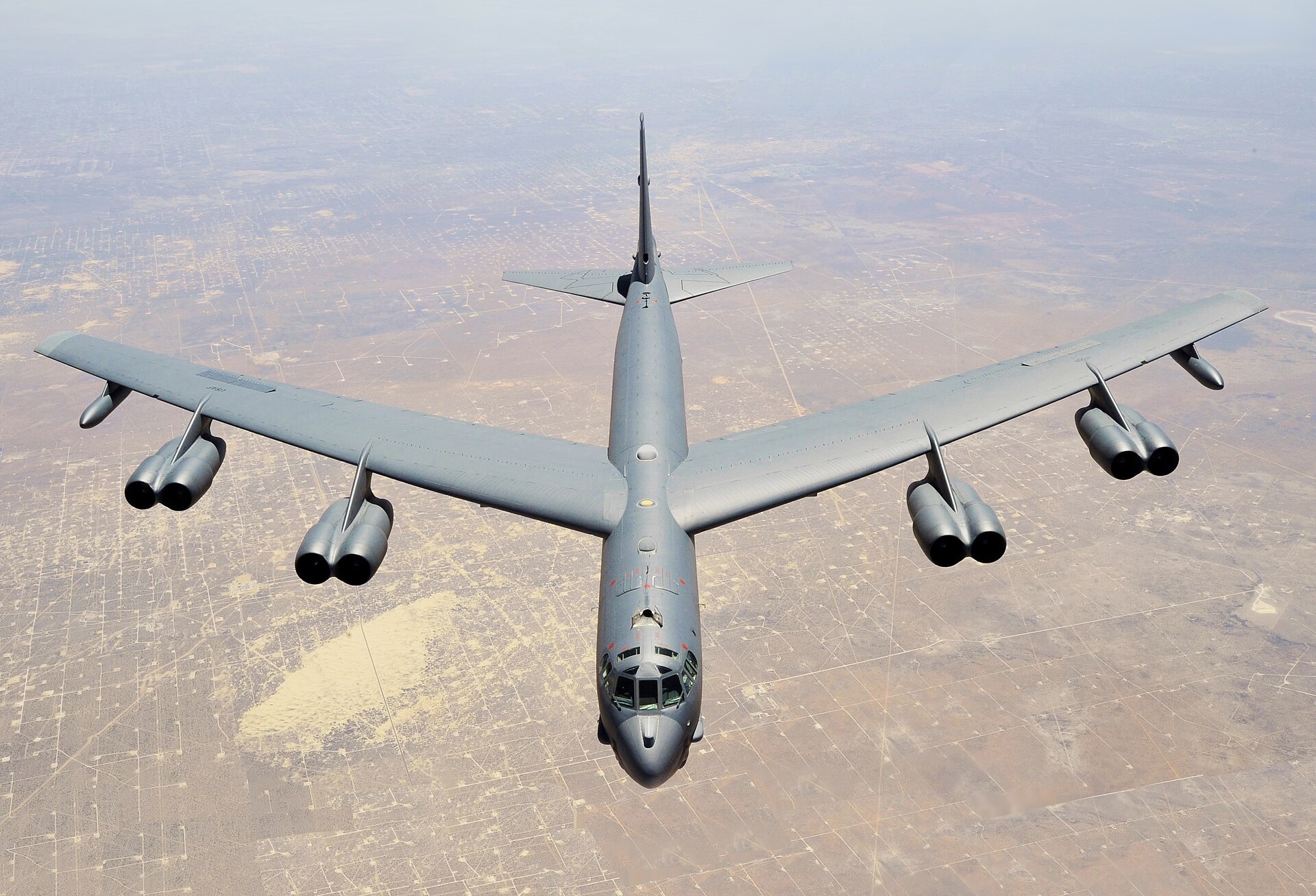
B-52 Stratofortress assigned to the 307th Bomb Wing (cropped)2014-05-15 · Airman 1st Class Victor J. CaputoWikimedia Commons · Public domain · Accessed 29 August 2026VIEW ORIGINAL FILE & RIGHTS RECORD ↗
04 · ARCHIVAL FOOTAGE
THE AIRFRAME IN MOTION.
A short, rights-screened motion record adds sound, movement, and operational scale without autoplaying or delaying the interactive model.
B-52 Bomber Task Force00:51
Operational footage of the B-52 family; the current service aircraft is the B-52H.
VARIANT NOTE Related-family footage is identified here and is not presented as the exact modeled variant.
REUSE NOTE Embedded without modification. Commercial editorial reuse remains subject to the source record, non-endorsement, trademark, privacy/publicity, and third-party-rights limitations.
The appearance of U.S. Department of War (DoW) visual information does not imply or constitute DoW endorsement.
A short, attributed line restores a human voice to the technical record. Period statements and later recollections are identified by the date label and accompanied by a source link.
“The B-52 is the most feared weapon in our arsenal.”
Robin RandU.S. Air Force general and Global Strike commander
Rand's words reflect the bomber's continuing deterrent and conventional-strike role decades after its first flight.
Focused facts connect the airframe's systems to the way it was built, flown, or used.
01
Landing alignment
The main landing gear can be set to track sideways, allowing crosswind landings with the fuselage pointed into the wind.
02
Bicycle gear
Four main gear units run along the fuselage centerline, with small outriggers supporting the wings.
03
Eight-engine layout
Engines are carried in four twin pods beneath the swept wing.
07 · HISTORICAL FIELD NOTE
WHY IT MATTERS.
Designed in the early jet age, the Stratofortress has remained a long-range strategic bomber through repeated upgrades in weapons, sensors, and communications. A large airframe, efficient swept wing, and abundant internal volume have allowed it to absorb missions and technologies that its original designers could not have anticipated. [1]
Reference figures vary by variant, payload, configuration, altitude, test method, and source. Values here are an editorial orientation—not operational or flight-planning data.
Each numbered citation links to an operator, national museum, manufacturer, or established research institution. The scope note tells you exactly what that source supports, and each entry includes its retrieval date.
Where the represented model and source variant differ, the scope is labelled rather than silently treated as an exact match. Read the editorial policy, report a correction through the legal notice, or review 3D-model provenance in the attribution directory.