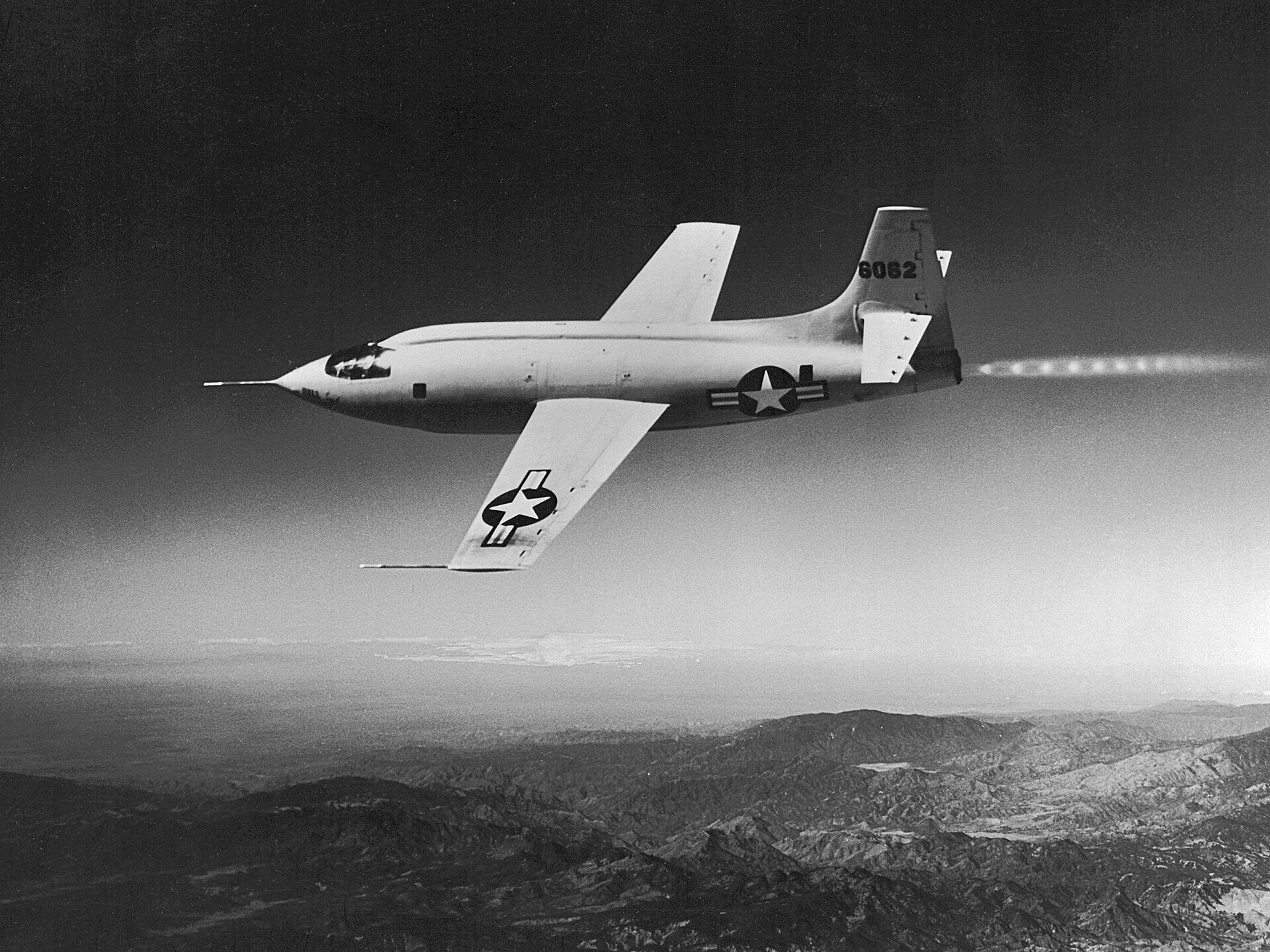
Performance and mechanical data are combined here for a faster, more compact read. Values describe the represented model or nearest clearly identified source variant.
Performance and mechanical specifications for Bell X-1
Primary role
Supersonic research aircraft
Crew
1 research pilot
Configuration
Air-launched rocket research aircraft
Powerplant
1 × Reaction Motors XLR11 rocket
Top speed
Mach 1.06
Ceiling
71,900 ft
Published range
Research sorties
Length
30 ft 11 in
Wingspan
28 ft
Loaded weight
≈13,000 lb
02 · SERVICE CHRONOLOGY
FROM ORIGIN TO LEGACY.
A dated sequence follows the airframe from development through operational use and later evolution. The number of milestones follows the story rather than a fixed template, and each note explains why the event mattered—not only what happened.
ORIGIN
Glide flights established landing and handling characteristics before powered expansion into the transonic region. [1]
DEVELOPMENT
Chuck Yeager flew the X-1 through Mach 1 in level flight; later X-1 variants pushed the research envelope further. [1]
SERVICE HISTORY
The first supersonic flight was one point in a longer research series that mapped transonic control and later exceeded Mach 2. Data from the X-1 family helped replace dangerous guesswork with measured flight behavior. [1]
CONTEXT & LEGACY
The original X-1 was transferred to the Smithsonian after completing its research career, while later members of the family continued exploring higher speeds and different wing configurations. [1]
03 · ARCHIVAL IMAGE
THE AIRFRAME IN CONTEXT.
A documented photograph or archival reference connects the interactive model to a real airframe, operation, or preserved example.
A short, rights-screened motion record adds sound, movement, and operational scale without autoplaying or delaying the interactive model.
Bell X-1 sound-barrier animation00:16
A short official animation reconstructs the X-1's historic supersonic flight; it is not period camera footage.
REUSE NOTE Embedded without modification. Commercial editorial reuse remains subject to the source record, non-endorsement, trademark, privacy/publicity, and third-party-rights limitations.
The appearance of U.S. Department of War (DoW) visual information does not imply or constitute DoW endorsement.
A short, attributed line restores a human voice to the technical record. Period statements and later recollections are identified by the date label and accompanied by a source link.
“This machmeter is screwy!”
Chuck YeagerU.S. Air Force test pilot
Yeager's understated radio call marked the instrument moving off scale during the first acknowledged level supersonic flight.
Focused facts connect the airframe's systems to the way it was built, flown, or used.
01
Bullet profile
Its fuselage followed the shape of a .50-caliber projectile known to remain stable through the transonic region.
02
Air launch
A B-29 carried the rocket aircraft to altitude, preserving fuel and avoiding a conventional takeoff.
03
Tail solution
An adjustable all-moving horizontal tail restored pitch control as shock waves formed near Mach 1.
07 · HISTORICAL FIELD NOTE
WHY IT MATTERS.
Dropped from a carrier aircraft and powered by a rocket engine, the X-1 carried Chuck Yeager through the sound barrier in controlled level flight. Shaped like a stable .50-caliber bullet, it converted the poorly understood transonic region into measured flight-test data and helped replace myth with engineering knowledge. [1]
Reference figures vary by variant, payload, configuration, altitude, test method, and source. Values here are an editorial orientation—not operational or flight-planning data.
Each numbered citation links to an operator, national museum, manufacturer, or established research institution. The scope note tells you exactly what that source supports, and each entry includes its retrieval date.
Where the represented model and source variant differ, the scope is labelled rather than silently treated as an exact match. Read the editorial policy, report a correction through the legal notice, or review 3D-model provenance in the attribution directory.