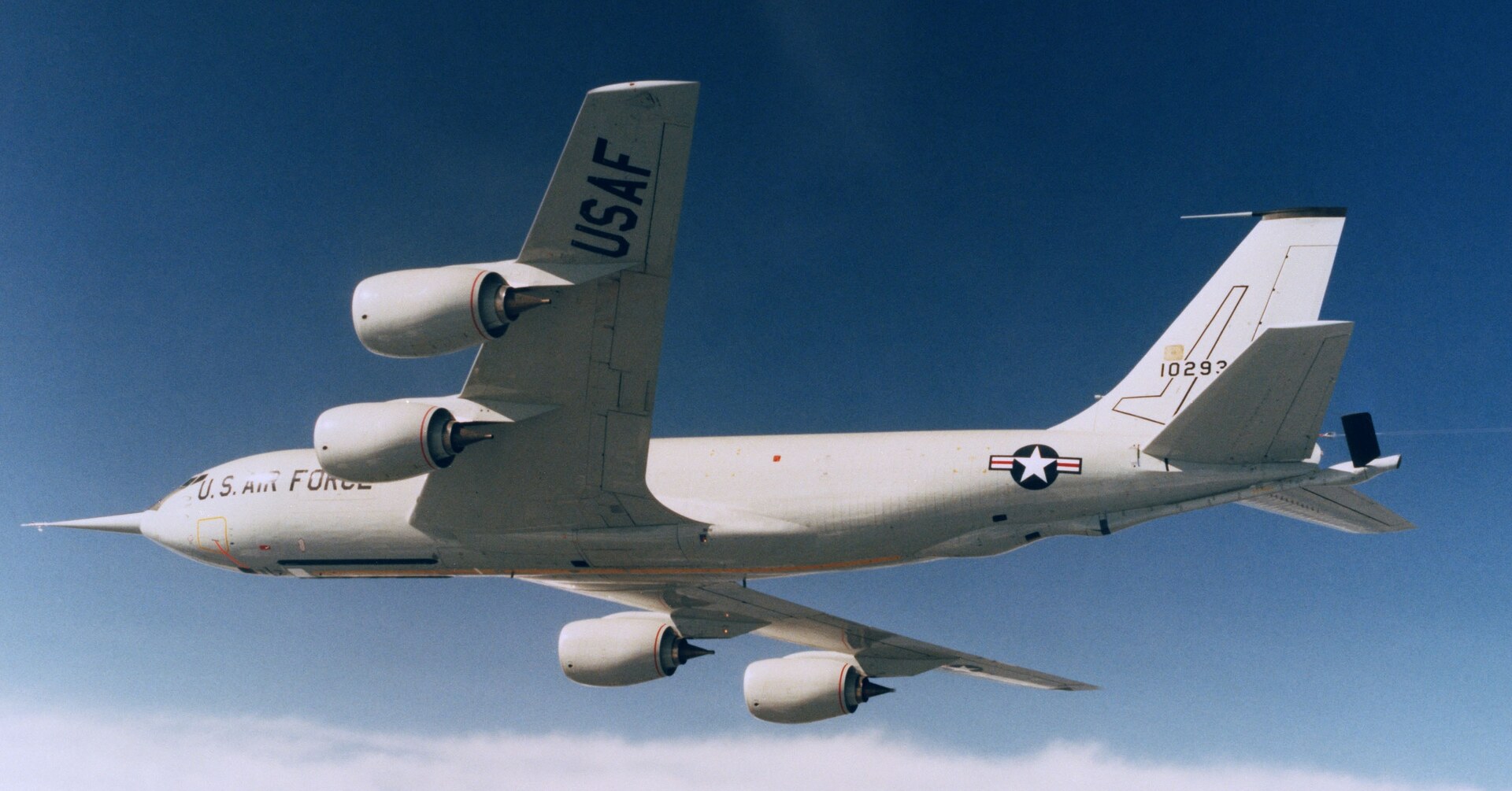
Performance and mechanical data are combined here for a faster, more compact read. Values describe the represented model or nearest clearly identified source variant.
Performance and mechanical specifications for Boeing KC-135R Stratotanker
Primary role
Aerial refueling tanker
Crew
3–4
Configuration
Flying-boom aerial-refueling tanker
Powerplant
4 × CFM56 turbofans
Top speed
530 mph
Ceiling
50,000 ft
Published range
1,500 mi with transfer fuel
Length
136 ft 3 in
Wingspan / rotor
130 ft 10 in
Weight
≈322,500 lb maximum
02 · SERVICE CHRONOLOGY
FROM ORIGIN TO LEGACY.
A dated sequence follows the airframe from development through operational use and later evolution. The number of milestones follows the story rather than a fixed template, and each note explains why the event mattered—not only what happened.
A short, rights-screened motion record adds sound, movement, and operational scale without autoplaying or delaying the interactive model.
KC-135 refuels an RC-135 Rivet Jointoperational footage
A KC-135 conducts aerial refuelling during an operational sortie.
REUSE NOTE Embedded without modification. Commercial editorial reuse remains subject to the source record, non-endorsement, trademark, privacy/publicity, and third-party-rights limitations.
The appearance of U.S. Department of War (DoW) visual information does not imply or constitute DoW endorsement.
Focused facts connect the airframe's systems to the way it was built, flown, or used.
01
Boom control
An operator steers the telescoping boom into the receiver's receptacle.
02
Not a 707
The KC-135 and 707 share ancestry but use distinct fuselage dimensions.
03
Two systems
Adapters let some KC-135s refuel probe-equipped aircraft by hose and drogue.
06 · HISTORICAL FIELD NOTE
WHY IT MATTERS.
The KC-135 made routine high-speed aerial refueling a foundation of U.S. global air operations. Re-engining to the KC-135R standard improved fuel efficiency, noise, takeoff performance, and offload capability, extending the useful life of an airframe first delivered in the 1950s. [1]
Reference figures vary by variant, payload, configuration, altitude, test method, and source. Values here are an editorial orientation—not operational or flight-planning data.
Each numbered citation links to an operator, national museum, manufacturer, or established research institution. The scope note tells you exactly what that source supports, and each entry includes its retrieval date.
Where the represented model and source variant differ, the scope is labelled rather than silently treated as an exact match. Read the editorial policy, report a correction through the legal notice, or review 3D-model provenance in the attribution directory.