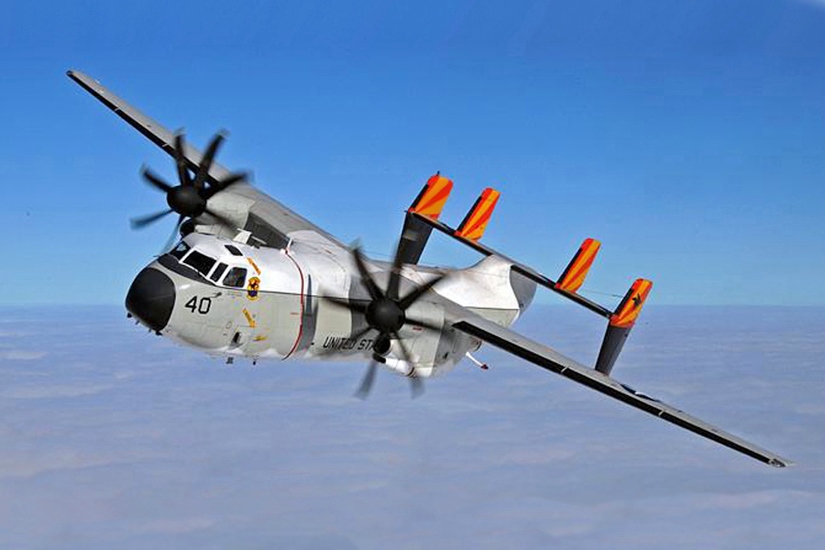
Performance and mechanical data are combined here for a faster, more compact read. Values describe the represented model or nearest clearly identified source variant.
Performance and mechanical specifications for C-2 Greyhound
Primary role
Carrier onboard delivery
Crew
4; up to 26 passengers
Configuration
Carrier-onboard-delivery transport
Powerplant
2 × Allison T56 turboprops
Top speed
343 mph
Ceiling
33,500 ft
Published range
1,300 mi
Length
56 ft 10 in
Wingspan
80 ft 7 in
Max weight
≈57,500 lb
02 · SERVICE CHRONOLOGY
FROM ORIGIN TO LEGACY.
A dated sequence follows the airframe from development through operational use and later evolution. The number of milestones follows the story rather than a fixed template, and each note explains why the event mattered—not only what happened.
ORIGIN
The first Greyhound flew using the E-2's wing and powerplant around a wider cargo fuselage and rear loading ramp. [1]
DEVELOPMENT
For decades the Greyhound carried people, mail, and high-priority cargo to deployed carriers. Its retirement closes a fixed-wing carrier-delivery system built around arrested landings and catapult launches. [1]
SERVICE HISTORY
Deliveries of new-production C-2A(R) aircraft began, renewing the carrier-onboard-delivery fleet with updated structure and systems for another generation of operations. [1]
CONTEXT & LEGACY
After decades linking carriers to shore, the fleet began transferring its delivery mission to the CMV-22B. [1]
03 · ARCHIVAL IMAGE
THE AIRFRAME IN CONTEXT.
A documented photograph or archival reference connects the interactive model to a real airframe, operation, or preserved example.
A short, rights-screened motion record adds sound, movement, and operational scale without autoplaying or delaying the interactive model.
C-2 Greyhound carrier launch02:53
Official deck footage includes a C-2 Greyhound launch.
REUSE NOTE Embedded without modification. Commercial editorial reuse remains subject to the source record, non-endorsement, trademark, privacy/publicity, and third-party-rights limitations.
The appearance of U.S. Department of War (DoW) visual information does not imply or constitute DoW endorsement.
A short, attributed line restores a human voice to the technical record. Period statements and later recollections are identified by the date label and accompanied by a source link.
“The Greyhound is the lifeline to the carrier.”
John LemmonU.S. Navy captain and E-2/C-2 program manager
Lemmon summarized a role measured in urgently delivered people, mail, and parts rather than combat sorties.
Focused facts connect the airframe's systems to the way it was built, flown, or used.
01
Shared ancestry
The Greyhound uses the E-2 Hawkeye's wing and powerplants around a wider cargo fuselage.
02
Carrier delivery
Its primary mission was moving passengers, mail, and priority cargo between shore bases and carriers.
03
Rear access
A large aft ramp supports pallet, engine, stretcher, and passenger loading.
07 · HISTORICAL FIELD NOTE
WHY IT MATTERS.
The Greyhound connects aircraft carriers with shore bases, carrying passengers, mail, engines, and other high-priority cargo far beyond helicopter range. Sharing major features with the E-2 simplified carrier integration, while its folding wings and robust landing gear allowed a transport-sized cabin to operate from the flight deck. [1]
Reference figures vary by variant, payload, configuration, altitude, test method, and source. Values here are an editorial orientation—not operational or flight-planning data.
Each numbered citation links to an operator, national museum, manufacturer, or established research institution. The scope note tells you exactly what that source supports, and each entry includes its retrieval date.
Where the represented model and source variant differ, the scope is labelled rather than silently treated as an exact match. Read the editorial policy, report a correction through the legal notice, or review 3D-model provenance in the attribution directory.