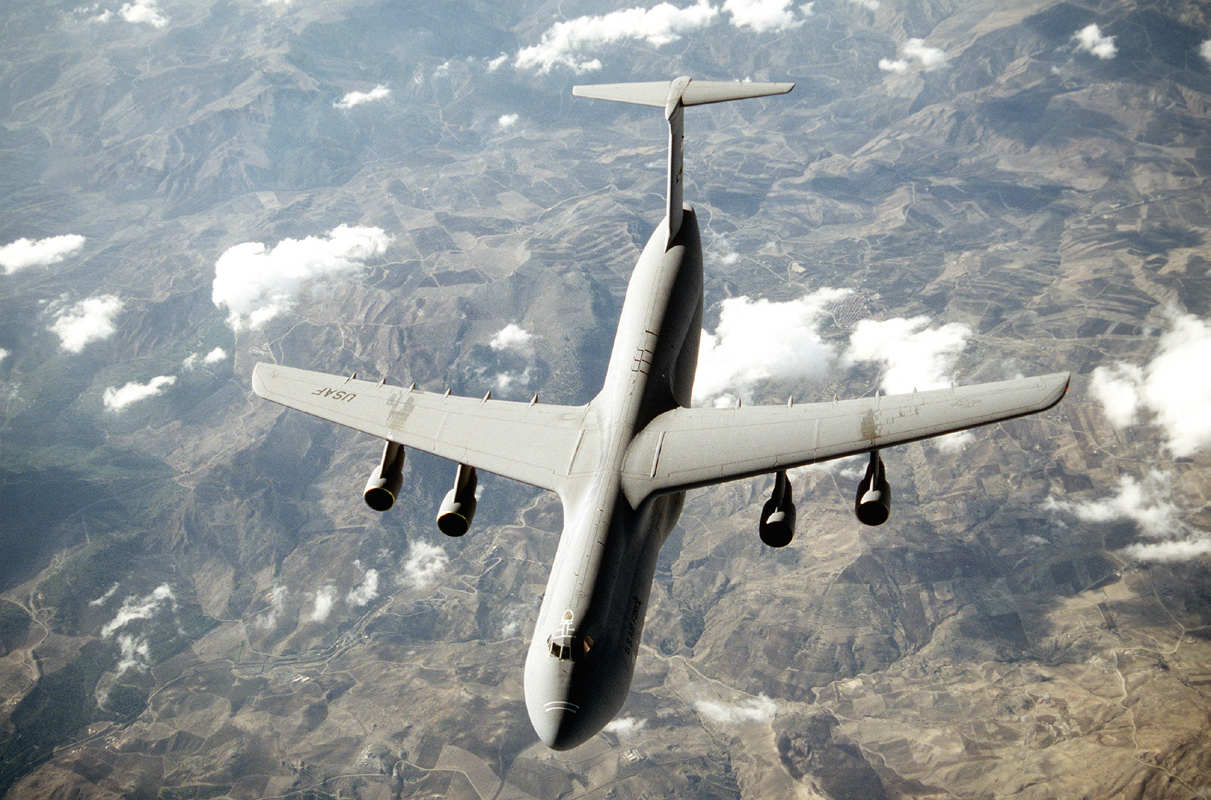
Performance and mechanical data are combined here for a faster, more compact read. Values describe the represented model or nearest clearly identified source variant.
Performance and mechanical specifications for C-5 Galaxy
Primary role
Strategic airlift
Crew
7 typical
Configuration
High-wing strategic outsized-cargo transport
Powerplant
4 × General Electric CF6 turbofans
Top speed
518 mph
Ceiling
35,700 ft
Published range
5,500 mi
Length
247 ft 1 in
Wingspan
222 ft 9 in
Max weight
840,000 lb
02 · SERVICE CHRONOLOGY
FROM ORIGIN TO LEGACY.
A dated sequence follows the airframe from development through operational use and later evolution. The number of milestones follows the story rather than a fixed template, and each note explains why the event mattered—not only what happened.
ORIGIN
The first Galaxy flew as the largest American aircraft of its era, built around drive-through loading and outsized cargo. [1]
DEVELOPMENT
During Operation Nickel Grass, C-5s carried outsized and urgently needed equipment to Israel, demonstrating the strategic value—and political visibility—of very-heavy airlift. [1]
SERVICE HISTORY
The C-5M program added commercial-derived engines and avionics to extend the fleet's useful life and improve reliability. [1]
CONTEXT & LEGACY
Completion of the C-5M conversion paired new engines with reliability improvements, preserving outsized airlift capacity. The result demonstrates how targeted modernization can keep a unique strategic asset viable. [1]
03 · ARCHIVAL IMAGE
THE AIRFRAME IN CONTEXT.
A documented photograph or archival reference connects the interactive model to a real airframe, operation, or preserved example.
A short, rights-screened motion record adds sound, movement, and operational scale without autoplaying or delaying the interactive model.
C-5 Galaxy landing00:06
A short landing view of the C-5 family; the archive record is not limited to the later C-5M configuration.
VARIANT NOTE Related-family footage is identified here and is not presented as the exact modeled variant.
REUSE NOTE Embedded without modification. Commercial editorial reuse remains subject to the source record, non-endorsement, trademark, privacy/publicity, and third-party-rights limitations.
The appearance of U.S. Department of War (DoW) visual information does not imply or constitute DoW endorsement.
A short, attributed line restores a human voice to the technical record. Period statements and later recollections are identified by the date label and accompanied by a source link.
“The C-5 gives our nation a capability no other aircraft can match.”
Carlton Everhart IIU.S. Air Force general and Air Mobility commander
Everhart emphasized the outsized-cargo mission that justified modernizing rather than replacing the Galaxy fleet.
Focused facts connect the airframe's systems to the way it was built, flown, or used.
01
Drive-through loading
Opening nose and aft cargo doors allow loading from either end and reduce ground-handling conflicts.
02
Kneeling gear
The landing gear lowers the cargo deck and adjusts its angle for vehicle loading.
03
Separated deck
A passenger compartment sits above the cargo hold, keeping personnel clear of outsized freight.
07 · HISTORICAL FIELD NOTE
WHY IT MATTERS.
The Galaxy’s immense cargo hold and hinged nose let it move outsized military equipment across intercontinental distances. Drive-through loading, kneeling landing gear, and aerial refueling allow tanks, helicopters, and other cargo to move between distant theaters with less disassembly and fewer intermediate stops. [1]
Reference figures vary by variant, payload, configuration, altitude, test method, and source. Values here are an editorial orientation—not operational or flight-planning data.
Each numbered citation links to an operator, national museum, manufacturer, or established research institution. The scope note tells you exactly what that source supports, and each entry includes its retrieval date.
Where the represented model and source variant differ, the scope is labelled rather than silently treated as an exact match. Read the editorial policy, report a correction through the legal notice, or review 3D-model provenance in the attribution directory.