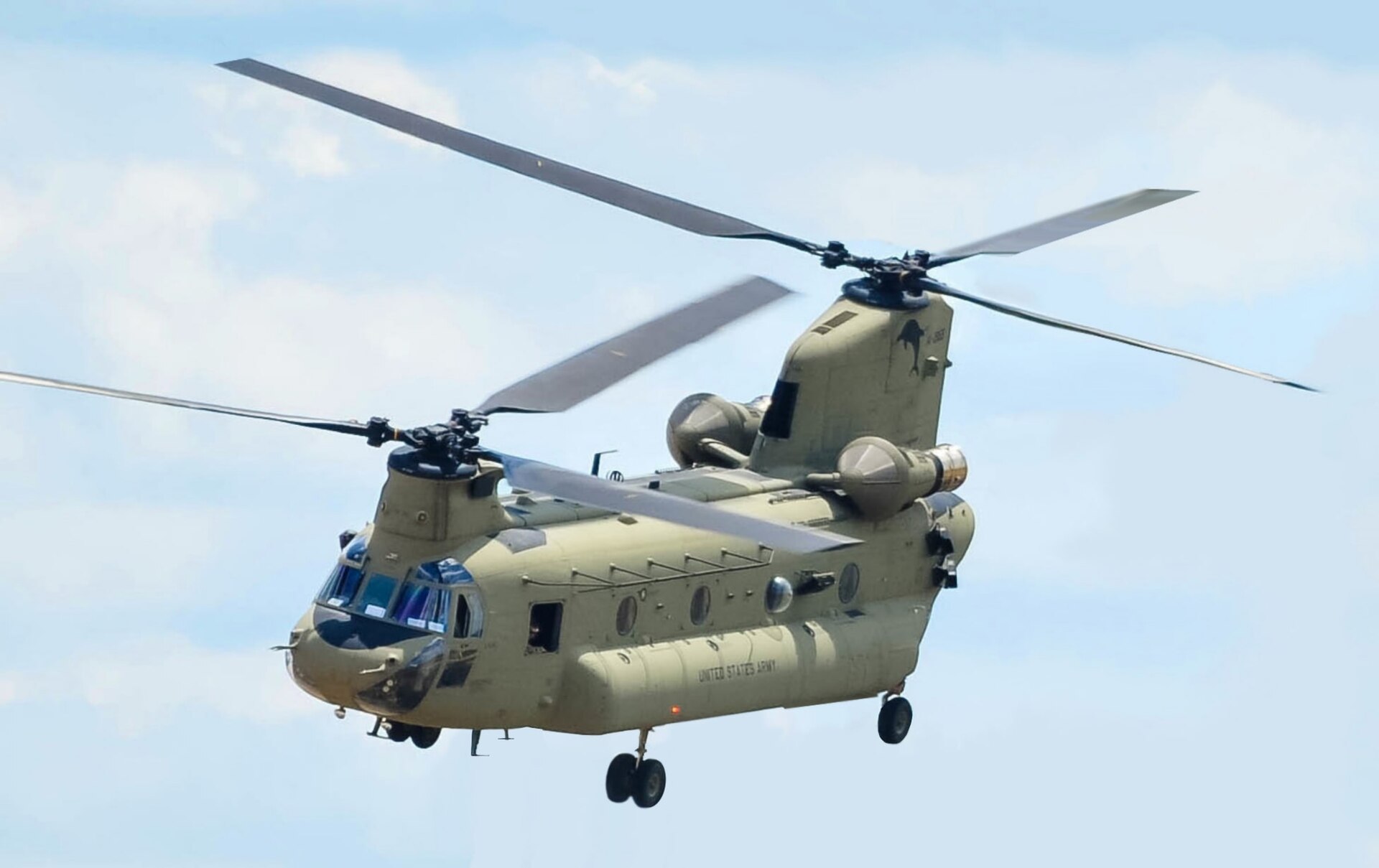
Performance and mechanical data are combined here for a faster, more compact read. Values describe the represented model or nearest clearly identified source variant.
Performance and mechanical specifications for CH-47 Chinook
Primary role
Heavy-lift transport helicopter
Crew
3; troop capacity varies
Configuration
Tandem-rotor heavy-lift helicopter
Powerplant
2 × Lycoming/Honeywell T55 turboshafts
Top speed
188 mph
Ceiling
20,000 ft
Published range
460 mi
Overall length
98 ft 10 in
Rotor diameter
60 ft each
Max weight
≈50,000 lb
02 · SERVICE CHRONOLOGY
FROM ORIGIN TO LEGACY.
A dated sequence follows the airframe from development through operational use and later evolution. The number of milestones follows the story rather than a fixed template, and each note explains why the event mattered—not only what happened.
ORIGIN
The first Chinook prototype flew as the Army sought a faster turbine replacement for piston transport helicopters. [1]
DEVELOPMENT
Repeated engine, rotor, cockpit, and structural upgrades kept the tandem-rotor design in production across generations. [1]
SERVICE HISTORY
Vietnam established the Chinook's heavy-lift value, and later rebuild programs renewed aging airframes with stronger structure and digital systems. The tandem-rotor concept survived because it continued to accept growth. [1]
CONTEXT & LEGACY
The CH-47F entered service with a digital cockpit, revised structure, and drivetrain improvements, continuing the tandem-rotor line through a major rebuild and new-production program. [1]
03 · ARCHIVAL IMAGE
THE AIRFRAME IN CONTEXT.
A documented photograph or archival reference connects the interactive model to a real airframe, operation, or preserved example.
CH-47 assigned to 3rd General Support Aviation Battalion, 82nd Combat Aviation Brigade2017-05-25 · Sgt. Steven GalimoreWikimedia Commons · CC0 · Accessed 29 August 2026VIEW ORIGINAL FILE & RIGHTS RECORD ↗
04 · ARCHIVAL FOOTAGE
THE AIRFRAME IN MOTION.
A short, rights-screened motion record adds sound, movement, and operational scale without autoplaying or delaying the interactive model.
CH-47 Chinook over Eglin00:11
A short operational flight view of a CH-47.
REUSE NOTE Embedded without modification. Commercial editorial reuse remains subject to the source record, non-endorsement, trademark, privacy/publicity, and third-party-rights limitations.
The appearance of U.S. Department of War (DoW) visual information does not imply or constitute DoW endorsement.
A short, attributed line restores a human voice to the technical record. Period statements and later recollections are identified by the date label and accompanied by a source link.
“The Chinook has been the backbone of Army aviation for decades.”
William T. CrosbyU.S. Army major general and aviation program executive
Crosby's assessment links the Chinook's continued production to a mission the Army still considers indispensable.
Focused facts connect the airframe's systems to the way it was built, flown, or used.
01
No tail rotor
Counter-rotating tandem rotors cancel torque while devoting all engine power to lift and thrust.
02
Useful center
The long cabin and rotors at each end keep the cargo area clear of a tail-rotor drive system.
03
Rear loading
A broad aft ramp accepts vehicles, pallets, troops, and litters.
07 · HISTORICAL FIELD NOTE
WHY IT MATTERS.
The tandem-rotor Chinook has carried troops, artillery, vehicles, and disaster-relief supplies since the early 1960s. Counter-rotating rotors eliminate the need for a tail rotor and place lifting power at both ends of the long cargo cabin, giving the aircraft unusual payload flexibility and excellent high-altitude performance. [1]
Reference figures vary by variant, payload, configuration, altitude, test method, and source. Values here are an editorial orientation—not operational or flight-planning data.
Each numbered citation links to an operator, national museum, manufacturer, or established research institution. The scope note tells you exactly what that source supports, and each entry includes its retrieval date.
Where the represented model and source variant differ, the scope is labelled rather than silently treated as an exact match. Read the editorial policy, report a correction through the legal notice, or review 3D-model provenance in the attribution directory.