Performance and mechanical data are combined here for a faster, more compact read. Values describe the represented model or nearest clearly identified source variant.
Performance and mechanical specifications for Chengdu J-10S
Primary role
Two-seat multirole fighter
Crew
2 in tandem
Configuration
Canard-delta multirole fighter
Powerplant
1 × afterburning turbofan
Top speed
Mach 1.8
Ceiling
59,000 ft
Published range
1,150 mi
Length
≈55 ft 5 in
Wingspan / rotor
≈32 ft 2 in
Weight
≈42,000 lb class
02 · SERVICE CHRONOLOGY
FROM ORIGIN TO LEGACY.
A dated sequence follows the airframe from development through operational use and later evolution. The number of milestones follows the story rather than a fixed template, and each note explains why the event mattered—not only what happened.
The J-10S entered service for conversion training and dual-crew missions. [1]
SERVICE HISTORY
It supported a growing fleet while later family variants gained new sensors. [1]
CONTEXT & LEGACY
Exact block identification remains essential because public data are limited. [1]
03 · ARCHIVAL IMAGE
THE AIRFRAME IN CONTEXT.
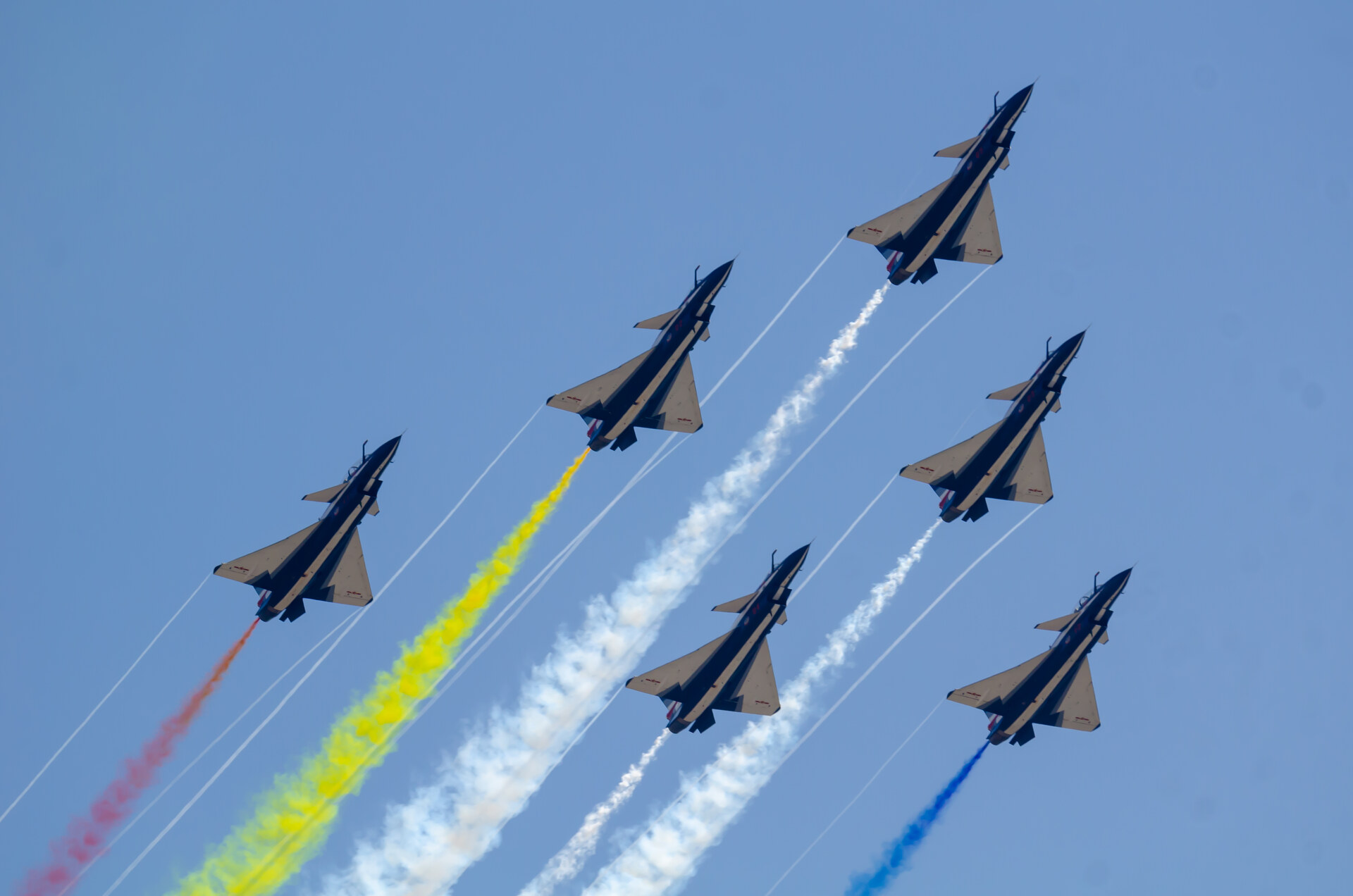
A documented photograph or archival reference connects the interactive model to a real airframe, operation, or preserved example.
Chengdu J-10 at the Zhuhai Airshow7 November 2018 · N509FZWikimedia Commons — related J-10 family reference · CC0 1.0 · Accessed 3 September 2026VIEW ORIGINAL FILE & RIGHTS RECORD ↗
Focused facts connect the airframe's systems to the way it was built, flown, or used.
01
Second cockpit
The tandem layout supports conversion training and shared mission workload.
02
Canard-delta control
Foreplanes provide pitch authority and shape flow over the delta wing.
03
Family distinction
The S should not be treated as visually identical to later J-10C aircraft.
05 · HISTORICAL FIELD NOTE
WHY IT MATTERS.
The two-seat J-10S extends the J-10 family into conversion training and complex multirole missions. Its close-coupled canard-delta layout supplies strong pitch authority while the second cockpit supports instruction, navigation, and shared workload. [1]
Reference figures vary by variant, payload, configuration, altitude, test method, and source. Values here are an editorial orientation—not operational or flight-planning data.
Each numbered citation links to an operator, national museum, manufacturer, or established research institution. The scope note tells you exactly what that source supports, and each entry includes its retrieval date.
Where the represented model and source variant differ, the scope is labelled rather than silently treated as an exact match. Read the editorial policy, report a correction through the legal notice, or review 3D-model provenance in the attribution directory.