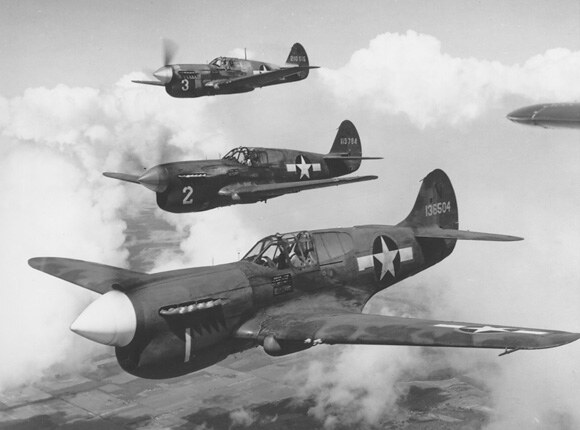
Performance and mechanical data are combined here for a faster, more compact read. Values describe the represented model or nearest clearly identified source variant.
Performance and mechanical specifications for Curtiss P-40 Warhawk
Primary role
Single-engine fighter
Crew
1 pilot
Configuration
Low-wing single-engine fighter
Powerplant
1 × Allison V-1710-39 V-12
Top speed
360 mph
Ceiling
29,000 ft
Published range
650 mi
Length
31 ft 9 in
Wingspan / rotor
37 ft 4 in
Weight
≈8,280 lb loaded
02 · SERVICE CHRONOLOGY
FROM ORIGIN TO LEGACY.
A dated sequence follows the airframe from development through operational use and later evolution. The number of milestones follows the story rather than a fixed template, and each note explains why the event mattered—not only what happened.
ORIGIN
The XP-40 first flew, joining the Hawk airframe to a liquid-cooled Allison engine. [1]
DEVELOPMENT
British Commonwealth P-40s entered combat in North Africa. [1]
SERVICE HISTORY
The American Volunteer Group made the shark-mouthed fighter an icon in China and Burma. [1]
SERVICE HISTORY
Later variants increasingly served as rugged fighter-bombers. [1]
CONTEXT & LEGACY
Restorations preserve a type that served across an unusually broad Allied map. [1]
03 · ARCHIVAL IMAGE
THE AIRFRAME IN CONTEXT.
A documented photograph or archival reference connects the interactive model to a real airframe, operation, or preserved example.
A short, rights-screened motion record adds sound, movement, and operational scale without autoplaying or delaying the interactive model.
Air Park Tours: P-40 Warhawk04:02
An official visual tour of a preserved P-40 Warhawk; the exact sub-variant differs from some aircraft represented by the family record.
VARIANT NOTE Related-family footage is identified here and is not presented as the exact modeled variant.
REUSE NOTE Embedded without modification. Commercial editorial reuse remains subject to the source record, non-endorsement, trademark, privacy/publicity, and third-party-rights limitations.
The appearance of U.S. Department of War (DoW) visual information does not imply or constitute DoW endorsement.
Focused facts connect the airframe's systems to the way it was built, flown, or used.
01
Altitude trade
Its single-stage Allison installation was strongest at low and medium altitude.
02
Tactical strength
A sturdy structure and strong dive acceleration rewarded energy-based attacks.
03
Three Allied names
British services used Tomahawk and Kittyhawk; U.S. service used Warhawk.
06 · HISTORICAL FIELD NOTE
WHY IT MATTERS.
Rugged, fast in a dive, and available when Allied air forces urgently needed modern fighters, the P-40 served from North Africa and China to the Pacific. It rewarded energy-conscious tactics rather than turning contests at altitude, and its durable airframe proved equally useful in fighter-bomber work. [1]
Reference figures vary by variant, payload, configuration, altitude, test method, and source. Values here are an editorial orientation—not operational or flight-planning data.
Each numbered citation links to an operator, national museum, manufacturer, or established research institution. The scope note tells you exactly what that source supports, and each entry includes its retrieval date.
Where the represented model and source variant differ, the scope is labelled rather than silently treated as an exact match. Read the editorial policy, report a correction through the legal notice, or review 3D-model provenance in the attribution directory.