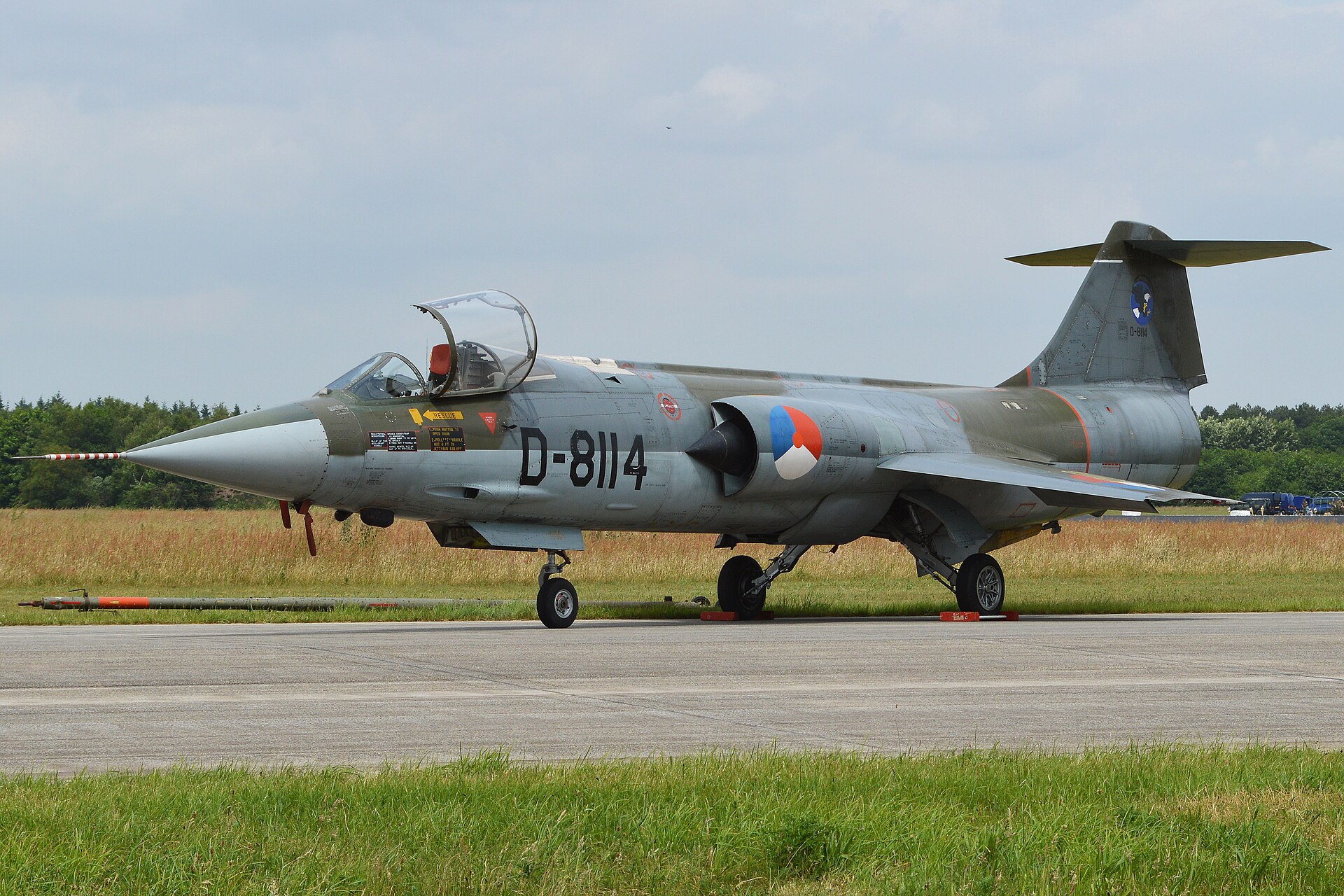
Performance and mechanical data are combined here for a faster, more compact read. Values describe the represented model or nearest clearly identified source variant.
Performance and mechanical specifications for F-104 Starfighter
Primary role
Supersonic interceptor
Crew
1 pilot
Configuration
Small-wing supersonic interceptor
Powerplant
1 × General Electric J79 turbojet
Top speed
Mach 2.0
Ceiling
58,000 ft
Published range
1,630 mi
Length
54 ft 9 in
Wingspan
21 ft 11 in
Max weight
≈29,000 lb
02 · SERVICE CHRONOLOGY
FROM ORIGIN TO LEGACY.
A dated sequence follows the airframe from development through operational use and later evolution. The number of milestones follows the story rather than a fixed template, and each note explains why the event mattered—not only what happened.
ORIGIN
The XF-104 first flew less than two years after Kelly Johnson began the project in response to Korean War pilot interviews. [1]
DEVELOPMENT
The Starfighter's career differed sharply by operator: a daylight interceptor in origin, it became a European all-weather strike and reconnaissance aircraft through national equipment, doctrine, and training systems. [1]
SERVICE HISTORY
The F-104 set world speed and altitude records in the same year, demonstrating the exceptional climb and high-speed performance around which the slender interceptor had been designed. [1]
CONTEXT & LEGACY
Licence-built versions served widely in NATO, often evolving from interceptor duty into strike and reconnaissance roles. [1]
03 · ARCHIVAL IMAGE
THE AIRFRAME IN CONTEXT.
A documented photograph or archival reference connects the interactive model to a real airframe, operation, or preserved example.
A short, rights-screened motion record adds sound, movement, and operational scale without autoplaying or delaying the interactive model.
Heritage display: F-104 Starfighter01:28
An official museum-side visual history of the F-104.
REUSE NOTE Embedded without modification. Commercial editorial reuse remains subject to the source record, non-endorsement, trademark, privacy/publicity, and third-party-rights limitations.
The appearance of U.S. Department of War (DoW) visual information does not imply or constitute DoW endorsement.
A short, attributed line restores a human voice to the technical record. Period statements and later recollections are identified by the date label and accompanied by a source link.
“I wanted the simplest, lightest, highest-performance airplane that could be built.”
Clarence “Kelly” JohnsonLockheed chief engineer
Johnson's statement captures the uncompromising design brief behind the Starfighter.
Focused facts connect the airframe's systems to the way it was built, flown, or used.
01
Wing philosophy
The exceptionally thin, sharp-edged wing minimized drag but demanded high approach speeds and careful handling.
02
Engine packaging
Side intakes left the pointed nose free for radar and concentrated the airframe around one powerful engine.
03
International system
Large NATO production programs turned the design into a multinational interceptor and strike family.
07 · HISTORICAL FIELD NOTE
WHY IT MATTERS.
Nicknamed the missile with a man in it, the Starfighter paired a tiny wing with blistering climb and supersonic speed. Designed first as a lightweight interceptor, it was later adapted for strike and reconnaissance, though its demanding high-speed approach and limited low-speed margin required disciplined training and careful operation. [1]
Reference figures vary by variant, payload, configuration, altitude, test method, and source. Values here are an editorial orientation—not operational or flight-planning data.
Each numbered citation links to an operator, national museum, manufacturer, or established research institution. The scope note tells you exactly what that source supports, and each entry includes its retrieval date.
Where the represented model and source variant differ, the scope is labelled rather than silently treated as an exact match. Read the editorial policy, report a correction through the legal notice, or review 3D-model provenance in the attribution directory.