Performance and mechanical data are combined here for a faster, more compact read. Values describe the represented model or nearest clearly identified source variant.
Performance and mechanical specifications for F-111F Aardvark
Primary role
Tactical strike aircraft
Crew
2
Configuration
Variable-sweep low-level strike aircraft
Powerplant
2 × Pratt & Whitney TF30 turbofans
Top speed
Mach 2.5
Ceiling
60,000 ft
Published range
3,700 mi
Length
73 ft 6 in
Wing spread
63 ft
Max weight
≈100,000 lb
02 · SERVICE CHRONOLOGY
FROM ORIGIN TO LEGACY.
A dated sequence follows the airframe from development through operational use and later evolution. The number of milestones follows the story rather than a fixed template, and each note explains why the event mattered—not only what happened.
ORIGIN
The first F-111 flew from a joint-service program whose naval branch was later cancelled. [1]
DEVELOPMENT
Early combat problems gave way to mature long-range strike performance in Libya and the Gulf War. [1]
SERVICE HISTORY
F-111Fs flew the long-range strike on Libya from bases in Britain, requiring extensive aerial refueling and demonstrating the aircraft's deep-attack reach. [1]
CONTEXT & LEGACY
Precision strike in the Gulf War capped the type's U.S. combat development, while Australia operated the final fleet until 2010. Its terrain following and variable sweep influenced later expectations for deep attack. [1]
03 · ARCHIVAL IMAGE
THE AIRFRAME IN CONTEXT.
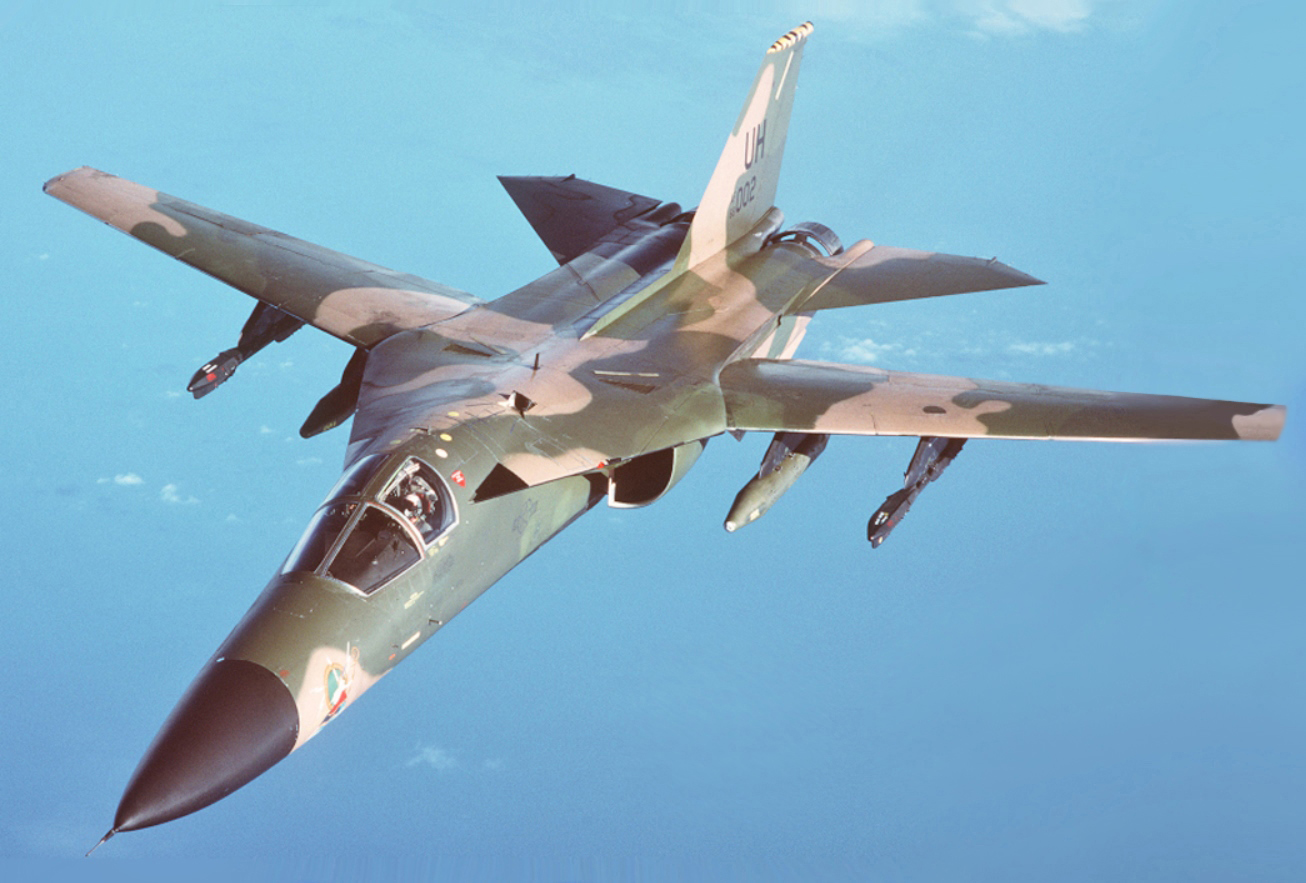
A documented photograph or archival reference connects the interactive model to a real airframe, operation, or preserved example.
AFR F-111 air to air refuelingcirca 1989 date QS:P,+1989-00-00T00:00:00Z/9,P1480,Q5727902 · Master Sgt. Patrick NugentWikimedia Commons · Public domain · Accessed 29 August 2026VIEW ORIGINAL FILE & RIGHTS RECORD ↗
04 · ARCHIVAL FOOTAGE
THE AIRFRAME IN MOTION.
A short, rights-screened motion record adds sound, movement, and operational scale without autoplaying or delaying the interactive model.
Heritage display: F-111 Aardvark01:26
An official museum-side visual history; the archive record focuses on the F-111F.
REUSE NOTE Embedded without modification. Commercial editorial reuse remains subject to the source record, non-endorsement, trademark, privacy/publicity, and third-party-rights limitations.
The appearance of U.S. Department of War (DoW) visual information does not imply or constitute DoW endorsement.
A short, attributed line restores a human voice to the technical record. Period statements and later recollections are identified by the date label and accompanied by a source link.
“The F-111 could go farther, faster, and lower than anything else we had.”
Richard CrandallU.S. Air Force F-111 pilot
Crandall's summary points to the combination of terrain following, range, and speed that defined the mature aircraft.
Focused facts connect the airframe's systems to the way it was built, flown, or used.
01
Automatic low level
Terrain-following radar could command the aircraft along a programmed clearance above the ground.
02
Crew escape
The entire side-by-side cockpit formed an escape capsule instead of relying on individual ejection seats.
03
Internal bay
A fuselage weapons bay reduced drag and could carry stores or specialized mission equipment.
07 · HISTORICAL FIELD NOTE
WHY IT MATTERS.
The F-111 combined terrain-following radar, variable-sweep wings, afterburning turbofans, and a side-by-side cockpit for fast, low-level penetration. The refined F model paired this range and speed with powerful avionics and precision weapons, proving especially effective in the closing phase of the 1991 Gulf War. [1]
Reference figures vary by variant, payload, configuration, altitude, test method, and source. Values here are an editorial orientation—not operational or flight-planning data.
Each numbered citation links to an operator, national museum, manufacturer, or established research institution. The scope note tells you exactly what that source supports, and each entry includes its retrieval date.
Where the represented model and source variant differ, the scope is labelled rather than silently treated as an exact match. Read the editorial policy, report a correction through the legal notice, or review 3D-model provenance in the attribution directory.