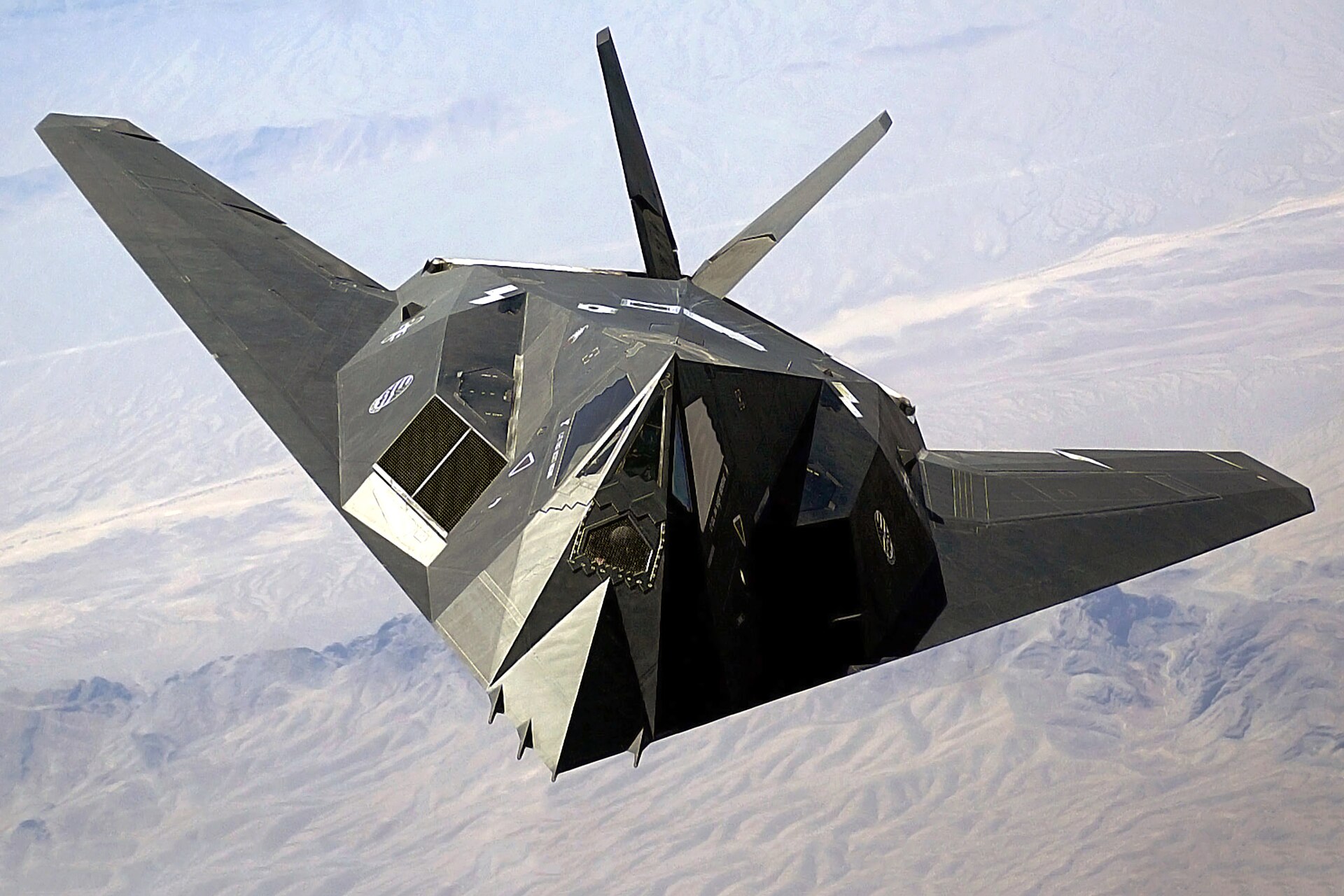
Performance and mechanical data are combined here for a faster, more compact read. Values describe the represented model or nearest clearly identified source variant.
Performance and mechanical specifications for F-117A Nighthawk
Primary role
Stealth attack aircraft
Crew
1 pilot
Configuration
Faceted low-observable attack aircraft
Powerplant
2 × General Electric F404 turbofans
Top speed
684 mph
Ceiling
45,000 ft
Published range
1,070 mi
Length
65 ft 11 in
Wingspan
43 ft 4 in
Max weight
≈52,500 lb
02 · SERVICE CHRONOLOGY
FROM ORIGIN TO LEGACY.
A dated sequence follows the airframe from development through operational use and later evolution. The number of milestones follows the story rather than a fixed template, and each note explains why the event mattered—not only what happened.
ORIGIN
The smaller Have Blue demonstrator validated the faceted shaping and control approach that led to the operational aircraft. [1]
DEVELOPMENT
Publicly acknowledged after years of secrecy, the F-117 served in multiple conflicts before formal retirement and later test use. [1]
SERVICE HISTORY
During the Gulf War, the F-117's precision missions made low-observable strike publicly visible on a large scale. Its success also encouraged investment in stealth across later bomber and fighter programs. [1]
CONTEXT & LEGACY
One F-117 was shot down over Serbia, a reminder that low observability reduces detection and engagement opportunities but does not make an aircraft invulnerable. [1]
03 · ARCHIVAL IMAGE
THE AIRFRAME IN CONTEXT.
A documented photograph or archival reference connects the interactive model to a real airframe, operation, or preserved example.
A short, rights-screened motion record adds sound, movement, and operational scale without autoplaying or delaying the interactive model.
F-117 Nighthawk retirement01:03
Official footage marking the retirement of the F-117A fleet.
REUSE NOTE Embedded without modification. Commercial editorial reuse remains subject to the source record, non-endorsement, trademark, privacy/publicity, and third-party-rights limitations.
The appearance of U.S. Department of War (DoW) visual information does not imply or constitute DoW endorsement.
A short, attributed line restores a human voice to the technical record. Period statements and later recollections are identified by the date label and accompanied by a source link.
“The airplane was very honest. It did exactly what you told it to do.”
Hal FarleyLockheed F-117 test pilot
Farley distinguished the Nighthawk's unconventional appearance from its predictable handling in trained hands.
Focused facts connect the airframe's systems to the way it was built, flown, or used.
01
Faceted solution
Flat panels and aligned edges reflected radar energy away from its source within the limits of period computing.
02
Computer stability
A quadruplex fly-by-wire system made the aerodynamically unusual shape controllable.
03
Internal precision
Two internal weapon bays carried precision-guided bombs without compromising the external stealth shape.
07 · HISTORICAL FIELD NOTE
WHY IT MATTERS.
Faceted surfaces and radar-absorbent materials made the Nighthawk the first operational aircraft designed around low observability. Its unconventional shape sacrificed aerodynamic elegance for survivability, enabling precise night attacks against heavily defended targets and demonstrating how stealth could change strike planning. [1]
Reference figures vary by variant, payload, configuration, altitude, test method, and source. Values here are an editorial orientation—not operational or flight-planning data.
Each numbered citation links to an operator, national museum, manufacturer, or established research institution. The scope note tells you exactly what that source supports, and each entry includes its retrieval date.
Where the represented model and source variant differ, the scope is labelled rather than silently treated as an exact match. Read the editorial policy, report a correction through the legal notice, or review 3D-model provenance in the attribution directory.