Performance and mechanical data are combined here for a faster, more compact read. Values describe the represented model or nearest clearly identified source variant.
Performance and mechanical specifications for F-14A Tomcat
Primary role
Fleet defense
Crew
2
Configuration
Variable-sweep carrier interceptor
Powerplant
2 × turbofans; type varies by version
Top speed
Mach 2.34
Ceiling
53,000 ft
Published range
1,840 mi
Length
62 ft 9 in
Wing spread
64 ft 1 in
Max weight
≈74,400 lb
02 · SERVICE CHRONOLOGY
FROM ORIGIN TO LEGACY.
A dated sequence follows the airframe from development through operational use and later evolution. The number of milestones follows the story rather than a fixed template, and each note explains why the event mattered—not only what happened.
ORIGIN
The Tomcat first flew only 22 months after Grumman received the development contract. [1]
DEVELOPMENT
The Tomcat evolved from long-range fleet defense into a precision strike platform through upgraded sensors and targeting pods. That late-career transformation extended its usefulness after its original missile-interceptor mission had narrowed. [1]
SERVICE HISTORY
Tomcats from USS Nimitz shot down two Libyan Su-22s over the Gulf of Sidra, one of the type's first widely reported air-to-air engagements. [1]
CONTEXT & LEGACY
The U.S. Navy retired the type after more than three decades, while Iranian Tomcats remained in service. [1]
03 · ARCHIVAL IMAGE
THE AIRFRAME IN CONTEXT.
A documented photograph or archival reference connects the interactive model to a real airframe, operation, or preserved example.
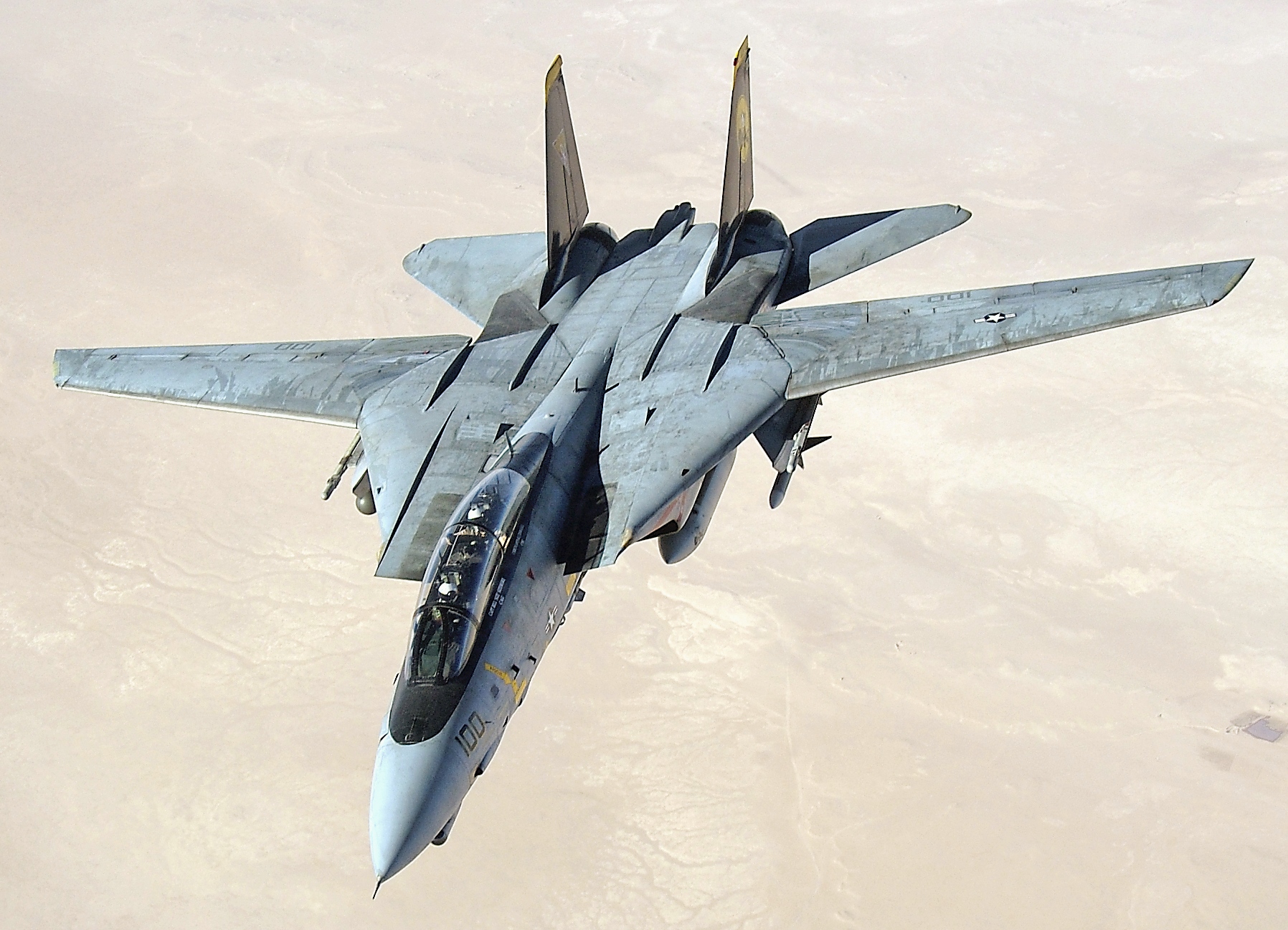
US Navy 051105-F-5480T-005 An F-14D Tomcat conducts a mission over the Persian Gulf-region2005-11-05 · U.S. Navy photoWikimedia Commons · Public domain · Accessed 29 August 2026VIEW ORIGINAL FILE & RIGHTS RECORD ↗
04 · ARCHIVAL FOOTAGE
THE AIRFRAME IN MOTION.
A short, rights-screened motion record adds sound, movement, and operational scale without autoplaying or delaying the interactive model.
USS Theodore Roosevelt deck operations02:53
Official deck footage includes an F-14 Tomcat launch; the archive model is the F-14A and the clip may show a later fleet variant.
VARIANT NOTE Related-family footage is identified here and is not presented as the exact modeled variant.
REUSE NOTE Embedded without modification. Commercial editorial reuse remains subject to the source record, non-endorsement, trademark, privacy/publicity, and third-party-rights limitations.
The appearance of U.S. Department of War (DoW) visual information does not imply or constitute DoW endorsement.
A short, attributed line restores a human voice to the technical record. Period statements and later recollections are identified by the date label and accompanied by a source link.
“Livin' the dream! I can't believe I'm still doing it.”
Dale “Snort” SnodgrassU.S. Navy F-14 pilot
Snodgrass remained closely identified with the Tomcat after a long fighter and demonstration career.
Focused facts connect the airframe's systems to the way it was built, flown, or used.
01
Fleet-defense system
The AWG-9 radar and AIM-54 Phoenix missile were built to engage distant threats approaching a carrier group.
02
Automatic geometry
A flight-control computer could schedule wing sweep continuously as speed and maneuver demands changed.
03
Crew partnership
The pilot flew the aircraft while the radar intercept officer managed sensors, navigation, and long-range intercepts.
07 · HISTORICAL FIELD NOTE
WHY IT MATTERS.
Variable-sweep wings and the long-range Phoenix missile made the Tomcat a powerful fleet-defense interceptor with excellent low-speed carrier handling. Its crew of two combined a pilot with a radar intercept officer, and later precision-strike upgrades extended the aircraft from Cold War interception into reconnaissance and attack missions. [1]
Reference figures vary by variant, payload, configuration, altitude, test method, and source. Values here are an editorial orientation—not operational or flight-planning data.
Each numbered citation links to an operator, national museum, manufacturer, or established research institution. The scope note tells you exactly what that source supports, and each entry includes its retrieval date.
Where the represented model and source variant differ, the scope is labelled rather than silently treated as an exact match. Read the editorial policy, report a correction through the legal notice, or review 3D-model provenance in the attribution directory.