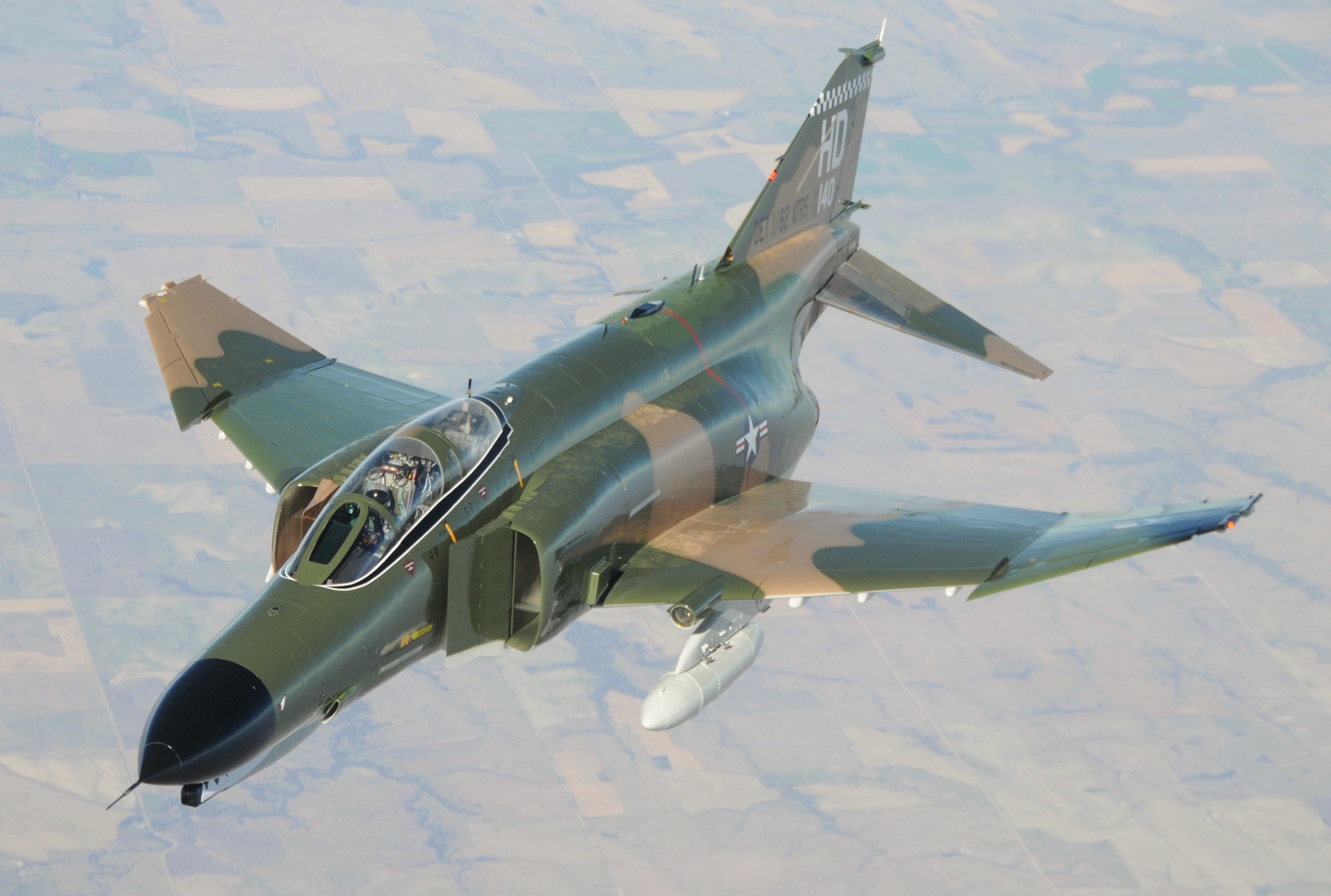
Performance and mechanical data are combined here for a faster, more compact read. Values describe the represented model or nearest clearly identified source variant.
Performance and mechanical specifications for F-4 Phantom II
Primary role
Interceptor / strike fighter
Crew
2
Configuration
Twin-engine tandem-seat multirole jet
Powerplant
2 × General Electric J79 turbojets
Top speed
Mach 2.23
Ceiling
60,000 ft
Published range
1,750 mi
Length
63 ft
Wingspan
38 ft 5 in
Max weight
≈61,800 lb
02 · SERVICE CHRONOLOGY
FROM ORIGIN TO LEGACY.
A dated sequence follows the airframe from development through operational use and later evolution. The number of milestones follows the story rather than a fixed template, and each note explains why the event mattered—not only what happened.
ORIGIN
The naval prototype first flew as a fleet-defense interceptor with exceptional thrust and missile capacity. [1]
DEVELOPMENT
Adoption by the Navy, Marine Corps, and Air Force made the Phantom a rare common combat aircraft across three U.S. services. [1]
SERVICE HISTORY
The Phantom entered U.S. Navy fleet service as the F4H-1, beginning a career that soon expanded from carrier interception into strike, reconnaissance, and land-based air defence. [1]
CONTEXT & LEGACY
Vietnam combat exposed the limits of early missile doctrine and helped restore emphasis on training and close-in maneuvering. Later Wild Weasel, reconnaissance, and strike variants kept the Phantom relevant through the Gulf War. [1]
03 · ARCHIVAL IMAGE
THE AIRFRAME IN CONTEXT.
A documented photograph or archival reference connects the interactive model to a real airframe, operation, or preserved example.
A short, attributed line restores a human voice to the technical record. Period statements and later recollections are identified by the date label and accompanied by a source link.
“What a magnificent warhorse that aircraft still is.”
Ron RappPilot and aviation writer
Rapp's later flight account captures the physical presence and enduring capability associated with the Phantom.
Focused facts connect the airframe's systems to the way it was built, flown, or used.
01
Missile-era design
Early Phantoms carried no internal gun because guided missiles were expected to dominate air combat.
02
Two-seat workload
A second crew member managed radar, navigation, and weapons tasks as mission complexity grew.
03
Visible signature
The J79 engines could leave a dark smoke trail, especially at military power.
07 · HISTORICAL FIELD NOTE
WHY IT MATTERS.
The twin-engine Phantom combined speed, payload, and versatility, serving in air-defense, strike, and reconnaissance roles across multiple U.S. services. Initially designed without an internal gun, it evolved through combat experience into a heavily updated family whose power and adaptability kept it active with international operators for decades. [1]
Reference figures vary by variant, payload, configuration, altitude, test method, and source. Values here are an editorial orientation—not operational or flight-planning data.
Each numbered citation links to an operator, national museum, manufacturer, or established research institution. The scope note tells you exactly what that source supports, and each entry includes its retrieval date.
Where the represented model and source variant differ, the scope is labelled rather than silently treated as an exact match. Read the editorial policy, report a correction through the legal notice, or review 3D-model provenance in the attribution directory.