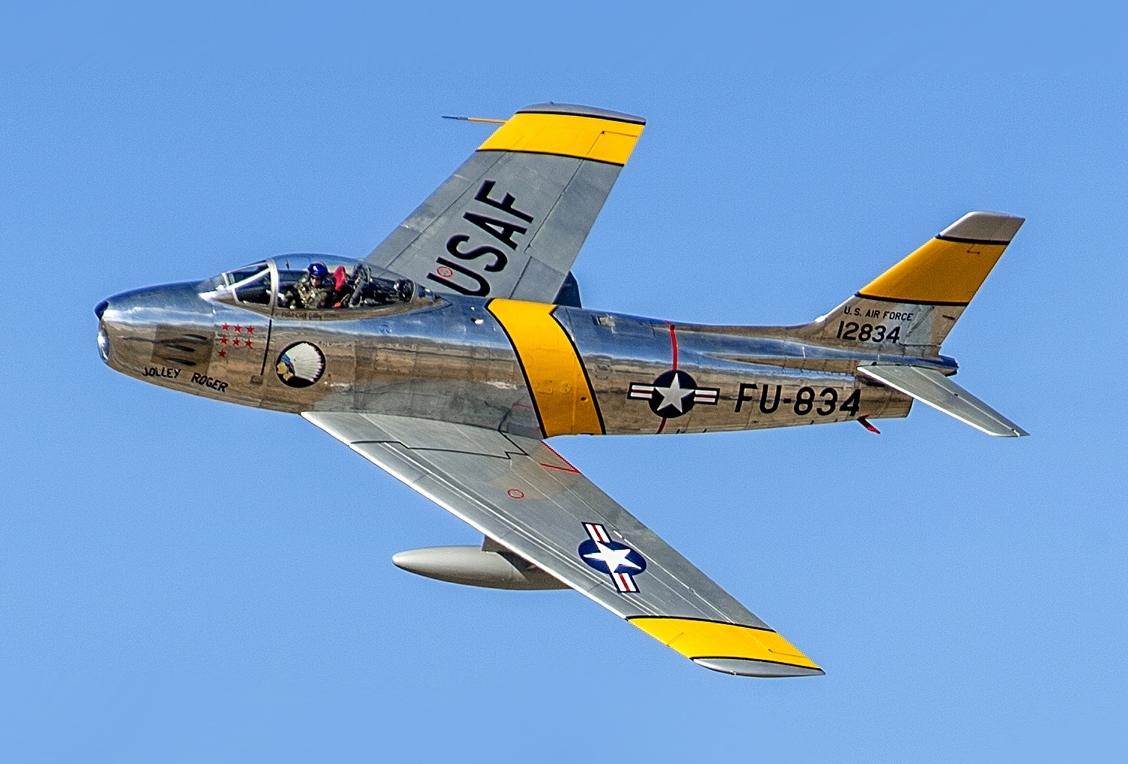
Performance and mechanical data are combined here for a faster, more compact read. Values describe the represented model or nearest clearly identified source variant.
Performance and mechanical specifications for F-86 Sabre
Primary role
Day fighter
Crew
1 pilot
Configuration
Swept-wing transonic day fighter
Powerplant
1 × General Electric J47 turbojet
Top speed
687 mph
Ceiling
49,600 ft
Published range
1,525 mi
Length
37 ft 1 in
Wingspan
37 ft 1 in
Max weight
≈16,400 lb
02 · SERVICE CHRONOLOGY
FROM ORIGIN TO LEGACY.
A dated sequence follows the airframe from development through operational use and later evolution. The number of milestones follows the story rather than a fixed template, and each note explains why the event mattered—not only what happened.
ORIGIN
The swept-wing XP-86 first flew after North American revised an earlier straight-wing proposal with captured aerodynamic research. [1]
DEVELOPMENT
Sabres entered combat over Korea and became closely associated with the high-altitude battles around MiG Alley. [1]
SERVICE HISTORY
Combat over Korea placed the Sabre against the MiG-15 and made radar-ranging gunsights, pilot training, and high-altitude energy management central to its operational reputation. [1]
CONTEXT & LEGACY
Successive Sabre variants added power, radar, and all-weather capability. Licence production in Canada, Australia, Italy, and Japan turned a Korean War fighter into a broad Western air-force family. [1]
03 · ARCHIVAL IMAGE
THE AIRFRAME IN CONTEXT.
A documented photograph or archival reference connects the interactive model to a real airframe, operation, or preserved example.
A short, attributed line restores a human voice to the technical record. Period statements and later recollections are identified by the date label and accompanied by a source link.
“The Sabre was a beautiful airplane to fly.”
James JabaraU.S. Air Force F-86 pilot
Jabara's assessment reflects the handling qualities behind the Sabre's combat reputation; the linked museum record supplies aircraft context.
Focused facts connect the airframe's systems to the way it was built, flown, or used.
01
Captured insight
German swept-wing research helped reshape North American's original straight-wing proposal.
02
Aiming aid
Later Sabres paired a radar-ranging gunsight with six closely grouped machine guns.
03
Control system
Hydraulically boosted controls helped manage aerodynamic loads at transonic speed.
07 · HISTORICAL FIELD NOTE
WHY IT MATTERS.
Its swept-wing design made the Sabre a benchmark early jet fighter, best known for high-speed air combat over Korea. Radar-assisted gunsights, hydraulic controls, and effective transonic handling helped it meet the MiG-15 in engagements that defined the first generation of jet-versus-jet warfare. [1]
Reference figures vary by variant, payload, configuration, altitude, test method, and source. Values here are an editorial orientation—not operational or flight-planning data.
Each numbered citation links to an operator, national museum, manufacturer, or established research institution. The scope note tells you exactly what that source supports, and each entry includes its retrieval date.
Where the represented model and source variant differ, the scope is labelled rather than silently treated as an exact match. Read the editorial policy, report a correction through the legal notice, or review 3D-model provenance in the attribution directory.