Performance and mechanical data are combined here for a faster, more compact read. Values describe the represented model or nearest clearly identified source variant.
Performance and mechanical specifications for F/A-18E/F Super Hornet
Primary role
Carrier strike fighter
Crew
1 or 2
Configuration
Twin-engine carrier multirole fighter
Powerplant
2 × General Electric F414 turbofans
Top speed
Mach 1.8
Ceiling
50,000+ ft
Published range
1,458 mi
Length
60 ft 1 in
Wingspan
44 ft 9 in
Max weight
66,000 lb
02 · SERVICE CHRONOLOGY
FROM ORIGIN TO LEGACY.
A dated sequence follows the airframe from development through operational use and later evolution. The number of milestones follows the story rather than a fixed template, and each note explains why the event mattered—not only what happened.
ORIGIN
The enlarged Super Hornet first flew as a substantially redesigned successor to the original F/A-18. [1]
DEVELOPMENT
Fleet introduction began a long transition in which the type absorbed fighter, tanker, and electronic-attack support roles. [1]
SERVICE HISTORY
The Super Hornet progressively replaced several carrier aircraft while adding aerial refueling and networked weapons. Commonality simplified the air wing, although it also concentrated more missions in one airframe family. [1]
CONTEXT & LEGACY
The Super Hornet flew its first combat missions during Operation Southern Watch, moving the enlarged design from fleet transition into operational strike patrols. [1]
03 · ARCHIVAL IMAGE
THE AIRFRAME IN CONTEXT.
A documented photograph or archival reference connects the interactive model to a real airframe, operation, or preserved example.
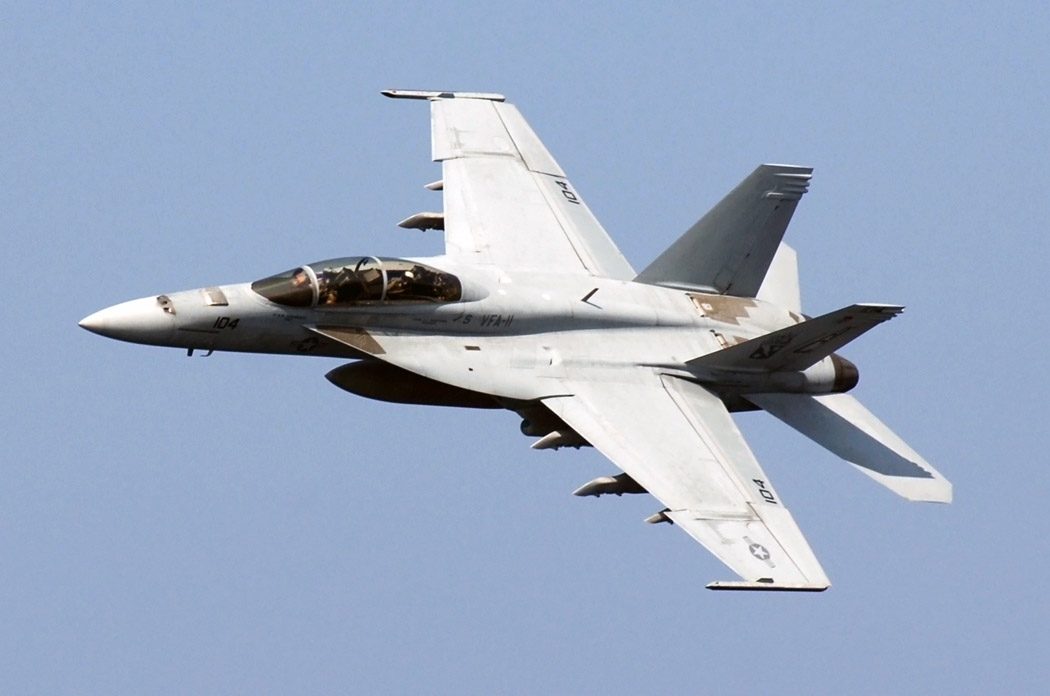
US Navy 071203-N-8923M-074 An F-A-18F Super Hornet, from the Red Rippers of Strike Fighter Squadron (VFA) 11, makes a sharp turn above the flight deck aboard the Nimitz-class nuclear-powered aircraft carrier USS Harry S. TrumanTaken on 3 December 2007 · U.S. Navy photo by Seaman Kevin T. Murray Jr.Wikimedia Commons · Public domain · Accessed 29 August 2026VIEW ORIGINAL FILE & RIGHTS RECORD ↗
04 · ARCHIVAL FOOTAGE
THE AIRFRAME IN MOTION.
A short, rights-screened motion record adds sound, movement, and operational scale without autoplaying or delaying the interactive model.
F/A-18F Super Hornets launch00:32
Carrier-launch footage of the two-seat F/A-18F represented by the combined E/F record.
REUSE NOTE Embedded without modification. Commercial editorial reuse remains subject to the source record, non-endorsement, trademark, privacy/publicity, and third-party-rights limitations.
The appearance of U.S. Department of War (DoW) visual information does not imply or constitute DoW endorsement.
A short, attributed line restores a human voice to the technical record. Period statements and later recollections are identified by the date label and accompanied by a source link.
“It is an absolutely phenomenal airplane to fly.”
Bob WinkleBoeing chief test pilot
Winkle's assessment refers to the Super Hornet's flight-test program and handling development.
Focused facts connect the airframe's systems to the way it was built, flown, or used.
01
Major redesign
Despite its familiar outline, the Super Hornet is substantially larger than the original F/A-18 Hornet.
02
Digital control
Full-authority fly-by-wire control helps manage the aircraft across carrier approaches and high-angle maneuvering.
03
Deck footprint
Outer wing panels fold upward so more aircraft can be parked and moved on a carrier deck.
07 · HISTORICAL FIELD NOTE
WHY IT MATTERS.
The Super Hornet is a larger, longer-range evolution of the Hornet, combining fighter agility with precision strike and carrier-based versatility. It also serves as the basis for aerial refueling and electronic-attack operations, allowing a common carrier-air-wing family to cover missions once divided among several specialized aircraft. [1]
Reference figures vary by variant, payload, configuration, altitude, test method, and source. Values here are an editorial orientation—not operational or flight-planning data.
Each numbered citation links to an operator, national museum, manufacturer, or established research institution. The scope note tells you exactly what that source supports, and each entry includes its retrieval date.
Where the represented model and source variant differ, the scope is labelled rather than silently treated as an exact match. Read the editorial policy, report a correction through the legal notice, or review 3D-model provenance in the attribution directory.