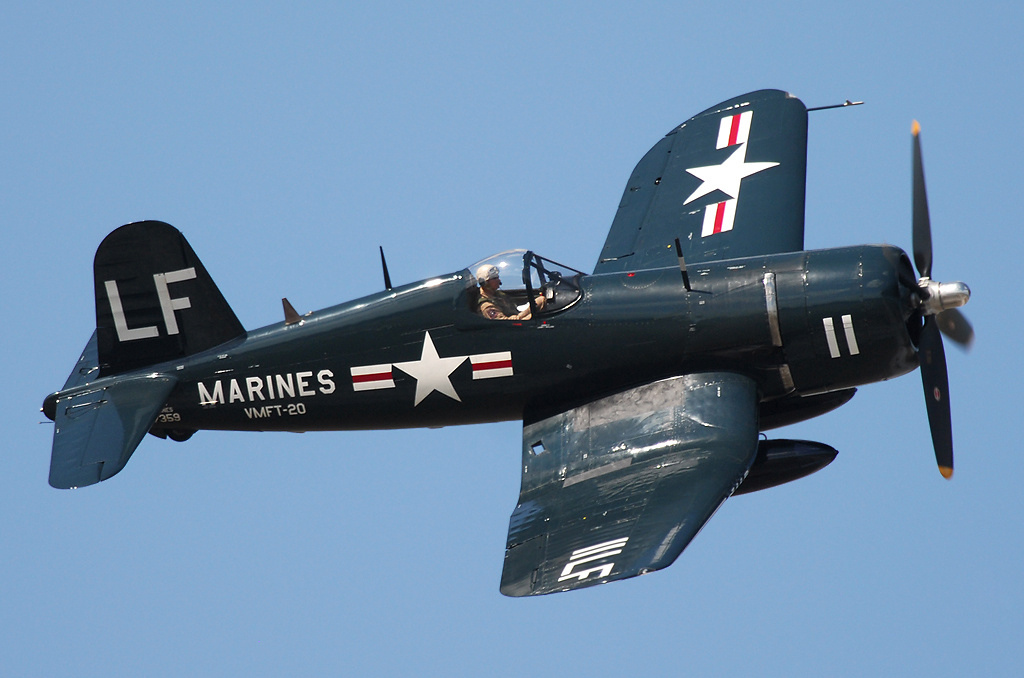
Performance and mechanical data are combined here for a faster, more compact read. Values describe the represented model or nearest clearly identified source variant.
Performance and mechanical specifications for F4U-1 Corsair
Primary role
Carrier fighter
Crew
1 pilot
Configuration
Inverted-gull-wing carrier fighter
Powerplant
1 × Pratt & Whitney R-2800 radial
Top speed
417 mph
Ceiling
36,900 ft
Published range
1,015 mi
Length
33 ft 4 in
Wingspan
41 ft
Max weight
≈14,700 lb
02 · SERVICE CHRONOLOGY
FROM ORIGIN TO LEGACY.
A dated sequence follows the airframe from development through operational use and later evolution. The number of milestones follows the story rather than a fixed template, and each note explains why the event mattered—not only what happened.
ORIGIN
The XF4U-1 prototype flew with one of the most powerful engines then fitted to a single-seat fighter. [1]
DEVELOPMENT
Carrier qualification problems were progressively corrected, but Marine squadrons had already shown the Corsair's value from island bases. By war's end it was both a fleet fighter and a highly effective fighter-bomber. [1]
SERVICE HISTORY
Corsairs returned to combat in Korea, increasingly valued for close air support and strike work. [1]
CONTEXT & LEGACY
U.S. production ended after the Corsair had evolved through fighter, night-fighter, reconnaissance, and attack variants; overseas operators kept the family active well beyond its American service peak. [1]
03 · ARCHIVAL IMAGE
THE AIRFRAME IN CONTEXT.
A documented photograph or archival reference connects the interactive model to a real airframe, operation, or preserved example.
A short, rights-screened motion record adds sound, movement, and operational scale without autoplaying or delaying the interactive model.
Wings of Heritage: F4U Corsair flight05:38
Modern airworthy Corsair footage; the record represents the wartime F4U-1 while this heritage formation includes a later surviving Corsair.
VARIANT NOTE Related-family footage is identified here and is not presented as the exact modeled variant.
REUSE NOTE Embedded without modification. Commercial editorial reuse remains subject to the source record, non-endorsement, trademark, privacy/publicity, and third-party-rights limitations.
The appearance of U.S. Department of War (DoW) visual information does not imply or constitute DoW endorsement.
A short, attributed line restores a human voice to the technical record. Period statements and later recollections are identified by the date label and accompanied by a source link.
“I was able to apply full power ... and have control about all three axes without stalling.”
Boone GuytonVought test pilot
Guyton recalled the Corsair prototype's unusual low-speed controllability during early flight testing.
Focused facts connect the airframe's systems to the way it was built, flown, or used.
01
Wing logic
Its inverted gull wing created propeller clearance without unusually long landing-gear legs.
02
Early benchmark
The XF4U-1 became the first U.S. single-engine fighter prototype to exceed 400 mph in level flight.
03
Carrier evolution
Raised seating, a revised canopy, and landing-gear changes improved the difficult forward view and deck manners.
07 · HISTORICAL FIELD NOTE
WHY IT MATTERS.
Built around a powerful radial engine and distinctive inverted gull wing, the Corsair became a formidable carrier and land-based fighter in the Pacific. Its unusual wing created propeller clearance without excessively long landing gear, while later variants continued serving in attack roles well beyond World War II. [1]
Reference figures vary by variant, payload, configuration, altitude, test method, and source. Values here are an editorial orientation—not operational or flight-planning data.
Each numbered citation links to an operator, national museum, manufacturer, or established research institution. The scope note tells you exactly what that source supports, and each entry includes its retrieval date.
Where the represented model and source variant differ, the scope is labelled rather than silently treated as an exact match. Read the editorial policy, report a correction through the legal notice, or review 3D-model provenance in the attribution directory.