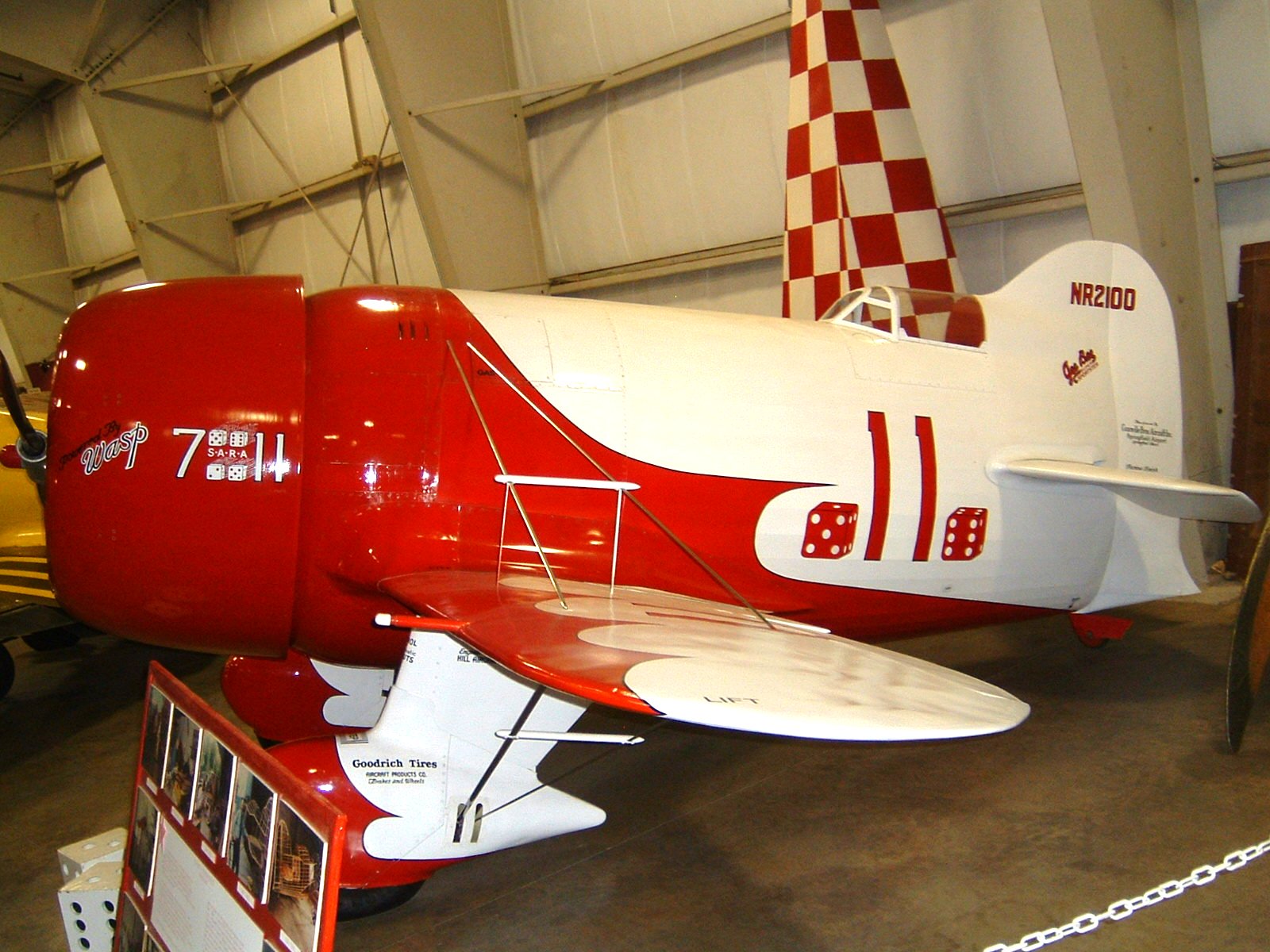
Performance and mechanical data are combined here for a faster, more compact read. Values describe the represented model or nearest clearly identified source variant.
Performance and mechanical specifications for Gee Bee R-1
Primary role
Racing aircraft
Crew
1 pilot
Configuration
Purpose-built pylon racer
Powerplant
1 × Pratt & Whitney R-1340 radial
Top speed
296 mph
Ceiling
—
Published range
925 mi
Length
17 ft 8 in
Wingspan
25 ft
Gross weight
≈3,100 lb
02 · SERVICE CHRONOLOGY
FROM ORIGIN TO LEGACY.
A dated sequence follows the airframe from development through operational use and later evolution. The number of milestones follows the story rather than a fixed template, and each note explains why the event mattered—not only what happened.
ORIGIN
Jimmy Doolittle won the Thompson Trophy in the R-1 after setting a closed-course speed record during the race. [1]
DEVELOPMENT
The R-1's victory reflected both Doolittle's precision and a design optimized around a narrow racing task. Its short career illustrates how record aircraft can trade forgiving behavior for maximum performance. [1]
SERVICE HISTORY
The original aircraft was destroyed in a fatal crash, but its extreme proportions made it an enduring symbol of interwar racing. [1]
CONTEXT & LEGACY
After the R-1's 1932 success, the Granville racers were rebuilt and modified for another season, illustrating how tightly optimized record aircraft could change rapidly between competitions. [1]
03 · ARCHIVAL IMAGE
THE AIRFRAME IN CONTEXT.
A documented photograph or archival reference connects the interactive model to a real airframe, operation, or preserved example.
A short, attributed line restores a human voice to the technical record. Period statements and later recollections are identified by the date label and accompanied by a source link.
“She is the sweetest ship I've ever flown.”
Jimmy DoolittleRacing pilot
Doolittle praised the R-1 after winning the Thompson Trophy, despite the design's later fearsome reputation.
Focused facts connect the airframe's systems to the way it was built, flown, or used.
01
Engine-shaped body
The compact fuselage wrapped tightly around a large radial engine to minimize frontal drag.
02
Purpose built
The R-1 was created for short, high-speed pylon racing rather than general flying.
03
1932 victory
Jimmy Doolittle flew the racer to victory in the Thompson Trophy.
06 · HISTORICAL FIELD NOTE
WHY IT MATTERS.
Built around the largest practical engine and the smallest possible airframe, the R-1 became an extreme expression of interwar air racing. Its bulbous fuselage and short wings minimized drag and weight around enormous power, producing spectacular speed along with handling that demanded exceptional judgment from its pilots. [1]
Reference figures vary by variant, payload, configuration, altitude, test method, and source. Values here are an editorial orientation—not operational or flight-planning data.
Each numbered citation links to an operator, national museum, manufacturer, or established research institution. The scope note tells you exactly what that source supports, and each entry includes its retrieval date.
Where the represented model and source variant differ, the scope is labelled rather than silently treated as an exact match. Read the editorial policy, report a correction through the legal notice, or review 3D-model provenance in the attribution directory.