Performance and mechanical data are combined here for a faster, more compact read. Values describe the represented model or nearest clearly identified source variant.
Performance and mechanical specifications for Horten Ho 229
Primary role
Flying-wing fighter prototype
Crew
1 pilot
Configuration
Tailless jet flying wing
Powerplant
2 × Junkers Jumo 004B turbojets
Top speed
590 mph projected
Ceiling
52,000 ft projected
Published range
620 mi projected
Length
≈25 ft
Wingspan
≈55 ft
Projected weight
≈19,800 lb
02 · SERVICE CHRONOLOGY
FROM ORIGIN TO LEGACY.
A dated sequence follows the airframe from development through operational use and later evolution. The number of milestones follows the story rather than a fixed template, and each note explains why the event mattered—not only what happened.
ORIGIN
An unpowered prototype established handling before the jet-powered V2 began a brief flight-test program. [1]
DEVELOPMENT
Only fragmentary testing occurred before Germany's collapse, and the surviving V3 never flew. Modern claims about stealth or combat performance must therefore be treated as reconstruction, not operational evidence. [1]
SERVICE HISTORY
U.S. forces captured the unfinished V3; its incomplete state limits firm conclusions about intended production performance. [1]
CONTEXT & LEGACY
The Smithsonian began a major conservation program on the unfinished V3, using material analysis and careful stabilization to separate surviving evidence from later speculation about the design. [1]
03 · ARCHIVAL IMAGE
THE AIRFRAME IN CONTEXT.
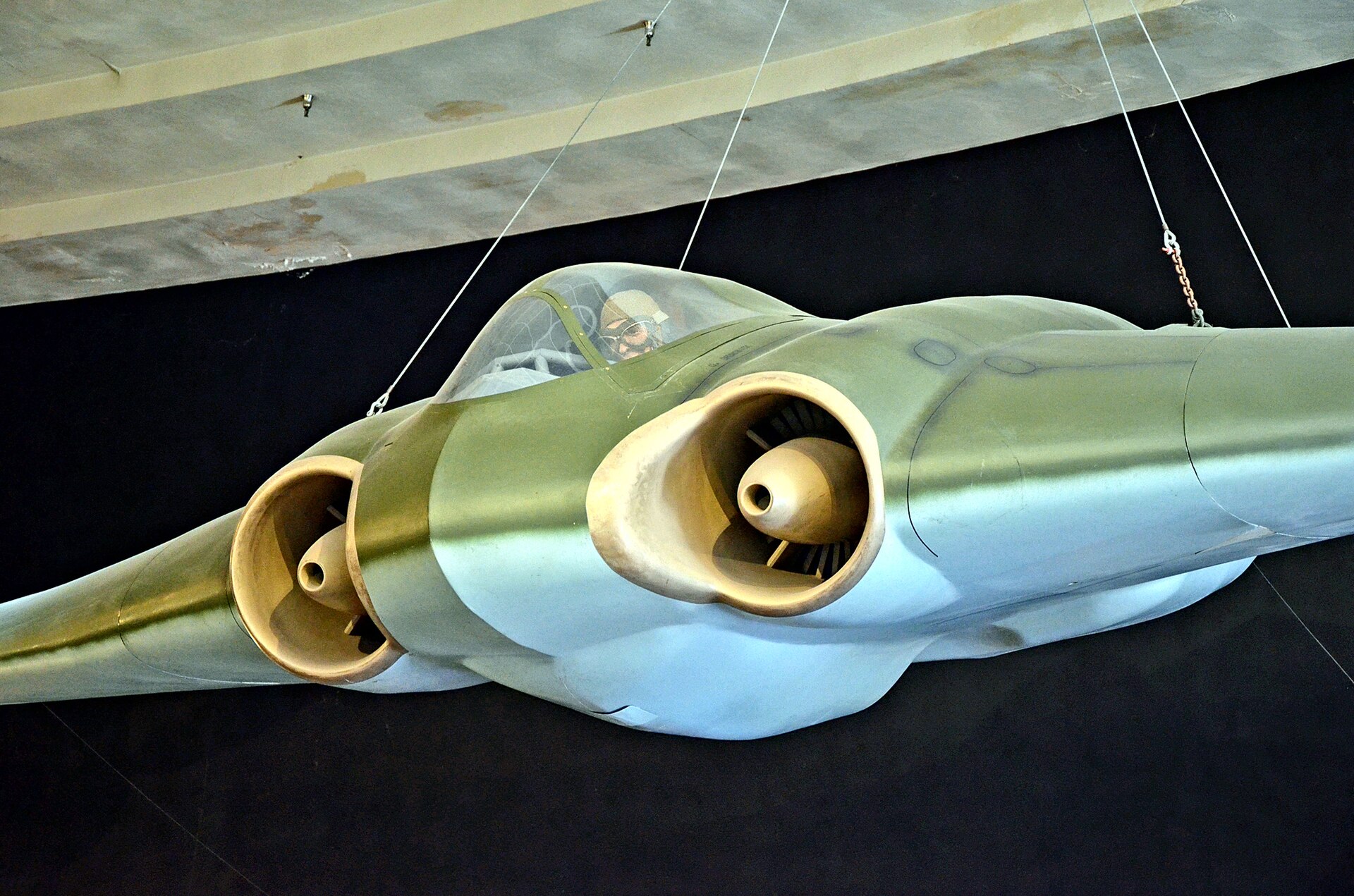
A documented photograph or archival reference connects the interactive model to a real airframe, operation, or preserved example.
Horton 229 V3 - Radar-testing Ho IX V3 reproduction at the San Diego Air and Space Museum (9668114493)2013-07-29 13:54 · Tomás Del Coro from Las Vegas, Nevada, USAWikimedia Commons · CC BY-SA 2.0 · Accessed 29 August 2026VIEW ORIGINAL FILE & RIGHTS RECORD ↗
04 · VOICES FROM THE RECORD
THE AIRFRAME, REMEMBERED.
A short, attributed line restores a human voice to the technical record. Period statements and later recollections are identified by the date label and accompanied by a source link.
“We wanted to eliminate everything that did not produce lift.”
Reimar HortenAircraft designer
Horten summarized the aerodynamic logic behind the brothers' tailless flying-wing experiments.
Focused facts connect the airframe's systems to the way it was built, flown, or used.
01
All-wing concept
The design placed crew, engines, fuel, and armament inside a flying wing with no conventional tail.
02
Mixed structure
A steel-tube center section supported wooden outer structure and skin.
03
Jet integration
Two buried turbojets promised fighter speed without external nacelles.
06 · HISTORICAL FIELD NOTE
WHY IT MATTERS.
This late-war flying-wing prototype paired jet propulsion with a low-drag tailless planform, anticipating configurations explored by later stealth aircraft. Only prototypes flew, so claims about its intended combat performance remain partly speculative, but the design remains an important example of aerodynamic experimentation under wartime pressure. [1]
Reference figures vary by variant, payload, configuration, altitude, test method, and source. Values here are an editorial orientation—not operational or flight-planning data.
Each numbered citation links to an operator, national museum, manufacturer, or established research institution. The scope note tells you exactly what that source supports, and each entry includes its retrieval date.
Where the represented model and source variant differ, the scope is labelled rather than silently treated as an exact match. Read the editorial policy, report a correction through the legal notice, or review 3D-model provenance in the attribution directory.