Performance and mechanical data are combined here for a faster, more compact read. Values describe the represented model or nearest clearly identified source variant.
Performance and mechanical specifications for Hughes H-4 Hercules
Primary role
Heavy transport prototype
Flight crew
Pilot, copilot, and engineer stations
Configuration
Eight-engine wooden flying boat
Powerplant
8 × Pratt & Whitney R-4360 radial engines
Top speed
250 mph
Ceiling
20,900 ft
Published range
3,000 mi
Length
218 ft 8 in
Wingspan
320 ft 11 in
Designed weight
≈400,000 lb
02 · SERVICE CHRONOLOGY
FROM ORIGIN TO LEGACY.
A dated sequence follows the airframe from development through operational use and later evolution. The number of milestones follows the story rather than a fixed template, and each note explains why the event mattered—not only what happened.
ORIGIN
The wartime transport concept began as a response to shipping losses and restrictions on strategic metals. [1]
DEVELOPMENT
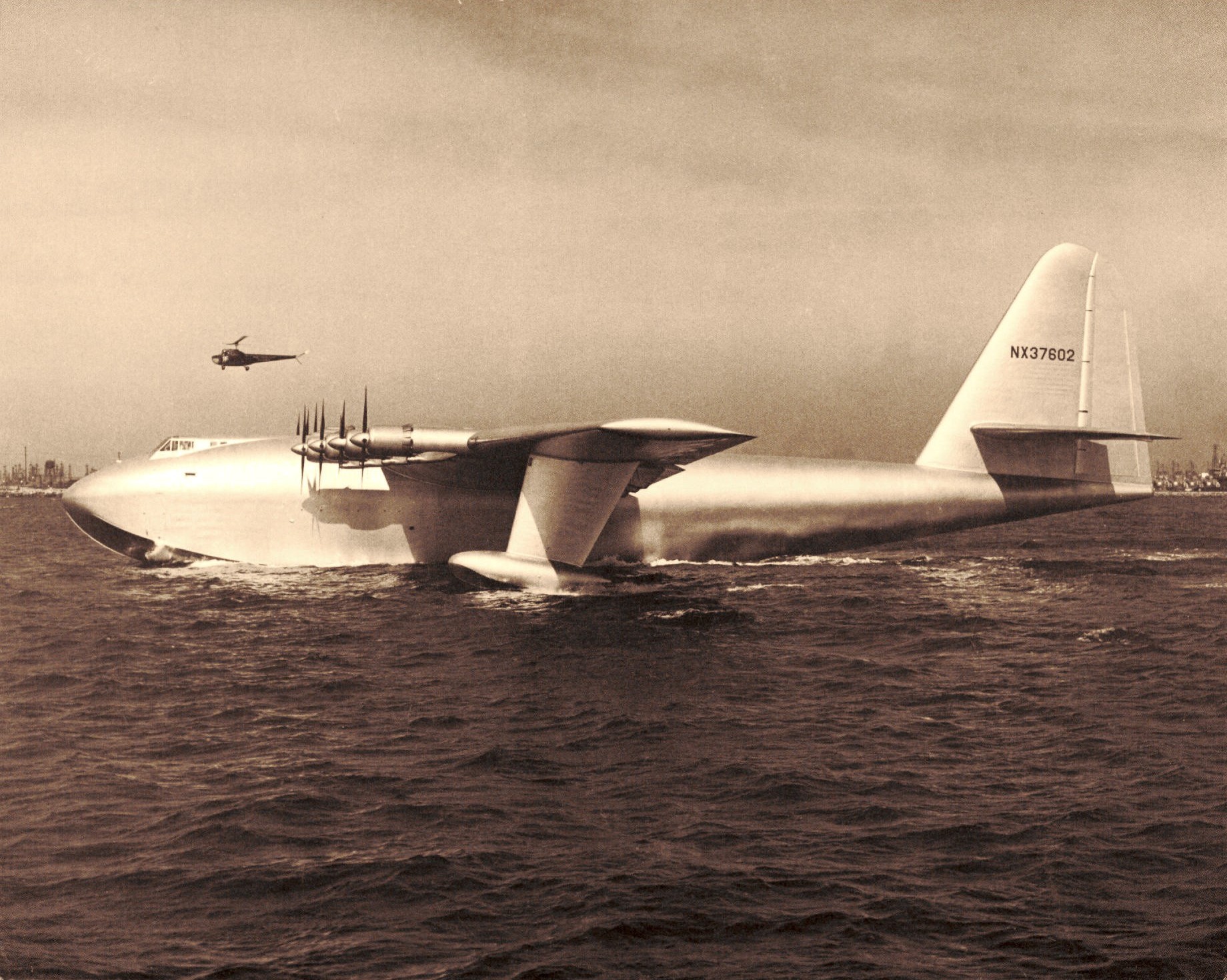
Howard Hughes lifted the H-4 briefly from Long Beach Harbor; the sole aircraft never flew again. [1]
SERVICE HISTORY
Hughes preserved the aircraft in climate-controlled storage with a dedicated crew for nearly three decades. That unusual afterlife helped turn a cancelled wartime prototype into a major museum artifact. [1]
CONTEXT & LEGACY
The H-4 went on public display at the Evergreen Aviation Museum site in Oregon, beginning the preserved aircraft's present museum chapter. [1]
03 · ARCHIVAL IMAGE
THE AIRFRAME IN CONTEXT.
A documented photograph or archival reference connects the interactive model to a real airframe, operation, or preserved example.
A short, attributed line restores a human voice to the technical record. Period statements and later recollections are identified by the date label and accompanied by a source link.
“I put the sweat of my life into this thing.”
Howard HughesH-4 project leader and pilot
Hughes defended the vast prototype before a Senate committee shortly before its only flight.
Focused facts connect the airframe's systems to the way it was built, flown, or used.
01
Material reality
The aircraft used laminated birch and resin, making “Spruce Goose” an inaccurate nickname.
02
Wartime purpose
It was conceived to move troops and cargo across the Atlantic beyond the reach of submarines.
03
Eight engines
Eight radial engines were distributed across the immense high wing.
06 · HISTORICAL FIELD NOTE
WHY IT MATTERS.
The immense H-4 Hercules was conceived during World War II to move troops and cargo without exposing ships to submarine attack. Built largely from laminated wood because strategic aluminium was restricted, it flew only once in 1947, but its scale made it an enduring demonstration of ambitious wartime engineering. [1]
Reference figures vary by variant, payload, configuration, altitude, test method, and source. Values here are an editorial orientation—not operational or flight-planning data.
Each numbered citation links to an operator, national museum, manufacturer, or established research institution. The scope note tells you exactly what that source supports, and each entry includes its retrieval date.
Where the represented model and source variant differ, the scope is labelled rather than silently treated as an exact match. Read the editorial policy, report a correction through the legal notice, or review 3D-model provenance in the attribution directory.