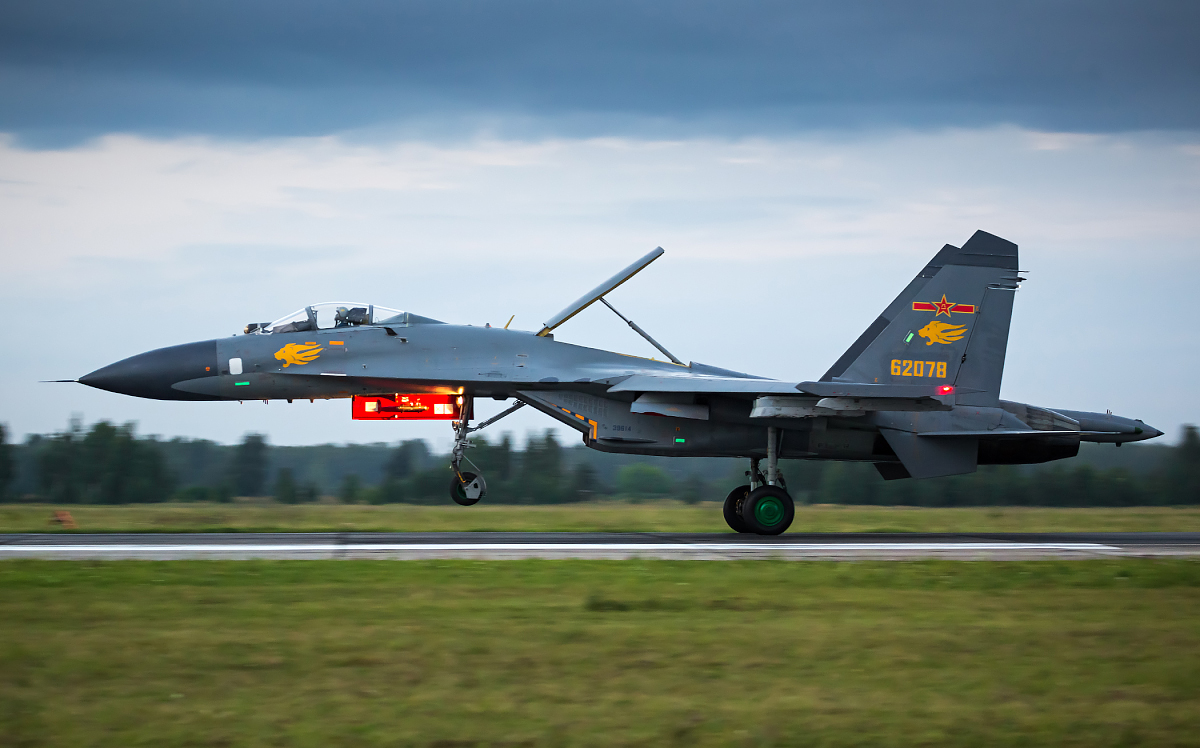
Performance and mechanical data are combined here for a faster, more compact read. Values describe the represented model or nearest clearly identified source variant.
Performance and mechanical specifications for J-11B
Primary role
Air superiority
Crew
1 pilot
Configuration
Twin-engine Flanker-derived fighter
Powerplant
2 × WS-10-series turbofans
Top speed
Mach 2.35
Ceiling
62,300 ft
Published range
2,070 mi
Length
≈72 ft
Wingspan
≈48 ft
Max weight
≈73,000 lb
02 · SERVICE CHRONOLOGY
FROM ORIGIN TO LEGACY.
A dated sequence follows the airframe from development through operational use and later evolution. The number of milestones follows the story rather than a fixed template, and each note explains why the event mattered—not only what happened.
ORIGIN
Chinese assembly of the Su-27SK established the production base from which the J-11 family developed. [1]
DEVELOPMENT
The J-11B introduced greater domestic content, including Chinese avionics, weapons integration, and eventually indigenous engines. [1]
SERVICE HISTORY
The J-11B marked a transition from licensed assembly toward a Chinese-managed weapons and avionics architecture. Subsequent subtypes show the airframe serving as a bridge between imported foundations and domestic fighter development. [1]
CONTEXT & LEGACY
Operational units fielded successive J-11B batches while changes to engines, sensors, and weapons documented the gradual maturation of a domestically supported Flanker-derived fleet. [1]
03 · ARCHIVAL IMAGE
THE AIRFRAME IN CONTEXT.
A documented photograph or archival reference connects the interactive model to a real airframe, operation, or preserved example.
A short, rights-screened motion record adds sound, movement, and operational scale without autoplaying or delaying the interactive model.
J-11 intercept over the South China Sea00:30
Official encounter footage of a People's Liberation Army Navy J-11. The source does not establish that the aircraft is the catalogue's J-11B sub-variant.
VARIANT NOTE Related-family footage is identified here and is not presented as the exact modeled variant.
REUSE NOTE Embedded without modification. Commercial editorial reuse remains subject to the source record, non-endorsement, trademark, privacy/publicity, and third-party-rights limitations.
The appearance of U.S. Department of War (DoW) visual information does not imply or constitute DoW endorsement.
A short, attributed line restores a human voice to the technical record. Period statements and later recollections are identified by the date label and accompanied by a source link.
“The J-11B represents a major step in China's indigenous fighter development.”
Andreas RupprechtChinese military aviation historian
Rupprecht's assessment places the J-11B between licensed Su-27 production and a more domestic combat-aircraft industry.
Focused facts connect the airframe's systems to the way it was built, flown, or used.
01
Design lineage
The J-11 family traces its broad aerodynamic layout to China's licensed production of the Su-27SK.
02
Domestic shift
The J-11B introduced a greater share of Chinese-made avionics, sensors, materials, and weapons integration.
03
Engine transition
Production and service experience included a gradual move toward domestically produced WS-10 engines.
07 · HISTORICAL FIELD NOTE
WHY IT MATTERS.
China’s domestically developed J-11B evolved the Flanker airframe with indigenous avionics, weapons integration, and composite structures. The result illustrates how a nation can adapt a foreign-derived aerodynamic platform into a locally supported weapons system with its own sensors, cockpit, engines, and operational requirements. [1]
Reference figures vary by variant, payload, configuration, altitude, test method, and source. Values here are an editorial orientation—not operational or flight-planning data.
Each numbered citation links to an operator, national museum, manufacturer, or established research institution. The scope note tells you exactly what that source supports, and each entry includes its retrieval date.
Where the represented model and source variant differ, the scope is labelled rather than silently treated as an exact match. Read the editorial policy, report a correction through the legal notice, or review 3D-model provenance in the attribution directory.