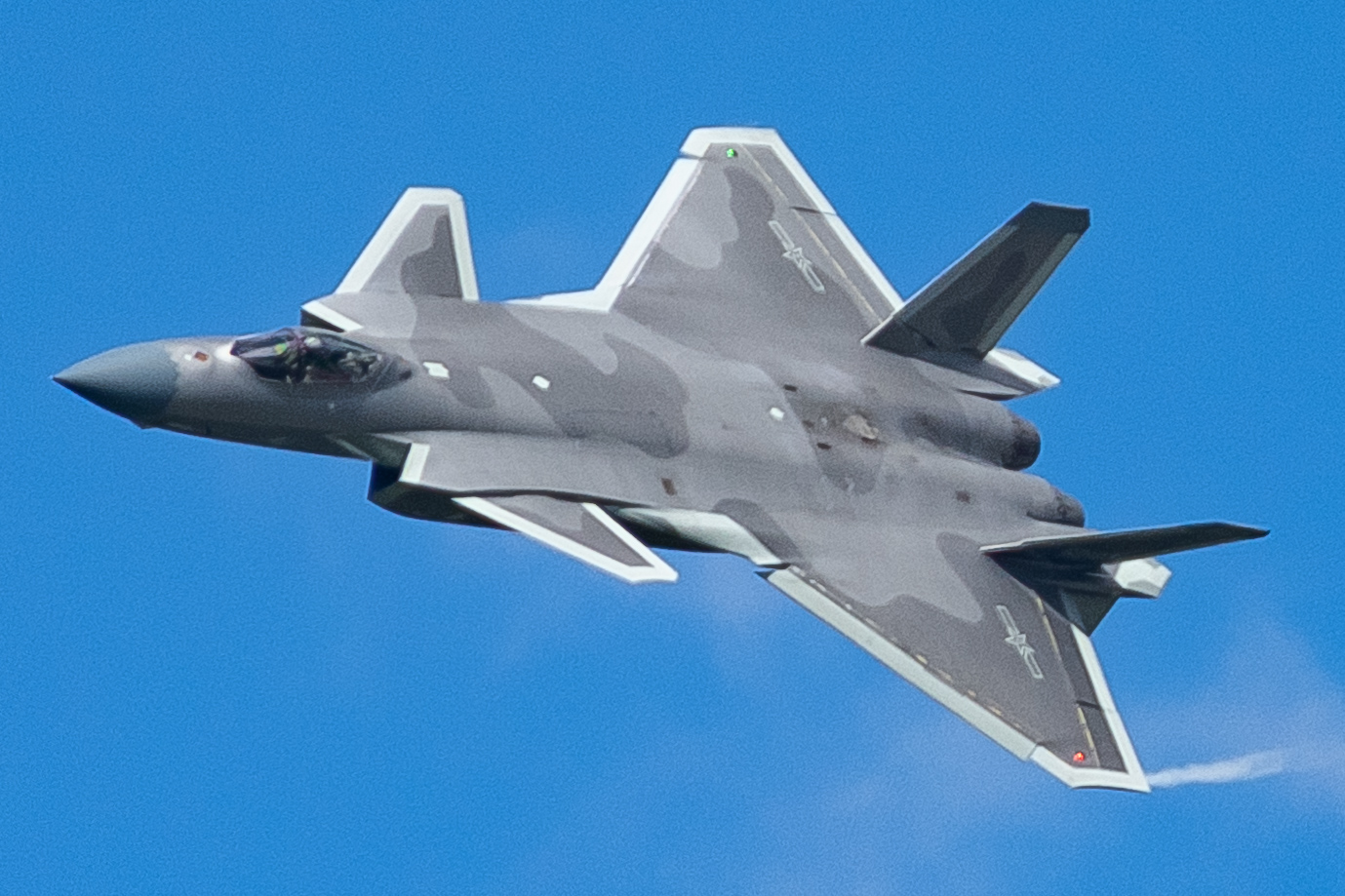
Performance and mechanical data are combined here for a faster, more compact read. Values describe the represented model or nearest clearly identified source variant.
Performance and mechanical specifications for J-20 Mighty Dragon
Primary role
Stealth air-superiority fighter
Crew
1; two-seat variant exists
Configuration
Canard-delta low-observable fighter
Powerplant
2 × afterburning turbofans
Top speed
Mach 2 class
Ceiling
66,000 ft
Published range
Classified
Length
≈69 ft
Wingspan
≈43 ft
Max weight
Open-source estimate ≈82,000 lb
02 · SERVICE CHRONOLOGY
FROM ORIGIN TO LEGACY.
A dated sequence follows the airframe from development through operational use and later evolution. The number of milestones follows the story rather than a fixed template, and each note explains why the event mattered—not only what happened.
ORIGIN
The first publicized prototype flight marked China's entry into full-scale low-observable fighter development. [1]
DEVELOPMENT
Operational service, indigenous-engine integration, and a two-seat version show an airframe family still expanding. [1]
SERVICE HISTORY
China announced that the J-20 had entered military service, moving the program from flight test and public demonstration into operational fielding. [1]
CONTEXT & LEGACY
Regular unit service, revised prototypes, and a two-seat derivative indicate continuing evolution rather than a fixed endpoint. External observers must separate visible configuration changes from unverified capability claims. [1]
03 · ARCHIVAL IMAGE
THE AIRFRAME IN CONTEXT.
A documented photograph or archival reference connects the interactive model to a real airframe, operation, or preserved example.
A short, attributed line restores a human voice to the technical record. Period statements and later recollections are identified by the date label and accompanied by a source link.
“The J-20 is not simply an aircraft; it is part of a combat system.”
Yang WeiJ-20 chief designer
Yang framed the fighter around sensors, networks, and cooperating platforms rather than isolated maneuver performance.
Focused facts connect the airframe's systems to the way it was built, flown, or used.
01
Canard-delta form
Foreplanes, a delta wing, and canted tails manage lift and control around a long internal volume.
02
Internal carriage
A large central bay and smaller side bays keep weapons within the low-observable outer shape.
03
Long-range emphasis
The airframe's size supports fuel, sensors, and weapons for operations at extended distance.
06 · HISTORICAL FIELD NOTE
WHY IT MATTERS.
China’s first operational stealth fighter uses a large internal-weapons airframe, advanced sensors, and long range for contested air operations. Its canards, broad fuselage, and emphasis on reach suggest a design shaped not only for fighter combat but also for threatening support aircraft and influencing operations far from its bases. [1]
Reference figures vary by variant, payload, configuration, altitude, test method, and source. Values here are an editorial orientation—not operational or flight-planning data.
Each numbered citation links to an operator, national museum, manufacturer, or established research institution. The scope note tells you exactly what that source supports, and each entry includes its retrieval date.
Where the represented model and source variant differ, the scope is labelled rather than silently treated as an exact match. Read the editorial policy, report a correction through the legal notice, or review 3D-model provenance in the attribution directory.