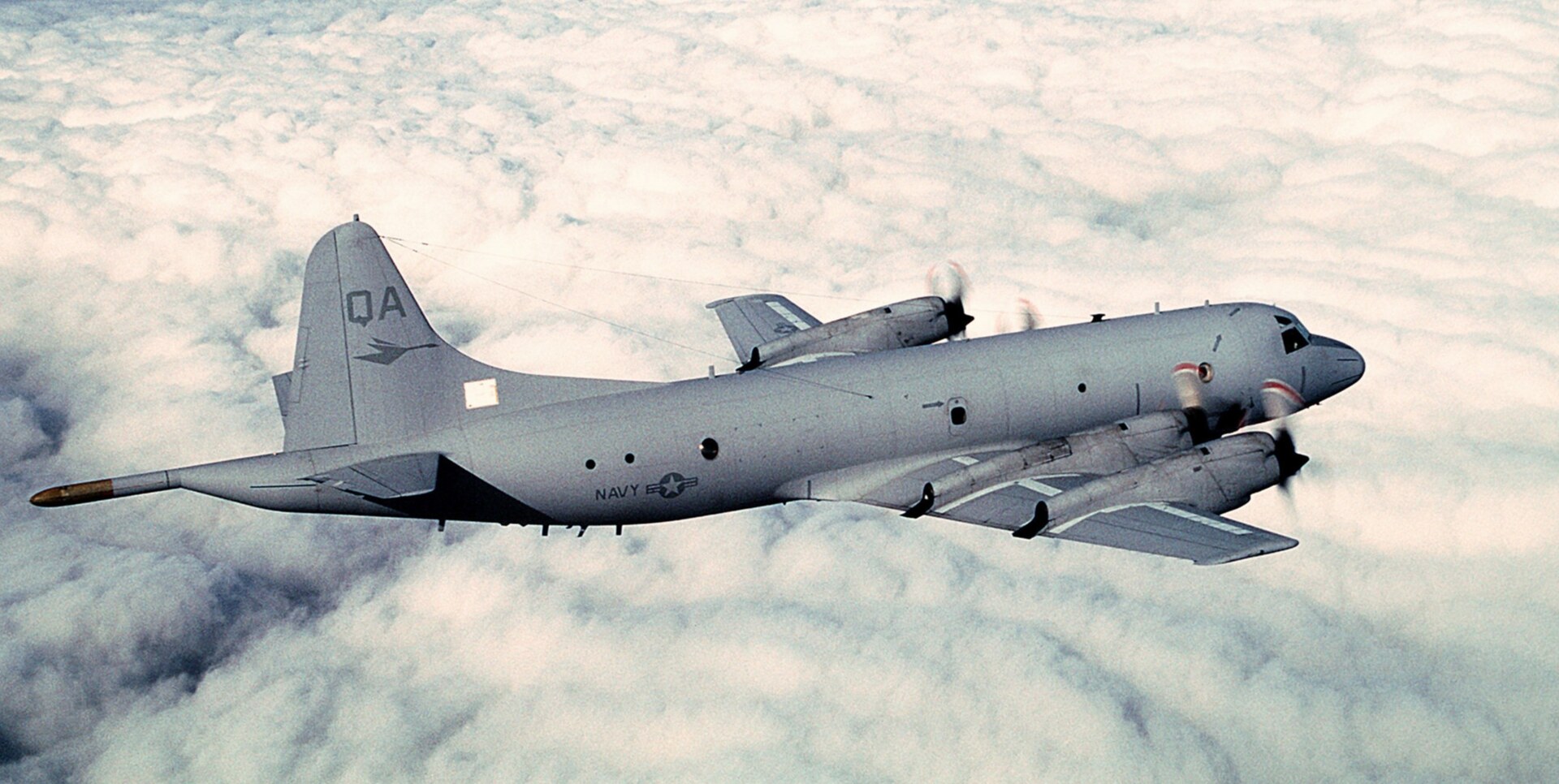
Performance and mechanical data are combined here for a faster, more compact read. Values describe the represented model or nearest clearly identified source variant.
Performance and mechanical specifications for Lockheed P-3 Orion
Primary role
Maritime patrol aircraft
Crew
11 typical
Configuration
Land-based maritime patrol aircraft
Powerplant
4 × Allison T56-A-14 turboprops
Top speed
473 mph
Ceiling
28,300 ft
Published range
5,570 mi
Length
116 ft 10 in
Wingspan / rotor
99 ft 8 in
Weight
≈139,760 lb maximum
02 · SERVICE CHRONOLOGY
FROM ORIGIN TO LEGACY.
A dated sequence follows the airframe from development through operational use and later evolution. The number of milestones follows the story rather than a fixed template, and each note explains why the event mattered—not only what happened.
ORIGIN
Lockheed proposed adapting the L-188 Electra for maritime patrol. [1]
DEVELOPMENT
Sensor and acoustic upgrades kept it central to antisubmarine warfare. [1]
A short, rights-screened motion record adds sound, movement, and operational scale without autoplaying or delaying the interactive model.
P-3C Orion flightshort feature
Official flight footage of the P-3C Orion represented by this record.
REUSE NOTE Embedded without modification. Commercial editorial reuse remains subject to the source record, non-endorsement, trademark, privacy/publicity, and third-party-rights limitations.
The appearance of U.S. Department of War (DoW) visual information does not imply or constitute DoW endorsement.
Focused facts connect the airframe's systems to the way it was built, flown, or used.
01
Airliner ancestry
The Orion adapted the Electra wing and turboprops around a dedicated mission cabin.
02
Tail detector
The long boom isolates its magnetic detector from aircraft interference.
03
Endurance method
Crews may shut down one engine during patrol when conditions permit.
04
Upgrade space
Cabin volume and electrical capacity supported decades of new sensors.
06 · HISTORICAL FIELD NOTE
WHY IT MATTERS.
Derived from the Electra airliner, the P-3 became a long-endurance maritime patrol platform built around sensors, sonobuoys, weapons, and crew workstations. Its ability to loiter low over the ocean made it a central Cold War submarine hunter and an adaptable surveillance aircraft. [1]
Reference figures vary by variant, payload, configuration, altitude, test method, and source. Values here are an editorial orientation—not operational or flight-planning data.
Each numbered citation links to an operator, national museum, manufacturer, or established research institution. The scope note tells you exactly what that source supports, and each entry includes its retrieval date.
Where the represented model and source variant differ, the scope is labelled rather than silently treated as an exact match. Read the editorial policy, report a correction through the legal notice, or review 3D-model provenance in the attribution directory.