Performance and mechanical data are combined here for a faster, more compact read. Values describe the represented model or nearest clearly identified source variant.
Performance and mechanical specifications for LZ 129 Hindenburg
Primary role
Passenger airship
Crew
About 40–60
Configuration
Rigid passenger airship
Powerplant
4 × Daimler-Benz diesel engines
Top speed
84 mph
Ceiling
650 ft
Published range
10,000 mi
Length
804 ft
Max diameter
135 ft
Gas volume
≈7 million cu ft
02 · SERVICE CHRONOLOGY
FROM ORIGIN TO LEGACY.
A dated sequence follows the airframe from development through operational use and later evolution. The number of milestones follows the story rather than a fixed template, and each note explains why the event mattered—not only what happened.
ORIGIN
Hindenburg completed a busy first season of scheduled transatlantic passenger service between Europe and the Americas. [1]
DEVELOPMENT
Hindenburg's crossings depended on ground crews, weather forecasting, mooring infrastructure, and a politically charged public image. The Lakehurst fire ended not just an aircraft but confidence in its passenger system. [1]
SERVICE HISTORY
Hindenburg opened scheduled transatlantic passenger service and completed multiple crossings, demonstrating the speed and reach of the airship system before the following year's disaster. [1]
CONTEXT & LEGACY
Its destruction while landing at Lakehurst killed 36 people and sharply accelerated the end of large passenger-airship travel. [1]
03 · ARCHIVAL IMAGE
THE AIRFRAME IN CONTEXT.
A documented photograph or archival reference connects the interactive model to a real airframe, operation, or preserved example.
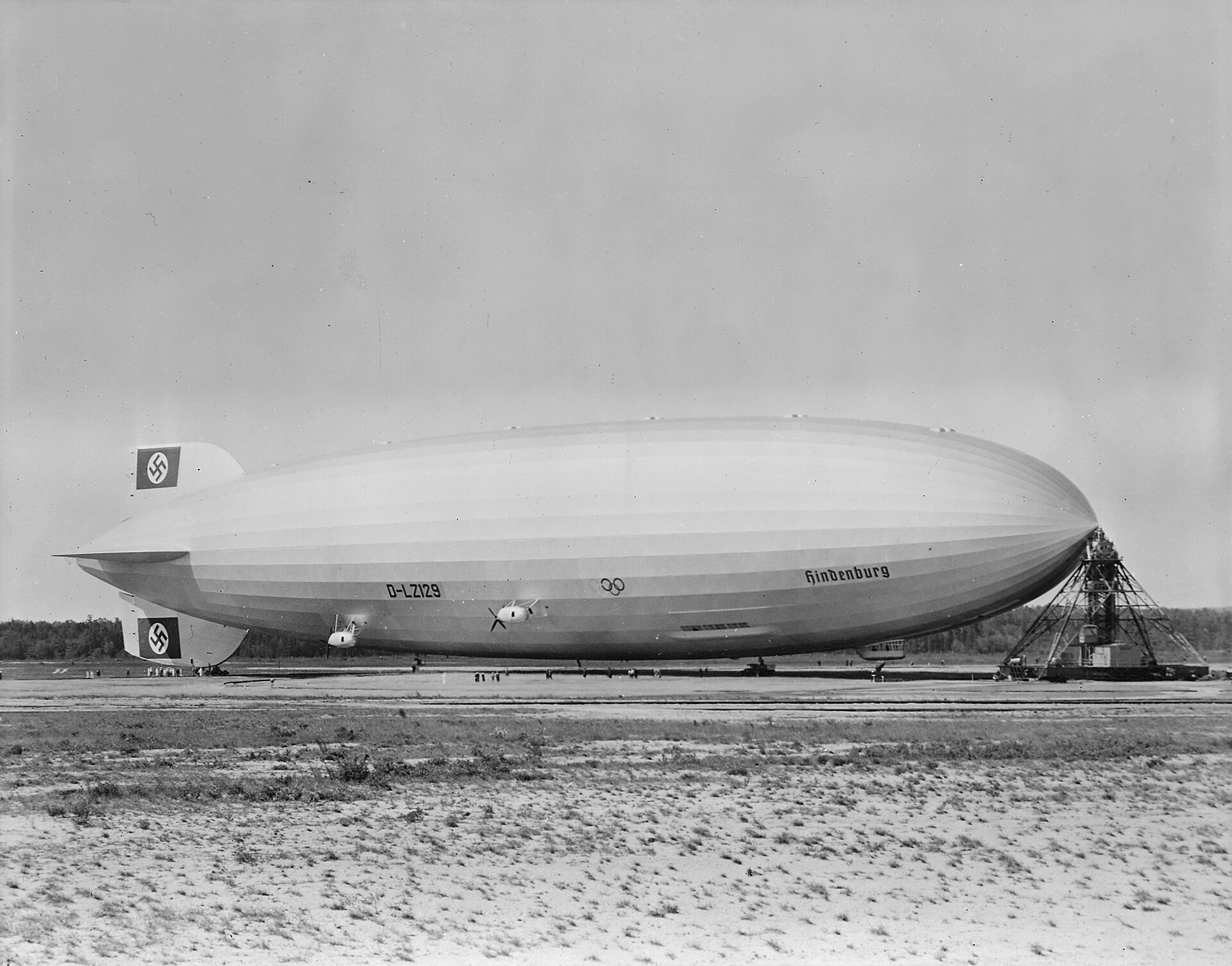
Hindenburg at lakehurst1937-01-25 · U.S. Department of the Navy. Bureau of Aeronautics. Naval Aircraft Factory, Philadelphia, Pennsylvania (USA).Wikimedia Commons · Public domain · Accessed 29 August 2026VIEW ORIGINAL FILE & RIGHTS RECORD ↗
04 · ARCHIVAL FOOTAGE
THE AIRFRAME IN MOTION.
A short, rights-screened motion record adds sound, movement, and operational scale without autoplaying or delaying the interactive model.
Hindenburg at Lakehurst05:27
Period newsreel footage includes the airship over New York and the Lakehurst disaster. Playback is manual and the sequence may be distressing.
REUSE NOTE Embedded without modification. The linked source-file page records the public-domain basis and any remaining rights notes.
A short, attributed line restores a human voice to the technical record. Period statements and later recollections are identified by the date label and accompanied by a source link.
“Oh, the humanity and all the passengers!”
Herbert MorrisonRadio reporter
Morrison's live description of the Lakehurst fire became inseparable from the public memory of Hindenburg.
Focused facts connect the airframe's systems to the way it was built, flown, or used.
01
Lifting gas
Hindenburg used hydrogen after political and export restrictions prevented access to sufficient U.S. helium.
02
Internal accommodation
Passenger rooms and public spaces were built inside the lower portion of the vast envelope, not in a separate gondola.
03
Diesel propulsion
Four reversible diesel engines drove external propellers from streamlined power cars.
07 · HISTORICAL FIELD NOTE
WHY IT MATTERS.
The largest class of rigid airship ever flown carried passengers across the Atlantic before the 1937 Lakehurst disaster ended its service. Its spacious interior and long-range comfort represented a competing vision of air travel, but dependence on lifting gas, enormous ground infrastructure, and weather sensitivity exposed the limits of the rigid airship era. [1]
Reference figures vary by variant, payload, configuration, altitude, test method, and source. Values here are an editorial orientation—not operational or flight-planning data.
Each numbered citation links to an operator, national museum, manufacturer, or established research institution. The scope note tells you exactly what that source supports, and each entry includes its retrieval date.
Where the represented model and source variant differ, the scope is labelled rather than silently treated as an exact match. Read the editorial policy, report a correction through the legal notice, or review 3D-model provenance in the attribution directory.