Performance and mechanical data are combined here for a faster, more compact read. Values describe the represented model or nearest clearly identified source variant.
Performance and mechanical specifications for Me 262 Schwalbe
Primary role
Interceptor
Crew
1 pilot
Configuration
Twin-engine swept-wing jet
Powerplant
2 × Junkers Jumo 004B turbojets
Top speed
540 mph
Ceiling
37,565 ft
Published range
652 mi
Length
34 ft 9 in
Wingspan
40 ft 11 in
Max weight
≈15,700 lb
02 · SERVICE CHRONOLOGY
FROM ORIGIN TO LEGACY.
A dated sequence follows the airframe from development through operational use and later evolution. The number of milestones follows the story rather than a fixed template, and each note explains why the event mattered—not only what happened.
ORIGIN
The prototype completed its first flight using jet power alone after earlier mixed-power testing. [1]
DEVELOPMENT
The Me 262 entered combat in small numbers while fuel shortages, engine life, training limits, and attacks on its bases constrained operations. Its speed was revolutionary, but the surrounding wartime system could not exploit it consistently. [1]
SERVICE HISTORY
Captured aircraft and engines gave Allied engineers direct access to an operational first-generation jet system. [1]
CONTEXT & LEGACY
Allied teams recovered aircraft, engines, drawings, and personnel at the end of the war, giving postwar engineers direct evidence from the first jet fighter used operationally. [1]
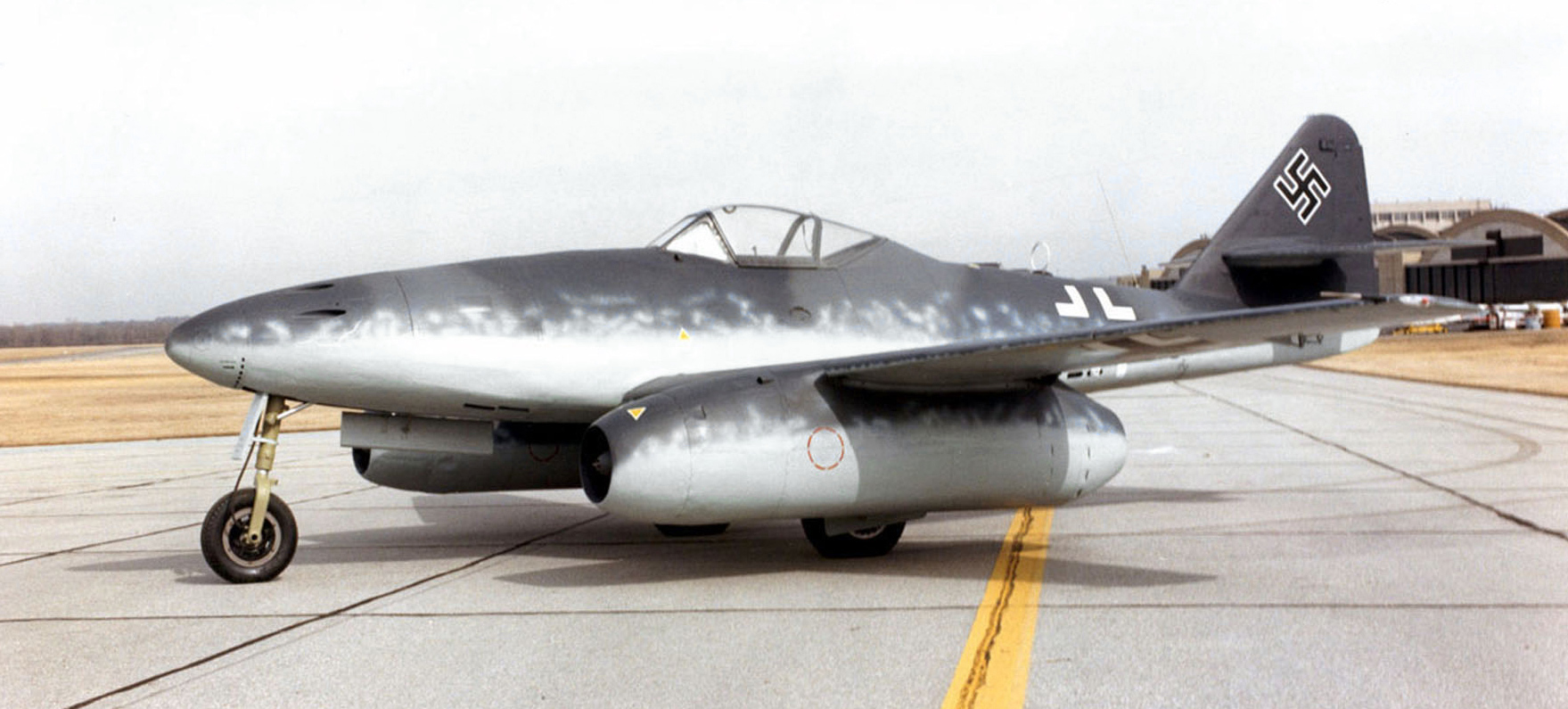
03 · ARCHIVAL IMAGE
THE AIRFRAME IN CONTEXT.
A documented photograph or archival reference connects the interactive model to a real airframe, operation, or preserved example.
Messerschmitt Me 262A at the National Museum of the USAF (cropped)29 September 2007 (original upload date) · USAF museumWikimedia Commons · Public domain · Accessed 29 August 2026VIEW ORIGINAL FILE & RIGHTS RECORD ↗
04 · ARCHIVAL FOOTAGE
THE AIRFRAME IN MOTION.
A short, rights-screened motion record adds sound, movement, and operational scale without autoplaying or delaying the interactive model.
Me 262 documentary footagearchival film
Period technical-documentary footage of the Me 262.
REUSE NOTE Embedded without modification. The linked source-file page records the public-domain basis and any remaining rights notes.
A short, attributed line restores a human voice to the technical record. Period statements and later recollections are identified by the date label and accompanied by a source link.
“It felt as though angels were pushing.”
Adolf GallandLuftwaffe fighter commander
Galland described his first flight in the jet-powered Me 262 prototype.
Focused facts connect the airframe's systems to the way it was built, flown, or used.
01
Engine reality
Its Jumo 004 engines used scarce materials and demanded careful throttle handling and frequent replacement.
02
Ground stance
Production aircraft used tricycle landing gear after early prototypes had flown with a tailwheel arrangement.
03
Mission split
The family served as fighter, reconnaissance platform, night fighter, and fast bomber.
07 · HISTORICAL FIELD NOTE
WHY IT MATTERS.
The world’s first operational jet-powered fighter brought unprecedented speed to combat, but arrived too late and in too few numbers to alter the war. Allied pilots learned to attack it during takeoff and landing, when its early jet engines and slow acceleration left this otherwise revolutionary aircraft most vulnerable. [1]
Reference figures vary by variant, payload, configuration, altitude, test method, and source. Values here are an editorial orientation—not operational or flight-planning data.
Each numbered citation links to an operator, national museum, manufacturer, or established research institution. The scope note tells you exactly what that source supports, and each entry includes its retrieval date.
Where the represented model and source variant differ, the scope is labelled rather than silently treated as an exact match. Read the editorial policy, report a correction through the legal notice, or review 3D-model provenance in the attribution directory.