Performance and mechanical data are combined here for a faster, more compact read. Values describe the represented model or nearest clearly identified source variant.
Performance and mechanical specifications for MiG-15
Primary role
Jet fighter / interceptor
Crew
1 pilot
Configuration
Swept-wing jet interceptor
Powerplant
1 × Klimov VK-1 turbojet
Top speed
668 mph
Ceiling
50,850 ft
Published range
750 mi
Length
33 ft 1 in
Wingspan / rotor
33 ft 1 in
Weight
≈10,850 lb loaded
02 · SERVICE CHRONOLOGY
FROM ORIGIN TO LEGACY.
A dated sequence follows the airframe from development through operational use and later evolution. The number of milestones follows the story rather than a fixed template, and each note explains why the event mattered—not only what happened.
ORIGIN
The I-310 prototype first flew with a swept wing and Nene-derived engine. [1]
DEVELOPMENT
The MiG-15 entered Soviet service as a heavily armed interceptor. [1]
SERVICE HISTORY
Its Korean debut forced an urgent Western reassessment of jet performance. [1]
SERVICE HISTORY
Licensed and derivative production spread across allied air forces. [1]
CONTEXT & LEGACY
Two-seat UTI trainers outlasted many combat variants. [1]
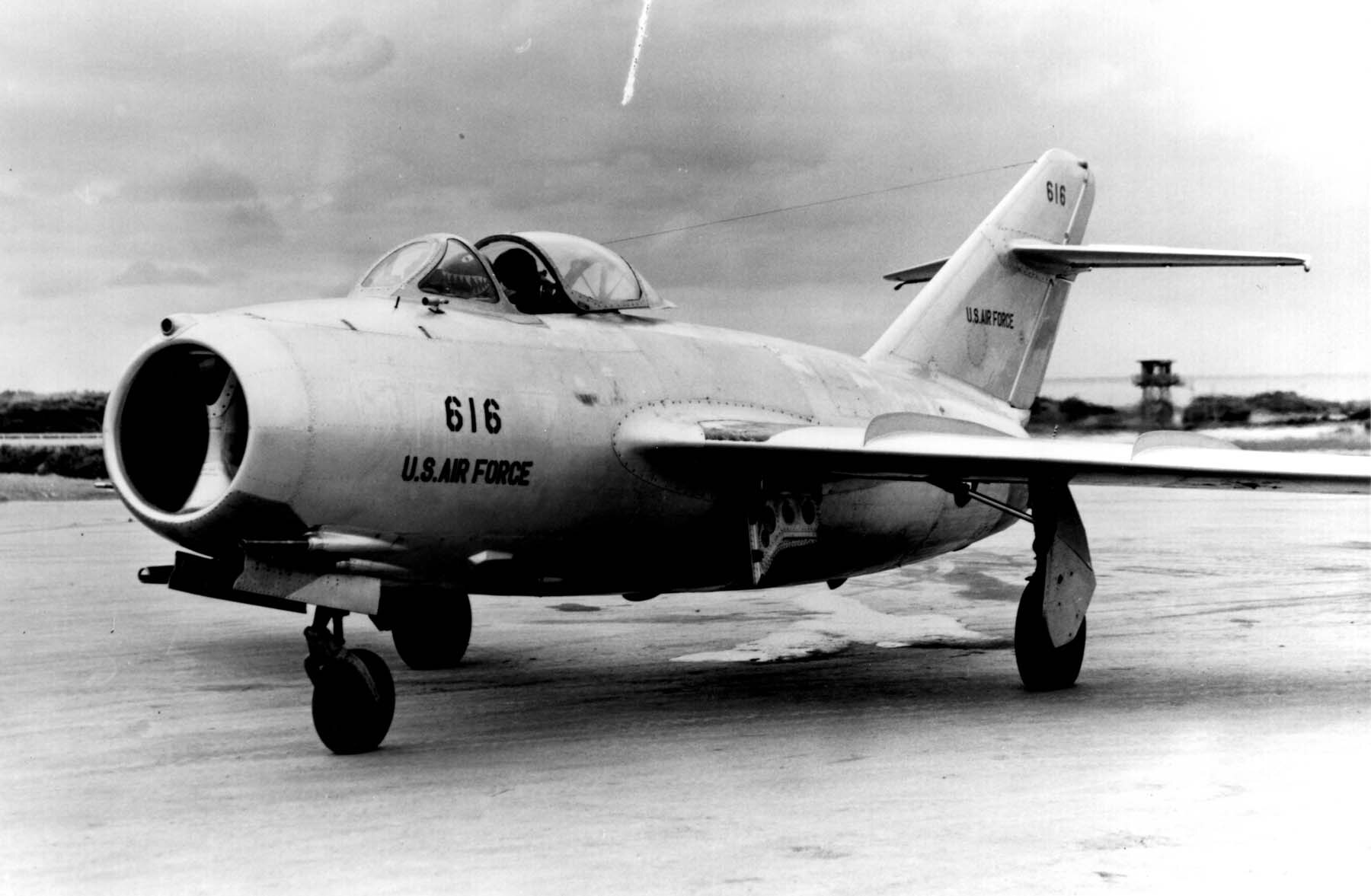
03 · ARCHIVAL IMAGE
THE AIRFRAME IN CONTEXT.
A documented photograph or archival reference connects the interactive model to a real airframe, operation, or preserved example.
Focused facts connect the airframe's systems to the way it was built, flown, or used.
01
Swept-wing leap
Its 35-degree sweep delayed compressibility effects at high speed.
02
Heavy battery
One 37 mm and two 23 mm cannon were selected to damage large bombers.
03
Engine lineage
The VK-1 descended from the British Rolls-Royce Nene.
04
Training afterlife
The two-seat UTI introduced generations of pilots to jet flight.
05 · HISTORICAL FIELD NOTE
WHY IT MATTERS.
The compact MiG-15 combined swept wings, a powerful centrifugal-flow turbojet, and heavy cannon armament. Its appearance over Korea forced a rapid reassessment of Western jet performance and helped make high-altitude, transonic combat the defining problem of early-jet fighter design. [1]
Reference figures vary by variant, payload, configuration, altitude, test method, and source. Values here are an editorial orientation—not operational or flight-planning data.
Each numbered citation links to an operator, national museum, manufacturer, or established research institution. The scope note tells you exactly what that source supports, and each entry includes its retrieval date.
Where the represented model and source variant differ, the scope is labelled rather than silently treated as an exact match. Read the editorial policy, report a correction through the legal notice, or review 3D-model provenance in the attribution directory.