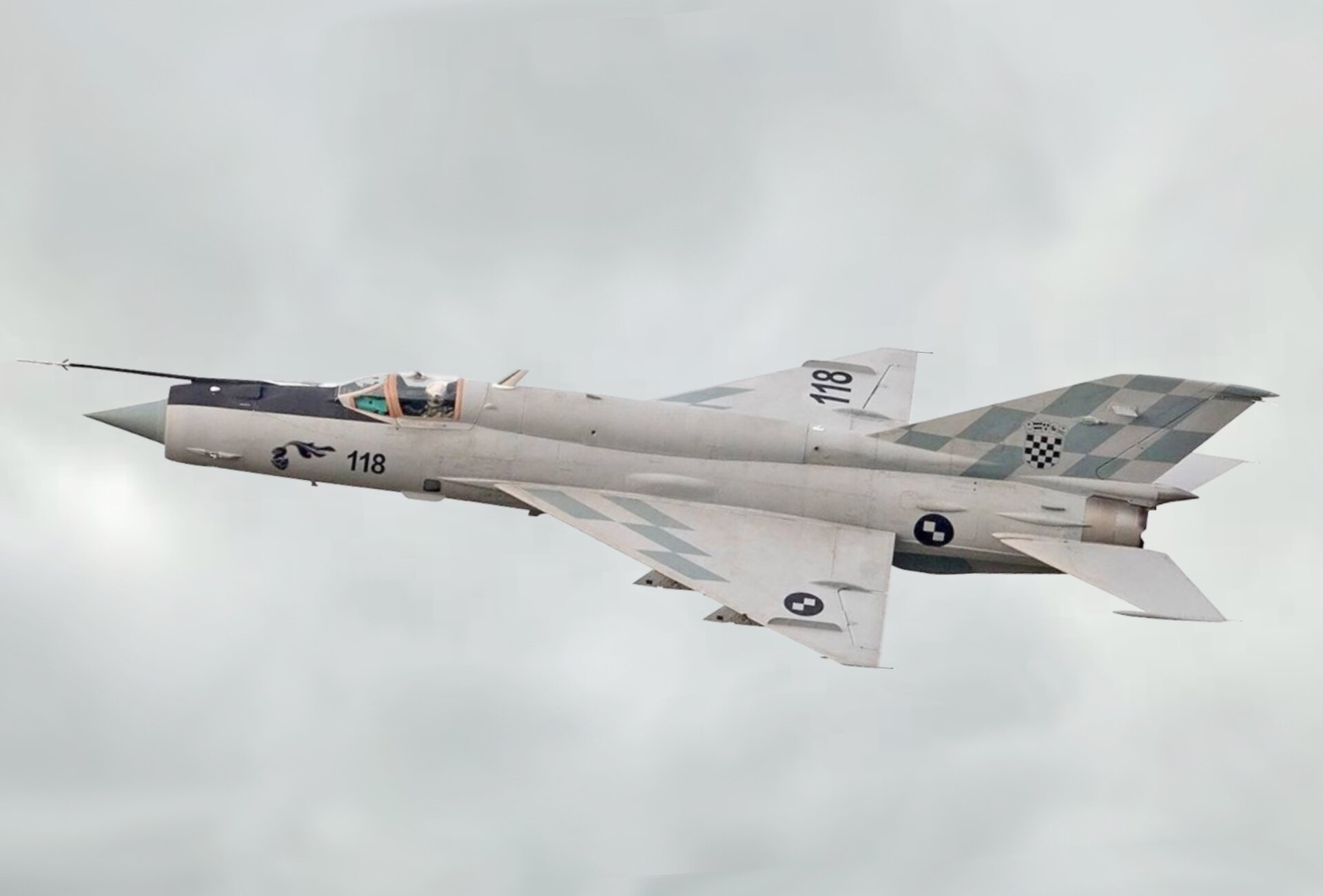
Performance and mechanical data are combined here for a faster, more compact read. Values describe the represented model or nearest clearly identified source variant.
Performance and mechanical specifications for MiG-21 Fishbed
Primary role
Interceptor
Crew
1 pilot
Configuration
Tailless delta with nose intake
Powerplant
1 × Tumansky turbojet
Top speed
Mach 2.05
Ceiling
57,400 ft
Published range
751 mi
Length
≈46 ft 3 in
Wingspan
≈23 ft 6 in
Max weight
≈21,600 lb
02 · SERVICE CHRONOLOGY
FROM ORIGIN TO LEGACY.
A dated sequence follows the airframe from development through operational use and later evolution. The number of milestones follows the story rather than a fixed template, and each note explains why the event mattered—not only what happened.
ORIGIN
The Ye-4 prototype began the delta-wing line that matured into the production MiG-21. [1]
DEVELOPMENT
Continuous production and local manufacture created dozens of variants, from short-range interceptors to upgraded multirole aircraft. Its longevity reflects affordability and a vast support base as much as aerodynamic performance. [1]
SERVICE HISTORY
Licence production and extensive exports made the family a standard fighter across much of the Warsaw Pact and developing world. [1]
CONTEXT & LEGACY
North Vietnamese MiG-21 units used ground-controlled interceptions and short, high-speed attacks against U.S. formations, showing how doctrine and control networks could offset limited onboard endurance. [1]
03 · ARCHIVAL IMAGE
THE AIRFRAME IN CONTEXT.
A documented photograph or archival reference connects the interactive model to a real airframe, operation, or preserved example.
A short, rights-screened motion record adds sound, movement, and operational scale without autoplaying or delaying the interactive model.
MiG-21 Lancer air exercise02:33
Cockpit and exterior footage of Romanian MiG-21 Lancers during Exercise Resilient Resolve; the archive record represents the broader MiG-21 family.
VARIANT NOTE Related-family footage is identified here and is not presented as the exact modeled variant.
REUSE NOTE Embedded without modification. Commercial editorial reuse remains subject to the source record, non-endorsement, trademark, privacy/publicity, and third-party-rights limitations.
The appearance of U.S. Department of War (DoW) visual information does not imply or constitute DoW endorsement.
A short, attributed line restores a human voice to the technical record. Period statements and later recollections are identified by the date label and accompanied by a source link.
“It's a completely manual aeroplane, with very simple systems.”
M. J. A. VinodIndian Air Force group captain and MiG-21 pilot
Vinod contrasted the MiG-21's direct systems with later, more automated fighters.
Focused facts connect the airframe's systems to the way it was built, flown, or used.
01
Intake solution
A movable shock cone in the nose managed airflow while also housing radar equipment.
02
Compact tradeoff
The small airframe delivered speed and climb performance at the cost of limited internal fuel and endurance.
03
Distributed production
Variants were manufactured in the Soviet Union, Czechoslovakia, India, and China.
07 · HISTORICAL FIELD NOTE
WHY IT MATTERS.
Small, fast, and produced in vast numbers, the MiG-21 served with air forces worldwide and became an enduring symbol of Cold War aviation. Its delta wing and nose intake favored speed and climb over endurance, leading many operators to adapt tactics around limited fuel, visibility, and weapons capacity. [1]
Reference figures vary by variant, payload, configuration, altitude, test method, and source. Values here are an editorial orientation—not operational or flight-planning data.
Each numbered citation links to an operator, national museum, manufacturer, or established research institution. The scope note tells you exactly what that source supports, and each entry includes its retrieval date.
Where the represented model and source variant differ, the scope is labelled rather than silently treated as an exact match. Read the editorial policy, report a correction through the legal notice, or review 3D-model provenance in the attribution directory.