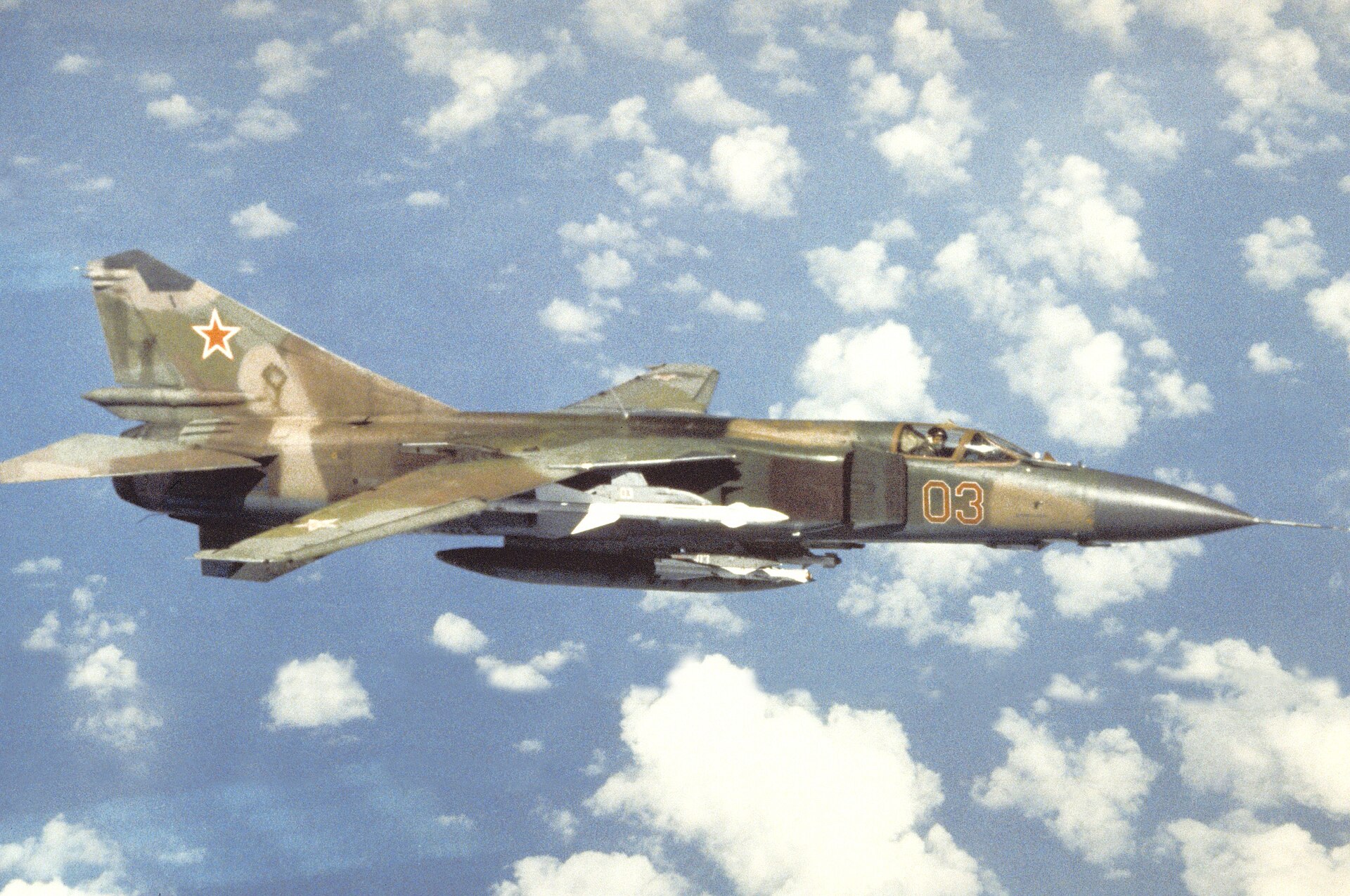
Performance and mechanical data are combined here for a faster, more compact read. Values describe the represented model or nearest clearly identified source variant.
Performance and mechanical specifications for MiG-23MLD Flogger
Primary role
Variable-sweep interceptor
Crew
1 pilot
Configuration
Single-engine variable-sweep interceptor
Powerplant
1 × Khachaturov R-35 turbojet
Top speed
Mach 2.35
Ceiling
60,000 ft
Published range
1,750 mi
Length
≈55 ft
Wing spread
≈46 ft
Max weight
≈39,700 lb
02 · SERVICE CHRONOLOGY
FROM ORIGIN TO LEGACY.
A dated sequence follows the airframe from development through operational use and later evolution. The number of milestones follows the story rather than a fixed template, and each note explains why the event mattered—not only what happened.
ORIGIN
The prototype flew as Soviet designers pursued shorter-field performance without sacrificing supersonic interception. [1]
DEVELOPMENT
Exports placed widely different MiG-23 variants into many air forces, often with different radars and weapons. Training, maintenance, and model identity strongly shaped the aircraft's uneven combat reputation. [1]
SERVICE HISTORY
The MLD upgrade reshaped aerodynamic details and improved avionics and countermeasures for the final major Soviet variant. [1]
CONTEXT & LEGACY
Syrian MiG-23s fought over Lebanon against Israeli aircraft, one of several conflicts in which variant, training, radar support, and tactical circumstances shaped sharply disputed results. [1]
03 · ARCHIVAL IMAGE
THE AIRFRAME IN CONTEXT.
A documented photograph or archival reference connects the interactive model to a real airframe, operation, or preserved example.
A short, rights-screened motion record adds sound, movement, and operational scale without autoplaying or delaying the interactive model.
MiG-23 dedication at Nellis06:09
A preserved MiG-23 is dedicated in recognition of Operation Constant Peg; the archive model represents the later MLD variant.
VARIANT NOTE Related-family footage is identified here and is not presented as the exact modeled variant.
REUSE NOTE Embedded without modification. Commercial editorial reuse remains subject to the source record, non-endorsement, trademark, privacy/publicity, and third-party-rights limitations.
The appearance of U.S. Department of War (DoW) visual information does not imply or constitute DoW endorsement.
A short, attributed line restores a human voice to the technical record. Period statements and later recollections are identified by the date label and accompanied by a source link.
“It accelerated very quickly, but it demanded respect in the landing pattern.”
Leon van MaurerU.S. Air Force evaluation pilot
The assessment separates the MiG-23's strong dash performance from the handling demands of its variable-sweep configuration.
Focused facts connect the airframe's systems to the way it was built, flown, or used.
01
Variable geometry
Three principal wing-sweep settings supported takeoff, maneuvering, and high-speed flight.
02
Clear radar nose
Side intakes freed the pointed nose for a substantially larger radar than the MiG-21 could carry.
03
Beyond visual range
The MiG-23 was designed to make radar-guided missile attacks before close combat.
07 · HISTORICAL FIELD NOTE
WHY IT MATTERS.
The MiG-23 introduced variable-sweep wings and beyond-visual-range missiles to Soviet frontline fighter units. The later MLD refinement improved handling, avionics, and countermeasures, addressing many limitations of earlier Flogger variants while preserving the design’s emphasis on acceleration and interception. [1]
Reference figures vary by variant, payload, configuration, altitude, test method, and source. Values here are an editorial orientation—not operational or flight-planning data.
Each numbered citation links to an operator, national museum, manufacturer, or established research institution. The scope note tells you exactly what that source supports, and each entry includes its retrieval date.
Where the represented model and source variant differ, the scope is labelled rather than silently treated as an exact match. Read the editorial policy, report a correction through the legal notice, or review 3D-model provenance in the attribution directory.