Performance and mechanical data are combined here for a faster, more compact read. Values describe the represented model or nearest clearly identified source variant.
Performance and mechanical specifications for MiG-29 (9-13)
Primary role
Air-superiority fighter
Crew
1 pilot
Configuration
Twin-engine high-agility tactical fighter
Powerplant
2 × Klimov RD-33 turbofans
Top speed
Mach 2.25
Ceiling
59,100 ft
Published range
890 mi
Length
56 ft 10 in
Wingspan
37 ft 3 in
Max weight
≈40,800 lb
02 · SERVICE CHRONOLOGY
FROM ORIGIN TO LEGACY.
A dated sequence follows the airframe from development through operational use and later evolution. The number of milestones follows the story rather than a fixed template, and each note explains why the event mattered—not only what happened.
ORIGIN
The first prototype flew as the Soviet answer to a new generation of Western lightweight fighters. [1]
DEVELOPMENT
The 9-13 version added a larger dorsal spine and internal equipment while exports spread the MiG-29 across many air forces. [1]
SERVICE HISTORY
Post-Cold War evaluations revealed exceptional short-range handling alongside limitations in early cockpit ergonomics, range, and support. Modern upgrades have focused heavily on avionics and weapons rather than basic shape. [1]
CONTEXT & LEGACY
The United States acquired 21 Moldovan MiG-29s, allowing direct examination of export variants while preventing their possible transfer to another state. [1]
03 · ARCHIVAL IMAGE
THE AIRFRAME IN CONTEXT.
A documented photograph or archival reference connects the interactive model to a real airframe, operation, or preserved example.
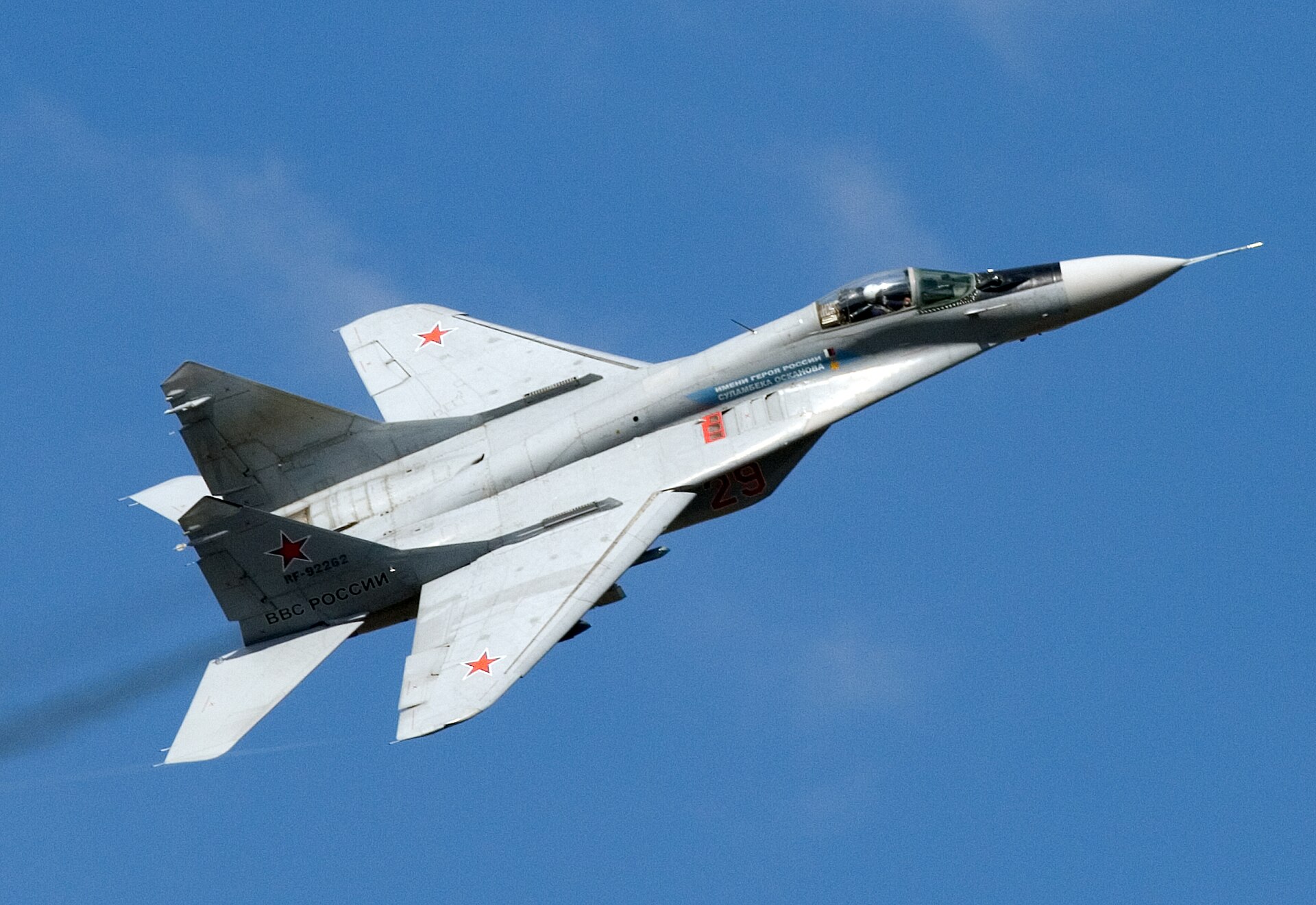
VVS 100th IMG 0691 (7727464290) (cropped)Taken on 6 August 2012, 16:30 · Artem Katranzhi from Bakashikha, RussiaWikimedia Commons · CC BY-SA 2.0 · Accessed 29 August 2026VIEW ORIGINAL FILE & RIGHTS RECORD ↗
04 · ARCHIVAL FOOTAGE
THE AIRFRAME IN MOTION.
A short, rights-screened motion record adds sound, movement, and operational scale without autoplaying or delaying the interactive model.
MiG-29 landing at Lviv01:11
A Ukrainian MiG-29 lands at Lviv; the exact sub-variant is not identified as the archive's 9-13 configuration.
VARIANT NOTE Related-family footage is identified here and is not presented as the exact modeled variant.
REUSE NOTE Embedded without modification. Commercial reuse requires attribution; adaptations must follow the linked ShareAlike terms.
A short, attributed line restores a human voice to the technical record. Period statements and later recollections are identified by the date label and accompanied by a source link.
“It is a very rugged aircraft.”
Harish MasandIndian Air Force air marshal and MiG-29 pilot
Masand described a practical strength that mattered alongside the Fulcrum's much-discussed maneuverability.
Focused facts connect the airframe's systems to the way it was built, flown, or used.
01
Lift-producing body
Broad wing-root extensions generate strong vortices and lift at high angles of attack.
02
Runway protection
Auxiliary upper intakes and main-inlet doors helped keep debris out during ground operation on rough fields.
03
Look-and-shoot
A helmet-mounted sight allowed pilots to cue short-range missiles away from the aircraft's centerline.
04
9-13 recognition
The represented 9-13 variant is identified by its enlarged dorsal spine behind the cockpit.
07 · HISTORICAL FIELD NOTE
WHY IT MATTERS.
Designed for agile front-line air defense, the Fulcrum combined high thrust, robust field operation, and formidable close-combat performance. Large leading-edge root extensions, helmet-cued weapons, and intake protections supported maneuverability and dispersed operations, while limited early avionics and range reflected its original short-range mission. [1]
Reference figures vary by variant, payload, configuration, altitude, test method, and source. Values here are an editorial orientation—not operational or flight-planning data.
Each numbered citation links to an operator, national museum, manufacturer, or established research institution. The scope note tells you exactly what that source supports, and each entry includes its retrieval date.
Where the represented model and source variant differ, the scope is labelled rather than silently treated as an exact match. Read the editorial policy, report a correction through the legal notice, or review 3D-model provenance in the attribution directory.