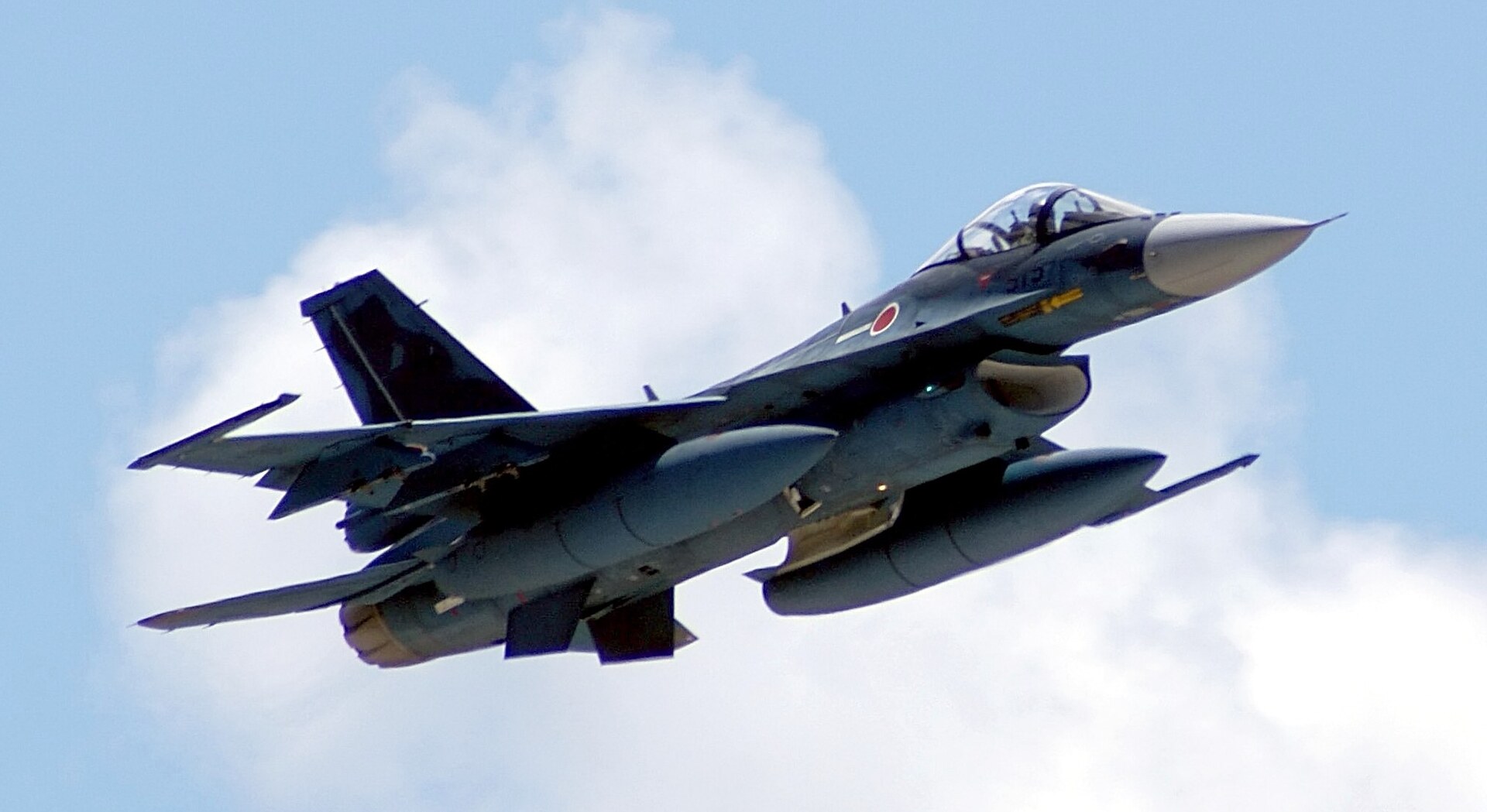
Performance and mechanical data are combined here for a faster, more compact read. Values describe the represented model or nearest clearly identified source variant.
Performance and mechanical specifications for Mitsubishi F-2A
Primary role
Multirole fighter
Crew
1 pilot
Configuration
Enlarged F-16-derived fighter
Powerplant
1 × GE F110-GE-129 turbofan
Top speed
Mach 2 class
Ceiling
50,000+ ft
Published range
2,600 mi ferry
Length
51 ft 1 in
Wingspan / rotor
36 ft 7 in
Weight
≈48,700 lb maximum
02 · SERVICE CHRONOLOGY
FROM ORIGIN TO LEGACY.
A dated sequence follows the airframe from development through operational use and later evolution. The number of milestones follows the story rather than a fixed template, and each note explains why the event mattered—not only what happened.
ORIGIN
Japan selected an F-16-based approach for the FS-X program. [1]
Focused facts connect the airframe's systems to the way it was built, flown, or used.
01
Larger wing
The F-2 has greater wing area and span than an F-16.
02
Composite milestone
Its co-cured composite wing was an ambitious production application.
03
Early AESA
The J/APG-1 made it an early operational AESA-equipped fighter.
05 · HISTORICAL FIELD NOTE
WHY IT MATTERS.
Developed from the F-16 design, the F-2 grew a larger wing and tail, incorporated extensive composite structure, and introduced an operational active electronically scanned array radar. Its proportions reflect Japan's emphasis on maritime strike, range, and a large anti-ship payload. [1]
Reference figures vary by variant, payload, configuration, altitude, test method, and source. Values here are an editorial orientation—not operational or flight-planning data.
Each numbered citation links to an operator, national museum, manufacturer, or established research institution. The scope note tells you exactly what that source supports, and each entry includes its retrieval date.
Where the represented model and source variant differ, the scope is labelled rather than silently treated as an exact match. Read the editorial policy, report a correction through the legal notice, or review 3D-model provenance in the attribution directory.