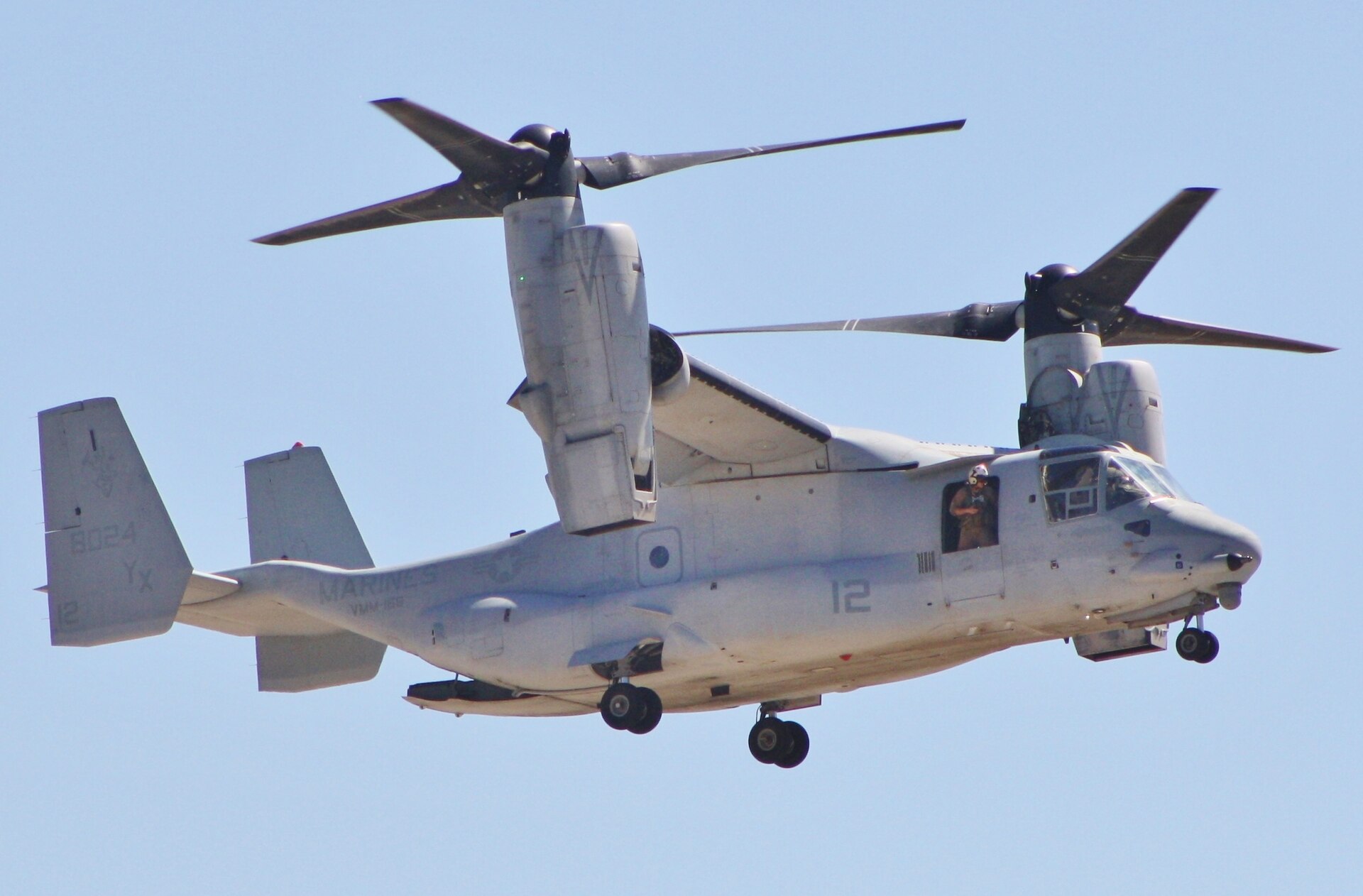
Performance and mechanical data are combined here for a faster, more compact read. Values describe the represented model or nearest clearly identified source variant.
Performance and mechanical specifications for MV-22 Osprey
Primary role
Marine medium-lift assault support
Crew
4; up to 24 troops
Configuration
Shipboard tiltrotor transport
Powerplant
2 × Rolls-Royce AE 1107C turboshafts
Top speed
316 mph
Ceiling
25,000 ft
Published range
1,011 mi
Fuselage length
57 ft 4 in
Rotor-tip span
84 ft 7 in
Max weight
60,500 lb
02 · SERVICE CHRONOLOGY
FROM ORIGIN TO LEGACY.
A dated sequence follows the airframe from development through operational use and later evolution. The number of milestones follows the story rather than a fixed template, and each note explains why the event mattered—not only what happened.
ORIGIN
The first V-22 prototype flew after a joint-service program combined helicopter access with turboprop cruise. [1]
DEVELOPMENT
The Marine Corps declared the MV-22 operational and soon deployed it, beginning replacement of the CH-46. [1]
SERVICE HISTORY
Air Force Special Operations Command used the CV-22's speed and range for long-distance infiltration and recovery. The same conversion mechanisms that enable those missions also create distinctive training and maintenance demands. [1]
CONTEXT & LEGACY
Air Force Special Operations Command declared initial operational capability, establishing the tiltrotor as a long-range infiltration, extraction, and resupply aircraft. [1]
03 · ARCHIVAL IMAGE
THE AIRFRAME IN CONTEXT.
A documented photograph or archival reference connects the interactive model to a real airframe, operation, or preserved example.
A short, rights-screened motion record adds sound, movement, and operational scale without autoplaying or delaying the interactive model.
MV-22 Osprey00:20
Official motion record of the MV-22 tiltrotor.
REUSE NOTE Embedded without modification. Commercial editorial reuse remains subject to the source record, non-endorsement, trademark, privacy/publicity, and third-party-rights limitations.
The appearance of U.S. Department of War (DoW) visual information does not imply or constitute DoW endorsement.
A short, attributed line restores a human voice to the technical record. Period statements and later recollections are identified by the date label and accompanied by a source link.
“The MV-22 brings a lot to the fight with its legs and vertical take offs.”
Craig AndersonU.S. Marine Corps captain and Osprey pilot
Anderson summarized the combination of range and vertical access at the center of the tiltrotor concept.
Focused facts connect the airframe's systems to the way it was built, flown, or used.
01
Connected rotors
A cross-shaft allows one engine to drive both proprotors if the other engine loses power.
02
Conversion
Rotating nacelles change the same propulsion system from vertical lift to airplane-like forward flight.
03
Compact stowage
The wing rotates and the proprotor blades fold for dense shipboard storage.
07 · HISTORICAL FIELD NOTE
WHY IT MATTERS.
The Marine Corps MV-22 combines helicopter-like vertical access with airplane speed and range for ship-to-shore assault support and expeditionary logistics. Rotating its engine nacelles transforms the aircraft between vertical and wing-borne flight, giving commanders reach that conventional helicopters cannot match while imposing distinctive training and maintenance demands. [1]
Reference figures vary by variant, payload, configuration, altitude, test method, and source. Values here are an editorial orientation—not operational or flight-planning data.
Each numbered citation links to an operator, national museum, manufacturer, or established research institution. The scope note tells you exactly what that source supports, and each entry includes its retrieval date.
Where the represented model and source variant differ, the scope is labelled rather than silently treated as an exact match. Read the editorial policy, report a correction through the legal notice, or review 3D-model provenance in the attribution directory.