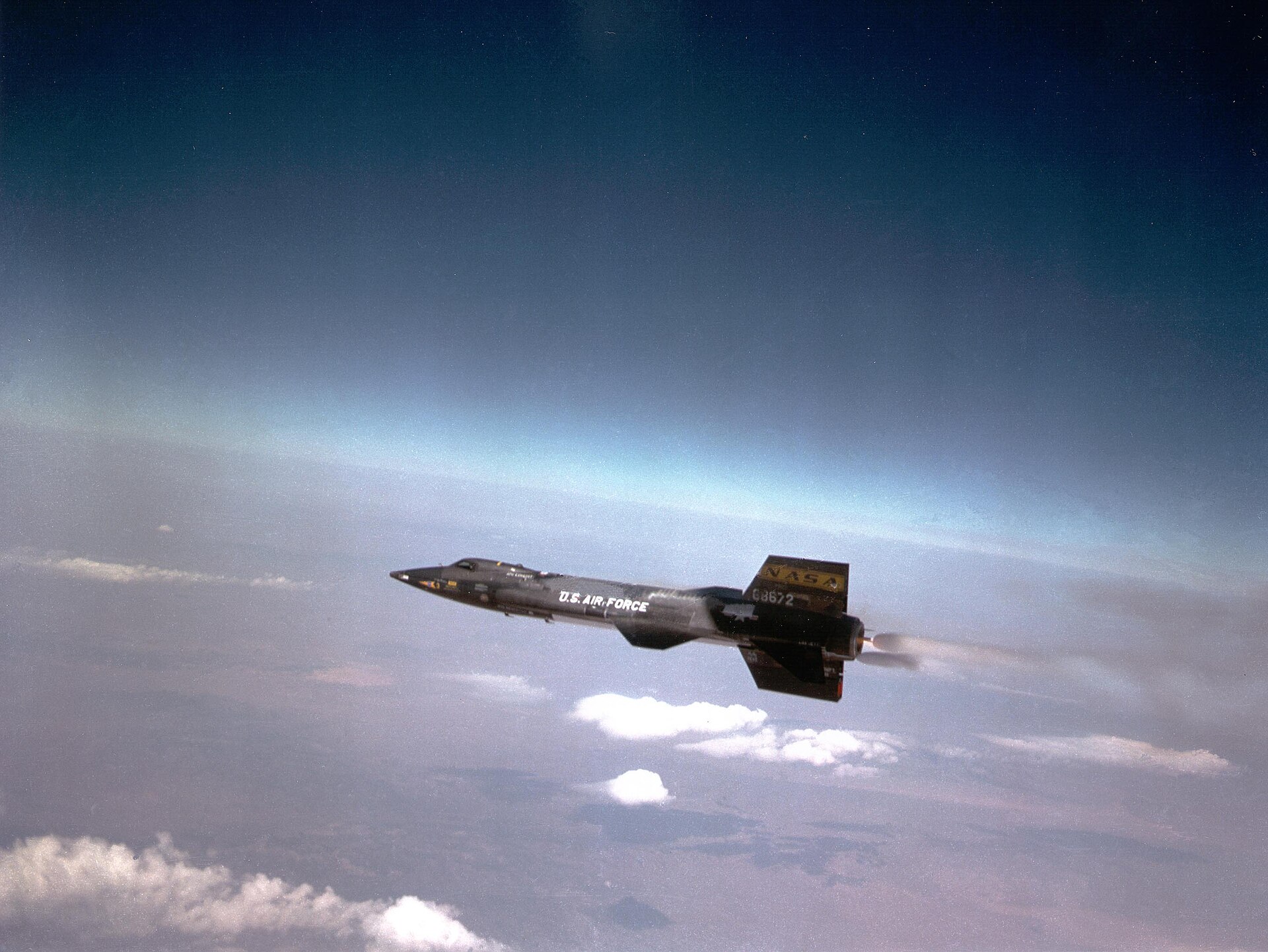
Performance and mechanical data are combined here for a faster, more compact read. Values describe the represented model or nearest clearly identified source variant.
Performance and mechanical specifications for North American X-15
Primary role
Hypersonic research
Crew
1 research pilot
Configuration
Air-launched rocket research aircraft
Powerplant
1 × Reaction Motors XLR99 rocket
Top speed
Mach 6.70
Ceiling
354,200 ft
Published range
280 mi
Length
50 ft 9 in
Wingspan
22 ft 4 in
Launch weight
≈34,000 lb
02 · SERVICE CHRONOLOGY
FROM ORIGIN TO LEGACY.
A dated sequence follows the airframe from development through operational use and later evolution. The number of milestones follows the story rather than a fixed template, and each note explains why the event mattered—not only what happened.
ORIGIN
The program began with glide flights before moving to powered missions from beneath a B-52 carrier aircraft. [1]
DEVELOPMENT
Across 199 flights, twelve pilots explored heating, stability, reaction controls, and human performance at the edge of space. The program linked aircraft-style flight test with problems later faced by crewed spacecraft. [1]
SERVICE HISTORY
Joseph Walker twice flew above 100 kilometres, while other missions crossed the U.S. 50-mile astronaut threshold; the flights connected aeronautical research with the practical boundary of spaceflight. [1]
CONTEXT & LEGACY
William Knight reached Mach 6.7, the program's enduring speed record; the full campaign ended after 199 flights. [1]
03 · ARCHIVAL IMAGE
THE AIRFRAME IN CONTEXT.
A documented photograph or archival reference connects the interactive model to a real airframe, operation, or preserved example.
A short, attributed line restores a human voice to the technical record. Period statements and later recollections are identified by the date label and accompanied by a source link.
“A real milestone in a program that we still benefit from today.”
Joe EngleX-15 pilot and NASA astronaut
Engle was reflecting on the X-15's first powered flight and its continuing research legacy.
Focused facts connect the airframe's systems to the way it was built, flown, or used.
01
Launch method
A modified B-52 carried the X-15 aloft, preserving rocket propellant for the research portion of each flight.
02
Near-space control
Small hydrogen-peroxide thrusters provided control when conventional aerodynamic surfaces lost authority.
03
Heat structure
The airframe relied heavily on Inconel X to tolerate heating during high-Mach flight.
07 · HISTORICAL FIELD NOTE
WHY IT MATTERS.
This rocket-powered research aircraft explored hypersonic flight and the edge of space, generating data that shaped later spacecraft and high-speed aircraft. Carried aloft beneath a B-52 and released before ignition, it let pilots investigate heating, stability, reaction controls, and human performance in an environment between aviation and spaceflight. [1]
Reference figures vary by variant, payload, configuration, altitude, test method, and source. Values here are an editorial orientation—not operational or flight-planning data.
Each numbered citation links to an operator, national museum, manufacturer, or established research institution. The scope note tells you exactly what that source supports, and each entry includes its retrieval date.
Where the represented model and source variant differ, the scope is labelled rather than silently treated as an exact match. Read the editorial policy, report a correction through the legal notice, or review 3D-model provenance in the attribution directory.