Performance and mechanical data are combined here for a faster, more compact read. Values describe the represented model or nearest clearly identified source variant.
Performance and mechanical specifications for P-8A Poseidon
Primary role
Maritime patrol aircraft
Crew
9 typical
Configuration
737-derived maritime patrol aircraft
Powerplant
2 × CFM International CFM56 turbofans
Top speed
564 mph
Ceiling
41,000 ft
Published range
4,500 mi
Length
129 ft 6 in
Wingspan
123 ft 6 in
Max weight
≈189,200 lb
02 · SERVICE CHRONOLOGY
FROM ORIGIN TO LEGACY.
A dated sequence follows the airframe from development through operational use and later evolution. The number of milestones follows the story rather than a fixed template, and each note explains why the event mattered—not only what happened.
ORIGIN
The first flight-test P-8A flew with strengthened structure, mission systems, and a weapons bay added to the 737 platform. [1]
DEVELOPMENT
Initial operational capability began the Navy's transition from the turboprop P-3 to a faster, higher-altitude patrol concept. [1]
SERVICE HISTORY
The U.S. Navy declared initial operational capability, beginning the fleet transition from the turboprop P-3 to a jet platform built around networked maritime surveillance. [1]
CONTEXT & LEGACY
Partner purchases and multinational deployments built a shared maritime-patrol network around the P-8. Its high-altitude sensors and off-board links complement, rather than simply reproduce, the P-3's low-level habits. [1]
03 · ARCHIVAL IMAGE
THE AIRFRAME IN CONTEXT.
A documented photograph or archival reference connects the interactive model to a real airframe, operation, or preserved example.
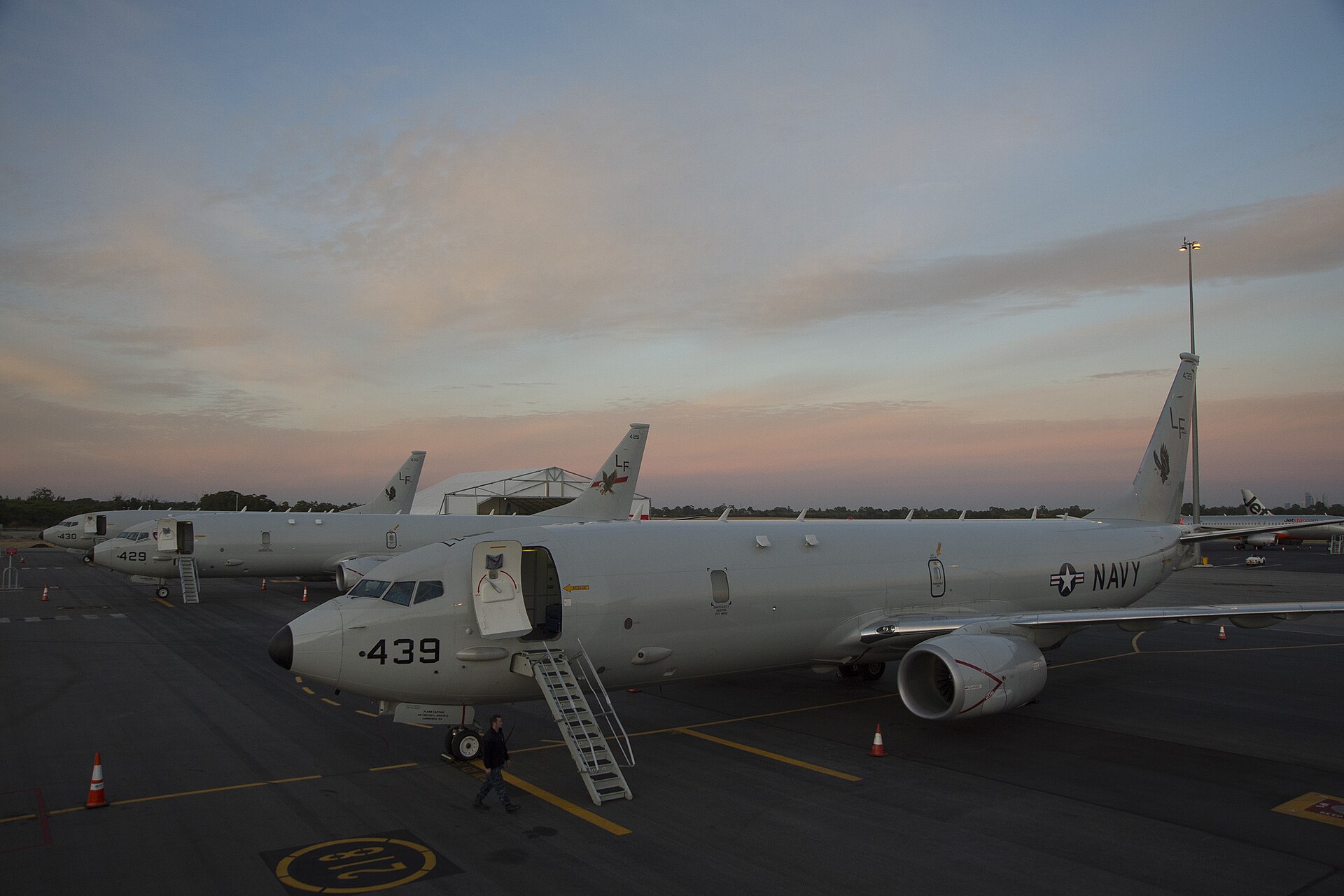
Three P-8A Poseidon aircraft from Patrol Squadron (VP) 16, at Perth Airport2014-04-08 · U.S. Navy photo by Chief Mass Communication Specialist Keith DeVinney/ReleasedWikimedia Commons · Public domain · Accessed 29 August 2026VIEW ORIGINAL FILE & RIGHTS RECORD ↗
04 · ARCHIVAL FOOTAGE
THE AIRFRAME IN MOTION.
A short, rights-screened motion record adds sound, movement, and operational scale without autoplaying or delaying the interactive model.
P-8A Poseidon arrives00:57
The P-8A lands at NAS Jacksonville during its introduction period.
REUSE NOTE Embedded without modification. Commercial editorial reuse remains subject to the source record, non-endorsement, trademark, privacy/publicity, and third-party-rights limitations.
The appearance of U.S. Department of War (DoW) visual information does not imply or constitute DoW endorsement.
A short, attributed line restores a human voice to the technical record. Period statements and later recollections are identified by the date label and accompanied by a source link.
“This aircraft is a game changer for maritime patrol.”
Tony RossiU.S. Navy captain and P-8 program manager
Rossi's remark points to the operational shift created by jet speed, networked sensors, and a new support model.
Focused facts connect the airframe's systems to the way it was built, flown, or used.
01
Search pattern
Sonobuoys, radar, electronic support measures, and electro-optical sensors build a layered maritime picture.
02
High-altitude concept
Unlike the P-3, the U.S. P-8A was designed without a tail-mounted magnetic anomaly detector.
03
Network role
Onboard systems share tracks and mission data with ships, aircraft, and shore commands.
07 · HISTORICAL FIELD NOTE
WHY IT MATTERS.
Built from the 737 airliner, the Poseidon carries maritime sensors, sonobuoys, and weapons for patrol and anti-submarine missions. Using a commercial airframe provides speed, altitude, range, and a global support base, while its mission systems turn the cabin into a coordinated workspace for tracking submarines and surface vessels. [1]
Reference figures vary by variant, payload, configuration, altitude, test method, and source. Values here are an editorial orientation—not operational or flight-planning data.
Each numbered citation links to an operator, national museum, manufacturer, or established research institution. The scope note tells you exactly what that source supports, and each entry includes its retrieval date.
Where the represented model and source variant differ, the scope is labelled rather than silently treated as an exact match. Read the editorial policy, report a correction through the legal notice, or review 3D-model provenance in the attribution directory.