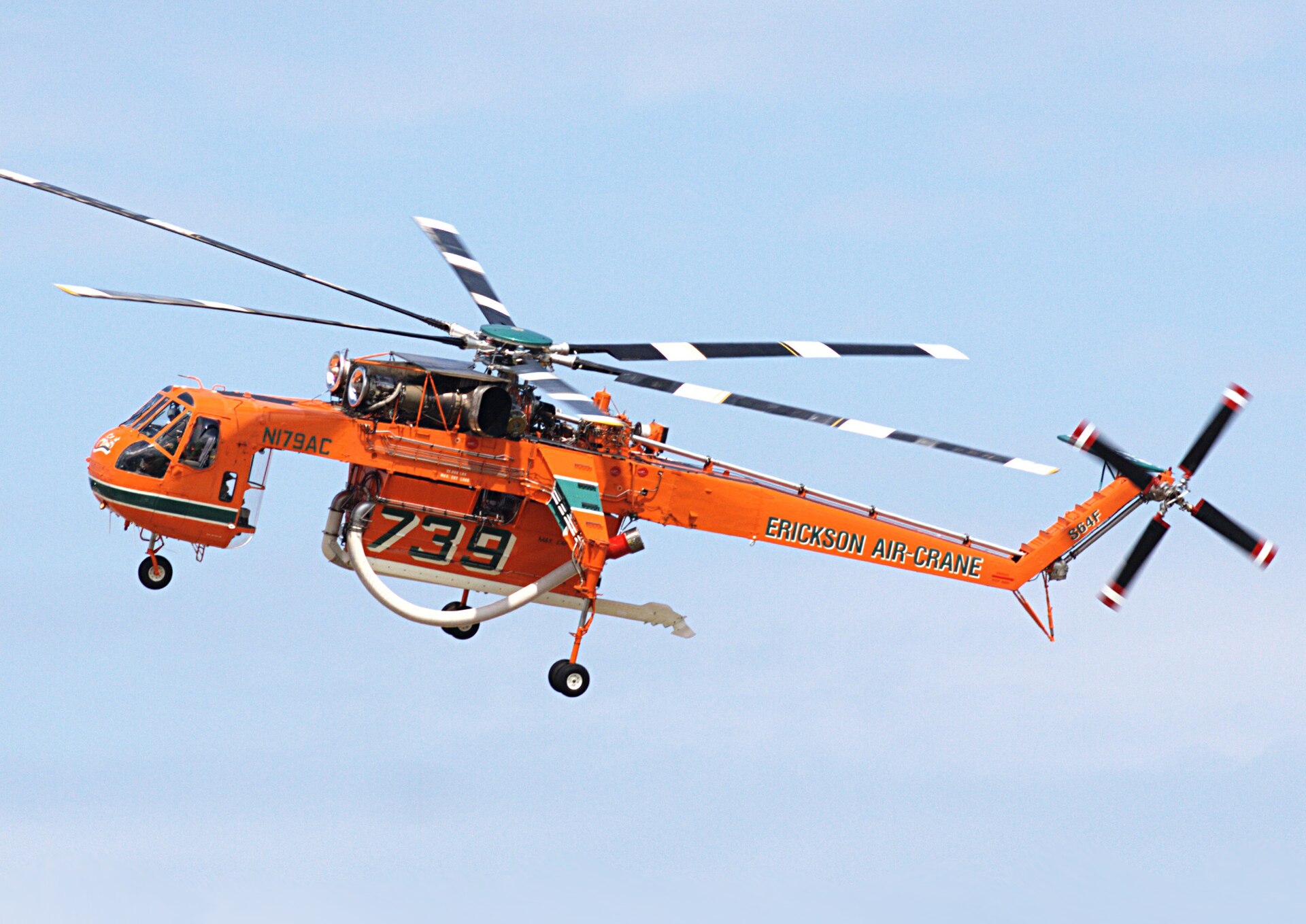
Performance and mechanical data are combined here for a faster, more compact read. Values describe the represented model or nearest clearly identified source variant.
Performance and mechanical specifications for S-64 Skycrane
Primary role
Heavy-lift helicopter
Crew
2–3
Configuration
Payload-under-slung heavy-lift helicopter
Powerplant
2 × Pratt & Whitney JFTD12 turboshafts
Top speed
126 mph
Ceiling
15,000 ft
Published range
230 mi
Fuselage length
≈70 ft
Rotor diameter
72 ft
Max weight
≈47,000 lb
02 · SERVICE CHRONOLOGY
FROM ORIGIN TO LEGACY.
A dated sequence follows the airframe from development through operational use and later evolution. The number of milestones follows the story rather than a fixed template, and each note explains why the event mattered—not only what happened.
ORIGIN
The S-64 first flew after Sikorsky developed the dedicated crane concept from the earlier S-60 demonstrator. [1]
DEVELOPMENT
The U.S. Army began receiving CH-54 Tarhes, using the detachable-load heavy-lift concept for artillery, vehicles, recovery, and engineering work. [1]
SERVICE HISTORY
Erickson acquired the type certificate and expanded the Air Crane's civil role, especially in aerial firefighting. [1]
CONTEXT & LEGACY
Civil operators developed removable tanks and mission equipment for firefighting and heavy construction. The aircraft's value lies in treating the load as an interchangeable module beneath a purpose-built flying crane. [1]
03 · ARCHIVAL IMAGE
THE AIRFRAME IN CONTEXT.
A documented photograph or archival reference connects the interactive model to a real airframe, operation, or preserved example.
A short, rights-screened motion record adds sound, movement, and operational scale without autoplaying or delaying the interactive model.
S-64 Skycrane wildfire operations02:59
An S-64 draws water during wildfire suppression.
REUSE NOTE Embedded without modification. Commercial editorial reuse remains subject to the source record, non-endorsement, trademark, privacy/publicity, and third-party-rights limitations.
The appearance of U.S. Department of War (DoW) visual information does not imply or constitute DoW endorsement.
A short, attributed line restores a human voice to the technical record. Period statements and later recollections are identified by the date label and accompanied by a source link.
“The load is the mission; the aircraft is the tool that carries it.”
Jack EricksonErickson Air-Crane founder
Erickson's formulation explains the detachable-load logic that made the S-64 valuable in construction and firefighting.
Focused facts connect the airframe's systems to the way it was built, flown, or used.
01
Purposeful emptiness
Removing a conventional cargo cabin leaves space beneath the fuselage for large external loads.
02
Modular payloads
Pods, tanks, and specialized equipment can be attached beneath the airframe for different jobs.
03
Loadmaster view
An aft-facing control station gives the operator a direct view of the suspended load.
07 · HISTORICAL FIELD NOTE
WHY IT MATTERS.
The Skycrane’s skeletal fuselage concentrates lifting power around interchangeable payloads, making it valuable for construction, firefighting, and outsized cargo. By eliminating a conventional cabin, the design gives crews direct visibility of the load and accepts specialized pods, tanks, or external cargo beneath its tall landing gear. [1]
Reference figures vary by variant, payload, configuration, altitude, test method, and source. Values here are an editorial orientation—not operational or flight-planning data.
Each numbered citation links to an operator, national museum, manufacturer, or established research institution. The scope note tells you exactly what that source supports, and each entry includes its retrieval date.
Where the represented model and source variant differ, the scope is labelled rather than silently treated as an exact match. Read the editorial policy, report a correction through the legal notice, or review 3D-model provenance in the attribution directory.