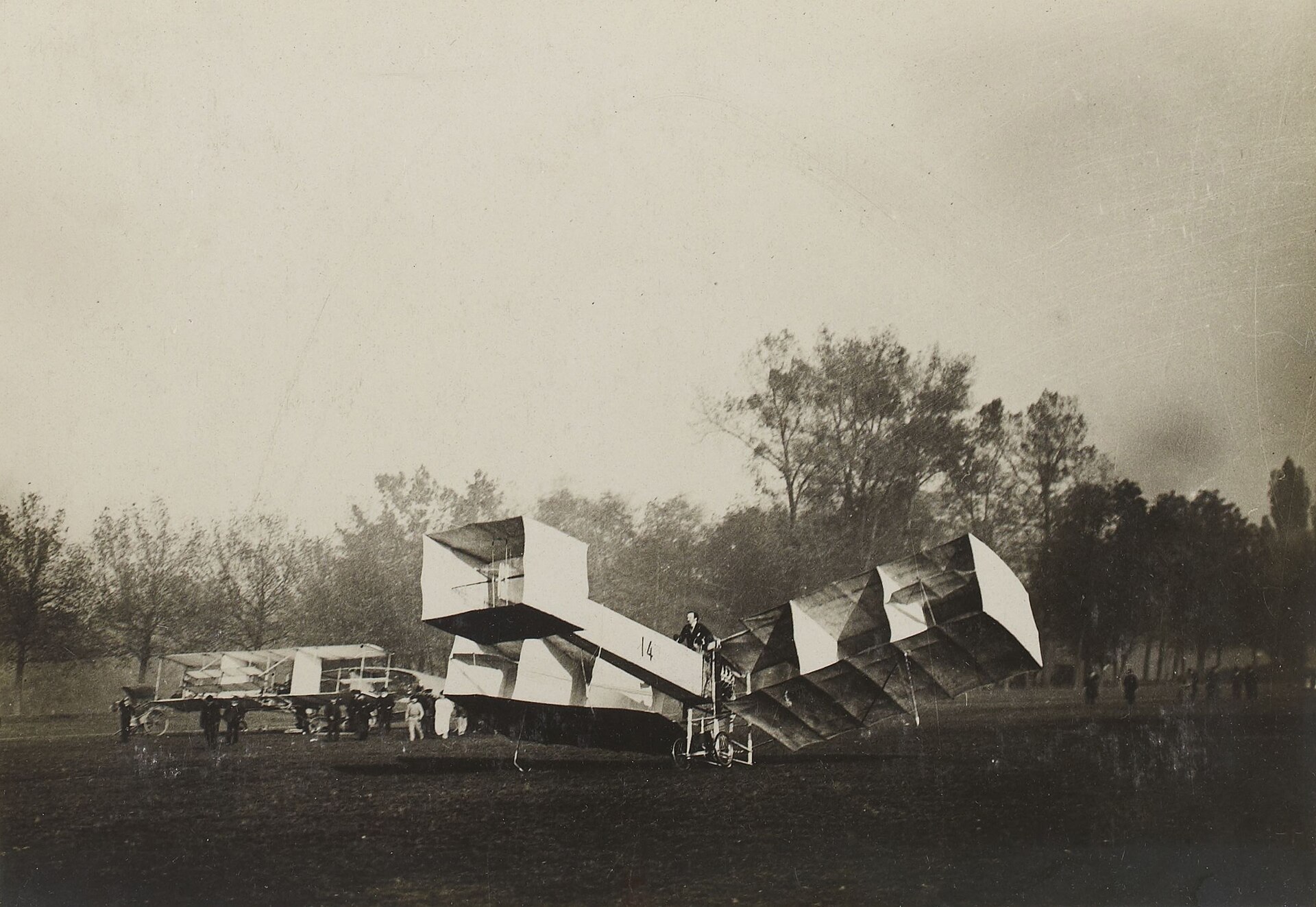
Performance and mechanical data are combined here for a faster, more compact read. Values describe the represented model or nearest clearly identified source variant.
Performance and mechanical specifications for Santos-Dumont 14-bis
Primary role
Pioneer experimental aircraft
Crew
1 pilot
Configuration
Canard box-kite biplane
Powerplant
1 × Antoinette V-8 piston engine
Top speed
25 mph
Ceiling
20 ft
Published range
722 ft
Length
≈33 ft
Wingspan
≈39 ft
Weight
≈640 lb
02 · SERVICE CHRONOLOGY
FROM ORIGIN TO LEGACY.
A dated sequence follows the airframe from development through operational use and later evolution. The number of milestones follows the story rather than a fixed template, and each note explains why the event mattered—not only what happened.
ORIGIN
A short public hop won an Aéro-Club de France prize for a powered flight exceeding 25 metres. [1]
DEVELOPMENT
A later flight covered roughly 220 metres before Santos-Dumont shifted attention to lighter, more practical designs. [1]
SERVICE HISTORY
Public, witnessed flights made the 14-bis especially important in Europe, where official prize rules required unassisted takeoff. Its significance is tied to verification and demonstration as well as distance flown. [1]
CONTEXT & LEGACY
After the 14-bis experiments, Santos-Dumont shifted toward the smaller Demoiselle series, carrying lessons from public powered flight into a lighter and more conventional arrangement. [1]
03 · ARCHIVAL IMAGE
THE AIRFRAME IN CONTEXT.
A documented photograph or archival reference connects the interactive model to a real airframe, operation, or preserved example.
A short, attributed line restores a human voice to the technical record. Period statements and later recollections are identified by the date label and accompanied by a source link.
“I have never thought that my aeroplane was a machine of war.”
Alberto Santos-DumontAeronaut and designer
Santos-Dumont's words frame his public demonstrations as a civil and personal project rather than a military one.
Focused facts connect the airframe's systems to the way it was built, flown, or used.
01
Forward control
The 14-bis used a canard surface ahead of its box-kite-like main wings.
02
Public proof
Its 1906 flights were officially observed in Paris before judges and spectators.
03
Unaided launch
The aircraft took off under its own power without a catapult, rail, or strong launch headwind.
06 · HISTORICAL FIELD NOTE
WHY IT MATTERS.
Santos-Dumont’s box-kite canard made one of Europe’s first publicly witnessed powered flights, helping establish practical heavier-than-air aviation. Taking off under its own power before an assembled audience, the 14-bis helped make powered flight a visible public achievement rather than a claim supported mainly by private demonstrations. [1]
Reference figures vary by variant, payload, configuration, altitude, test method, and source. Values here are an editorial orientation—not operational or flight-planning data.
Each numbered citation links to an operator, national museum, manufacturer, or established research institution. The scope note tells you exactly what that source supports, and each entry includes its retrieval date.
Where the represented model and source variant differ, the scope is labelled rather than silently treated as an exact match. Read the editorial policy, report a correction through the legal notice, or review 3D-model provenance in the attribution directory.