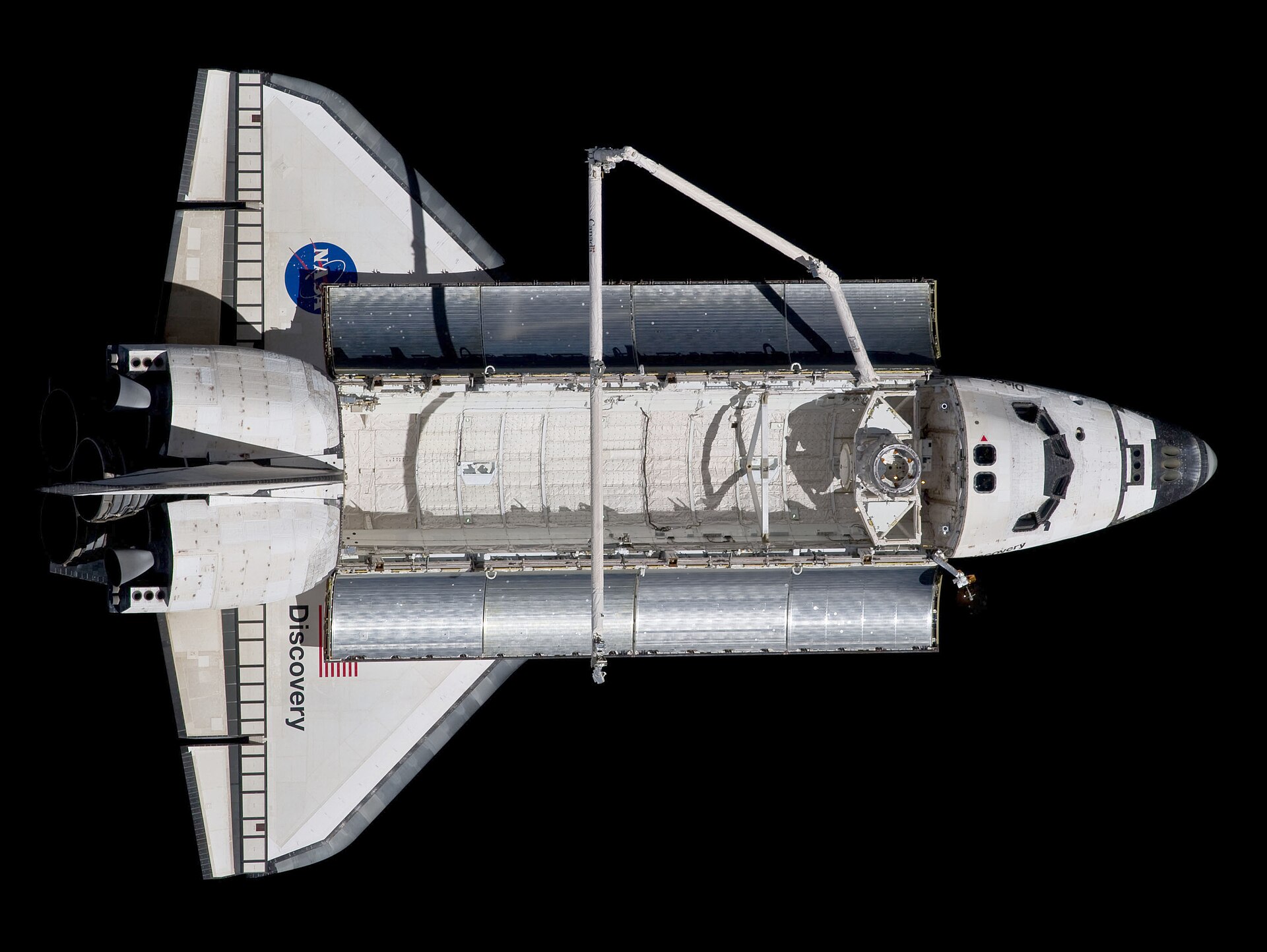
Performance and mechanical data are combined here for a faster, more compact read. Values describe the represented model or nearest clearly identified source variant.
Performance and mechanical specifications for Space Shuttle Discovery
Primary role
Reusable orbital spacecraft
Flight crew
2–7
Configuration
Reusable winged orbital spacecraft
Main propulsion
3 × main engines plus orbital maneuvering system
Top speed
Orbital velocity
Ceiling
Low Earth orbit
Published range
39 orbital missions
Orbiter length
122 ft 2 in
Wingspan
78 ft 1 in
Landing weight
Up to ≈230,000 lb
02 · SERVICE CHRONOLOGY
FROM ORIGIN TO LEGACY.
A dated sequence follows the airframe from development through operational use and later evolution. The number of milestones follows the story rather than a fixed template, and each note explains why the event mattered—not only what happened.
ORIGIN
Discovery began its career on STS-41-D and became the third shuttle orbiter to reach space. [2]
DEVELOPMENT
It flew both return-to-flight missions after the Challenger and Columbia losses, then retired in 2011 after 39 missions. [1]
SERVICE HISTORY
Discovery deployed the Hubble Space Telescope on STS-31, linking the orbiter's payload-bay and robotic-arm capabilities to one of the shuttle program's most consequential scientific missions. [1]
CONTEXT & LEGACY
After its final mission, Discovery was transferred to the Smithsonian rather than prepared for another flight. Preservation fixed the orbiter at the end of a thirty-year operational and institutional story. [1]
03 · ARCHIVAL IMAGE
THE AIRFRAME IN CONTEXT.
A documented photograph or archival reference connects the interactive model to a real airframe, operation, or preserved example.
A short, attributed line restores a human voice to the technical record. Period statements and later recollections are identified by the date label and accompanied by a source link.
“We, the crew of Discovery, witness this earthly splendor from America's spacecraft.”
Richard CoveySTS-26 pilot
Covey spoke during the first shuttle mission after Challenger, giving the return-to-flight moment a human voice.
Focused facts connect the airframe's systems to the way it was built, flown, or used.
01
Fleet leader
Discovery flew 39 missions—more than any other Space Shuttle orbiter.
02
Hubble mission
Its crew deployed the Hubble Space Telescope in 1990 and later flew servicing missions to the observatory.
03
Return-to-flight role
Discovery led both return-to-flight missions after the Challenger and Columbia losses.
07 · HISTORICAL FIELD NOTE
WHY IT MATTERS.
Discovery was NASA’s third operational space shuttle orbiter and flew 39 missions from 1984 to 2011, more than any other member of the fleet. Its work included deploying the Hubble Space Telescope, supporting International Space Station assembly, and flying both of NASA’s post-accident return-to-flight missions. [1][2]
Reference figures vary by variant, payload, configuration, altitude, test method, and source. Values here are an editorial orientation—not operational or flight-planning data.
Each numbered citation links to an operator, national museum, manufacturer, or established research institution. The scope note tells you exactly what that source supports, and each entry includes its retrieval date.
Where the represented model and source variant differ, the scope is labelled rather than silently treated as an exact match. Read the editorial policy, report a correction through the legal notice, or review 3D-model provenance in the attribution directory.