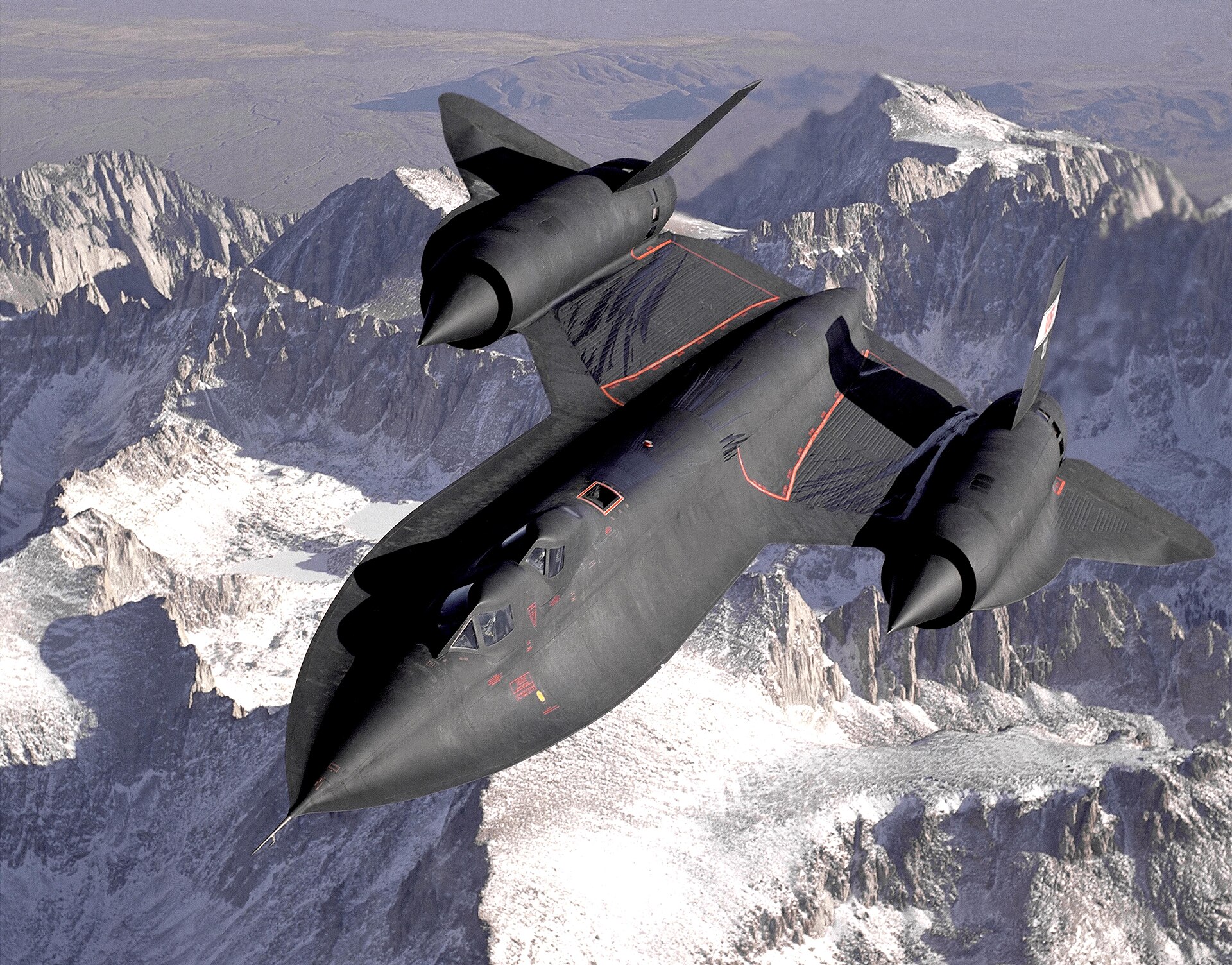
Performance and mechanical data are combined here for a faster, more compact read. Values describe the represented model or nearest clearly identified source variant.
Performance and mechanical specifications for SR-71 Blackbird
Primary role
Strategic reconnaissance
Crew
2
Configuration
Twin-engine Mach 3 reconnaissance aircraft
Powerplant
2 × Pratt & Whitney J58 turbojets
Top speed
Mach 3.3+
Ceiling
85,000+ ft
Published range
3,355 mi
Length
107 ft 5 in
Wingspan
55 ft 7 in
Max weight
≈172,000 lb
02 · SERVICE CHRONOLOGY
FROM ORIGIN TO LEGACY.
A dated sequence follows the airframe from development through operational use and later evolution. The number of milestones follows the story rather than a fixed template, and each note explains why the event mattered—not only what happened.
ORIGIN
The first SR-71 flew from the highly classified A-12 lineage developed by Lockheed's Skunk Works. [1]
DEVELOPMENT
Operational missions relied on tankers, specialized fuel, mission planning, and post-flight intelligence processing. The famous aircraft was therefore the visible point of a much larger reconnaissance system. [1]
SERVICE HISTORY
Operational SR-71 missions began from Kadena Air Base, pairing the aircraft with aerial tankers, specialized fuel, weather planning, and a large intelligence-processing organization. [1]
CONTEXT & LEGACY
After an initial retirement, a small number briefly returned before NASA and the Air Force ended flight operations. [1]
03 · ARCHIVAL IMAGE
THE AIRFRAME IN CONTEXT.
A documented photograph or archival reference connects the interactive model to a real airframe, operation, or preserved example.
A short, rights-screened motion record adds sound, movement, and operational scale without autoplaying or delaying the interactive model.
SR-71 research flight00:13
Short NASA flight-test record of an SR-71.
REUSE NOTE Transcoded from the linked public-domain source solely for reliable browser playback; the source-file page records the public-domain basis and remaining rights notes.
A short, attributed line restores a human voice to the technical record. Period statements and later recollections are identified by the date label and accompanied by a source link.
“You've never been lost until you've been lost at Mach 3.”
Paul F. CrickmoreSR-71 historian quoting operational experience
The line condenses the navigation scale and speed that made Blackbird operations unlike conventional flight.
Focused facts connect the airframe's systems to the way it was built, flown, or used.
01
Thermal fit
Panel gaps closed as the airframe heated and expanded, so fuel seepage on the ground was an accepted characteristic.
02
Special fuel
Low-volatility JP-7 reduced the risk of fuel vapor igniting at extreme skin temperatures.
03
Navigation method
An astro-inertial system tracked stars through a window above the fuselage to correct the aircraft's position.
07 · HISTORICAL FIELD NOTE
WHY IT MATTERS.
Flying above Mach 3 at extreme altitude, the Blackbird gathered strategic intelligence while relying on speed and height to evade interception. Its titanium structure, specialized fuel, and carefully managed thermal expansion were necessary because sustained high-speed flight heated and physically changed the aircraft in ways ordinary airframes never experienced. [1]
Reference figures vary by variant, payload, configuration, altitude, test method, and source. Values here are an editorial orientation—not operational or flight-planning data.
Each numbered citation links to an operator, national museum, manufacturer, or established research institution. The scope note tells you exactly what that source supports, and each entry includes its retrieval date.
Where the represented model and source variant differ, the scope is labelled rather than silently treated as an exact match. Read the editorial policy, report a correction through the legal notice, or review 3D-model provenance in the attribution directory.