Performance and mechanical data are combined here for a faster, more compact read. Values describe the represented model or nearest clearly identified source variant.
Performance and mechanical specifications for Su-57 Felon
Primary role
Stealth multirole fighter
Crew
1 pilot
Configuration
Twin-engine low-observable multirole fighter
Powerplant
2 × afterburning turbofans
Top speed
Mach 2.0
Ceiling
66,000 ft
Published range
2,175 mi
Length
≈66 ft
Wingspan
≈47 ft
Max weight
≈77,000 lb
02 · SERVICE CHRONOLOGY
FROM ORIGIN TO LEGACY.
A dated sequence follows the airframe from development through operational use and later evolution. The number of milestones follows the story rather than a fixed template, and each note explains why the event mattered—not only what happened.
ORIGIN
The T-50 prototype first flew as Russia's first full-scale effort to field a low-observable tactical fighter. [1]
DEVELOPMENT
Initial service aircraft entered a continuing development path that includes weapons, software, and a planned new engine. [1]
SERVICE HISTORY
Russia accepted the first production Su-57 after an earlier production aircraft was lost during a test flight, beginning service entry with a very small fleet. [1]
CONTEXT & LEGACY
Public claims of operational use have accompanied slow fleet growth and continued development. Limited independent visibility means declared capabilities, test progress, and routine readiness should be distinguished carefully. [1]
03 · ARCHIVAL IMAGE
THE AIRFRAME IN CONTEXT.
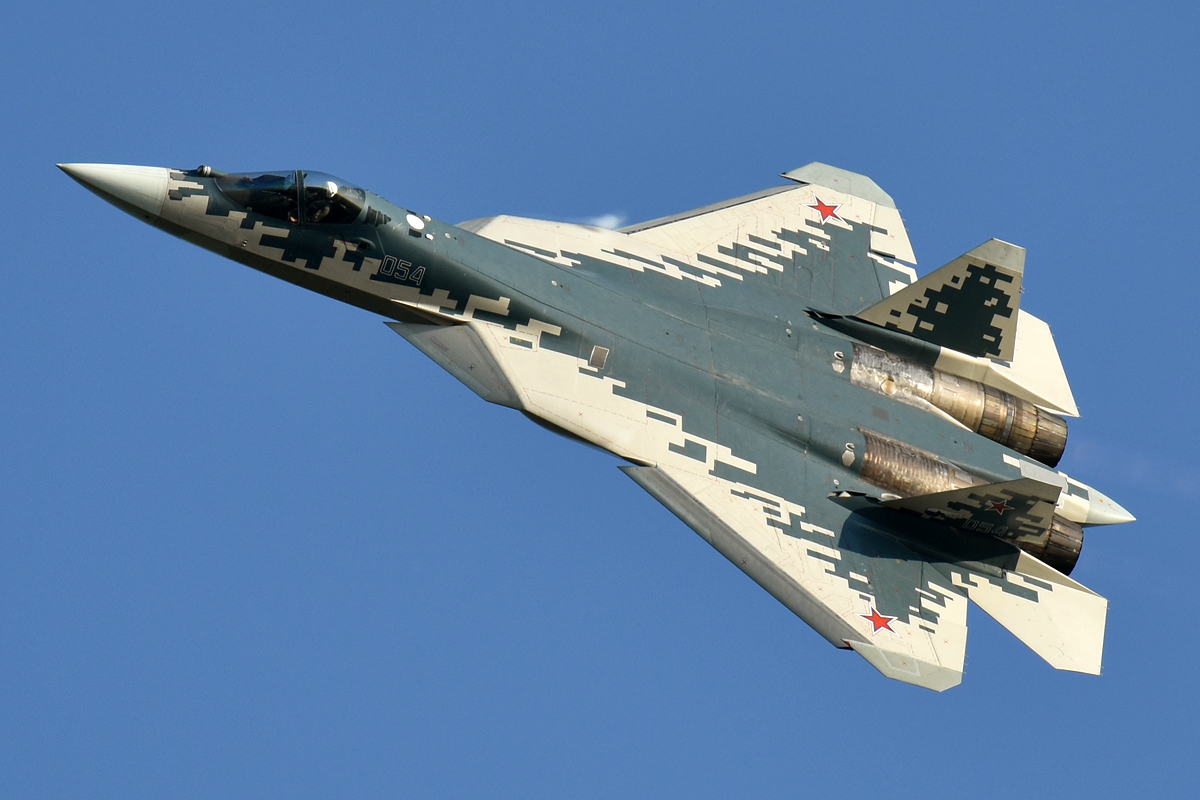
A documented photograph or archival reference connects the interactive model to a real airframe, operation, or preserved example.
Sukhoi Design Bureau, 054, Sukhoi T-50 (Su-57 prototype) (49581303977)2019-08-29 17:32 · Anna Zvereva from Tallinn, EstoniaWikimedia Commons · CC BY-SA 2.0 · Accessed 29 August 2026VIEW ORIGINAL FILE & RIGHTS RECORD ↗
04 · VOICES FROM THE RECORD
THE AIRFRAME, REMEMBERED.
A short, attributed line restores a human voice to the technical record. Period statements and later recollections are identified by the date label and accompanied by a source link.
“It doesn't really have any limitations.”
Sergei BogdanSukhoi chief test pilot
Bogdan was discussing controllability with thrust vectoring; this is a manufacturer's test-pilot assessment, not independent verification.
Focused facts connect the airframe's systems to the way it was built, flown, or used.
01
Blended volume
The fuselage and wing flow into a broad lifting body that creates internal space for fuel and weapons.
02
Weapon bays
Main weapons are carried between the engines, with smaller side bays intended for short-range missiles.
03
Control authority
Widely spaced engines and thrust-vectoring nozzles contribute to high-angle maneuverability.
04
Sensor distribution
The design combines a nose radar with additional arrays and electro-optical sensors around the airframe.
06 · HISTORICAL FIELD NOTE
WHY IT MATTERS.
Russia’s first operational stealth fighter blends a low-observable airframe with internal weapons, advanced sensors, and high agility. Its design balances reduced detectability with maneuver performance and broad mission ambitions, although the program’s production scale and evolving engine configuration distinguish it from more mature stealth fleets. [1]
Reference figures vary by variant, payload, configuration, altitude, test method, and source. Values here are an editorial orientation—not operational or flight-planning data.
Each numbered citation links to an operator, national museum, manufacturer, or established research institution. The scope note tells you exactly what that source supports, and each entry includes its retrieval date.
Where the represented model and source variant differ, the scope is labelled rather than silently treated as an exact match. Read the editorial policy, report a correction through the legal notice, or review 3D-model provenance in the attribution directory.