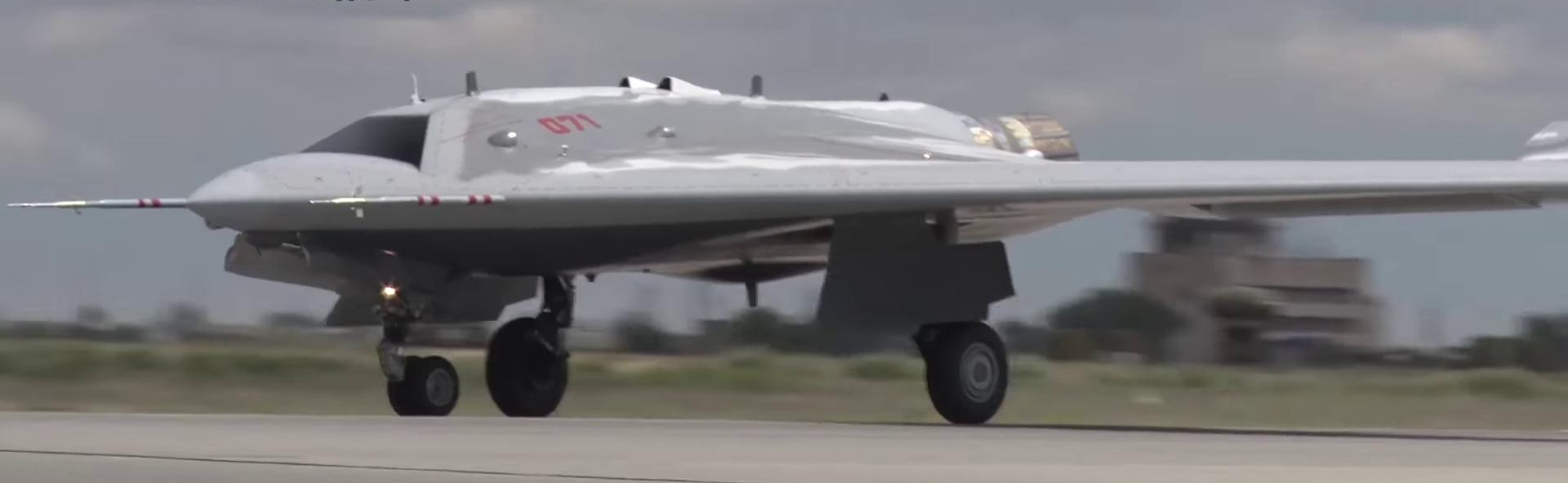
Performance and mechanical data are combined here for a faster, more compact read. Values describe the represented model or nearest clearly identified source variant.
Performance and mechanical specifications for Sukhoi S-70 Okhotnik-B
Primary role
Uncrewed combat-aircraft demonstrator
Crew
Uncrewed
Configuration
Flying-wing combat demonstrator
Powerplant
1 × AL-31-family turbofan, reported
Top speed
Subsonic
Ceiling
Published data limited
Published range
Published data limited
Length
≈46 ft, reported
Wingspan / rotor
≈62 ft, reported
Weight
Not reliably published
02 · SERVICE CHRONOLOGY
FROM ORIGIN TO LEGACY.
A dated sequence follows the airframe from development through operational use and later evolution. The number of milestones follows the story rather than a fixed template, and each note explains why the event mattered—not only what happened.
ORIGIN
The first S-70 prototype completed its publicized maiden flight. [1]
DEVELOPMENT
Joint flight with an Su-57 signaled a crewed–uncrewed development path. [1]
SERVICE HISTORY
Testing continued with limited official technical disclosure. [1]
SERVICE HISTORY
A revised prototype appeared with cleaner exhaust shaping. [1]
CONTEXT & LEGACY
Observed milestones are separated from speculative claims about autonomy and payload. [1]
03 · ARCHIVAL IMAGE
THE AIRFRAME IN CONTEXT.
A documented photograph or archival reference connects the interactive model to a real airframe, operation, or preserved example.
Focused facts connect the airframe's systems to the way it was built, flown, or used.
01
Tailless control
A flying wing trades conventional stability surfaces for control-system dependence.
02
Evidence limit
Open evidence establishes flights more clearly than operational capability.
03
Team concept
The Su-57 flight suggested cooperation without disclosing autonomy details.
05 · HISTORICAL FIELD NOTE
WHY IT MATTERS.
The S-70 is a large flying-wing uncrewed combat-aircraft demonstrator associated with efforts to pair autonomous systems with crewed fighters. Public information remains limited, so its significance is best understood through its configuration, flight-test milestones, and demonstrated formation work rather than speculative capability claims. [1]
Reference figures vary by variant, payload, configuration, altitude, test method, and source. Values here are an editorial orientation—not operational or flight-planning data.
Each numbered citation links to an operator, national museum, manufacturer, or established research institution. The scope note tells you exactly what that source supports, and each entry includes its retrieval date.
Where the represented model and source variant differ, the scope is labelled rather than silently treated as an exact match. Read the editorial policy, report a correction through the legal notice, or review 3D-model provenance in the attribution directory.