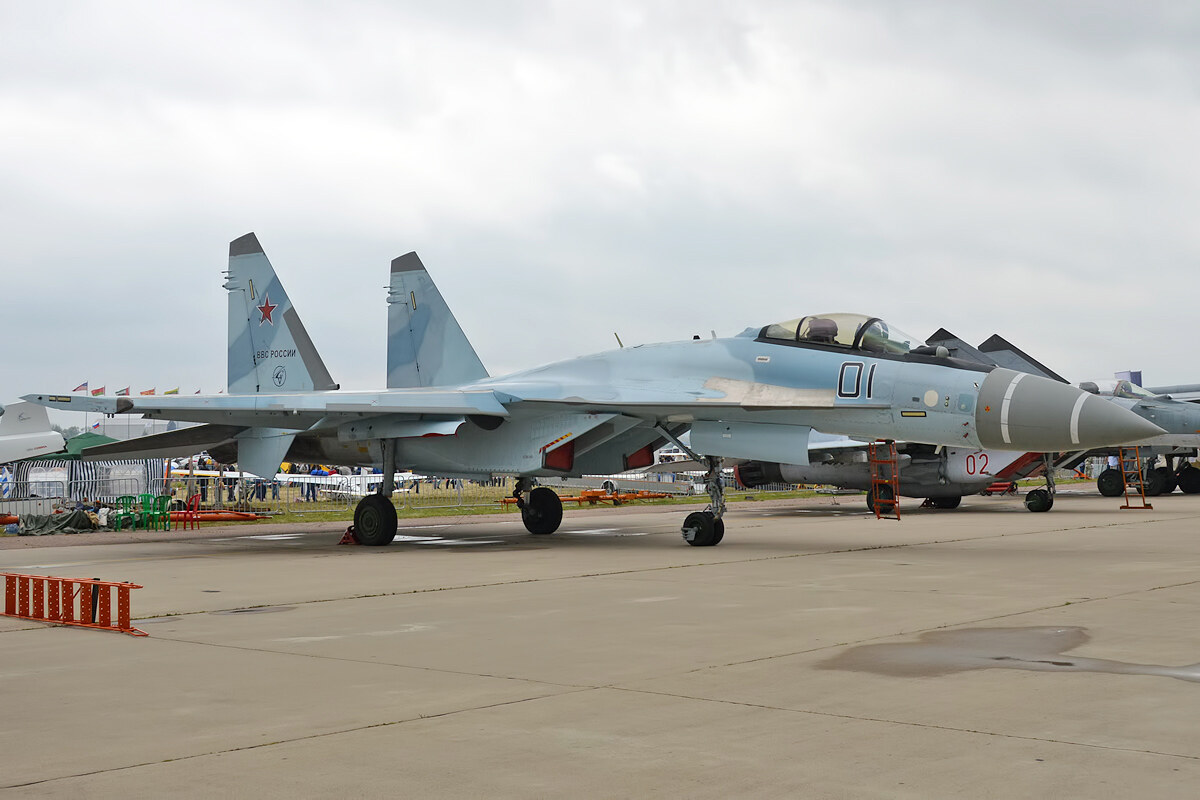
Performance and mechanical data are combined here for a faster, more compact read. Values describe the represented model or nearest clearly identified source variant.
Performance and mechanical specifications for Sukhoi Su-35S
Primary role
Multirole air-superiority fighter
Crew
1 pilot
Configuration
Thrust-vectoring Flanker derivative
Powerplant
2 × Saturn AL-41F1S turbofans
Top speed
Mach 2.25
Ceiling
59,000 ft
Published range
2,200 mi
Length
71 ft 10 in
Wingspan / rotor
50 ft 2 in
Weight
≈76,060 lb maximum
02 · SERVICE CHRONOLOGY
FROM ORIGIN TO LEGACY.
A dated sequence follows the airframe from development through operational use and later evolution. The number of milestones follows the story rather than a fixed template, and each note explains why the event mattered—not only what happened.
ORIGIN
The first modern Su-35 development aircraft flew. [1]
DEVELOPMENT
Initial production aircraft entered state flight evaluation. [1]
A short, rights-screened motion record adds sound, movement, and operational scale without autoplaying or delaying the interactive model.
Russian Su-35 intercept over Syria00:32
Declassified operational footage records an exact Su-35 in flight. The clip documents an unsafe intercept and is presented for identification and historical context.
REUSE NOTE Embedded without modification. Commercial editorial reuse remains subject to the source record, non-endorsement, trademark, privacy/publicity, and third-party-rights limitations.
The appearance of U.S. Department of War (DoW) visual information does not imply or constitute DoW endorsement.
Focused facts connect the airframe's systems to the way it was built, flown, or used.
01
Internal reach
The large Flanker airframe carries substantial fuel without routine external tanks.
02
Sensor suite
Irbis-E radar is paired with infrared search-and-track equipment.
03
Name caution
The Su-35S differs substantially from the earlier 1990s Su-35.
06 · HISTORICAL FIELD NOTE
WHY IT MATTERS.
The Su-35S is a deeply modernized member of the Flanker family. Powerful engines with thrust-vectoring nozzles, a large radar, long endurance, and extensive control-surface authority give it an unusual combination of range, payload, and low-speed agility. [1]
Reference figures vary by variant, payload, configuration, altitude, test method, and source. Values here are an editorial orientation—not operational or flight-planning data.
Each numbered citation links to an operator, national museum, manufacturer, or established research institution. The scope note tells you exactly what that source supports, and each entry includes its retrieval date.
Where the represented model and source variant differ, the scope is labelled rather than silently treated as an exact match. Read the editorial policy, report a correction through the legal notice, or review 3D-model provenance in the attribution directory.