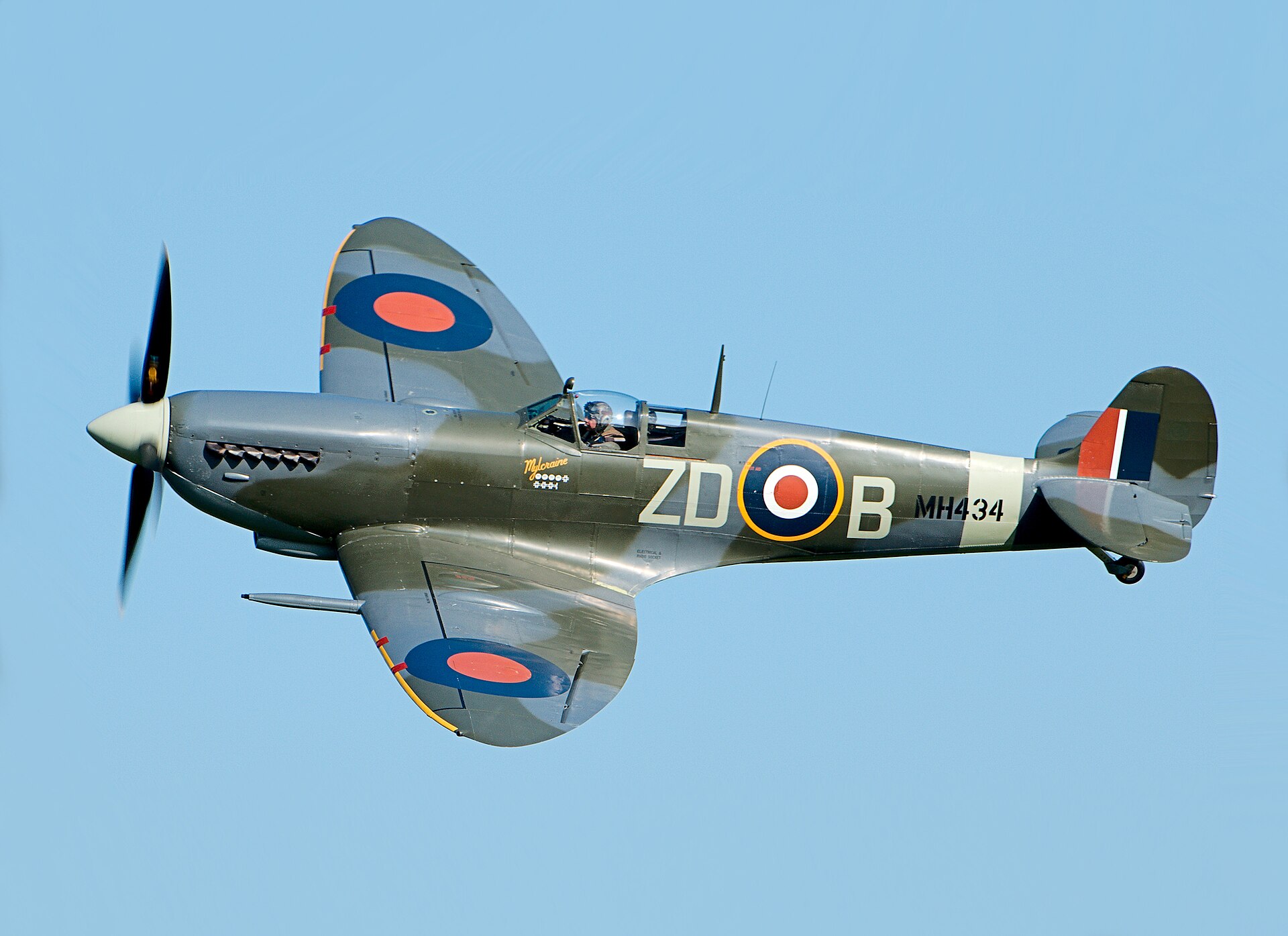
Performance and mechanical data are combined here for a faster, more compact read. Values describe the represented model or nearest clearly identified source variant.
Performance and mechanical specifications for Supermarine Spitfire
Primary role
Fighter
Crew
1 pilot
Configuration
Elliptical-wing interceptor
Powerplant
1 × Rolls-Royce Merlin V-12
Top speed
374 mph
Ceiling
36,500 ft
Published range
434 mi
Length
29 ft 11 in
Wingspan
36 ft 10 in
Loaded weight
≈6,700 lb
02 · SERVICE CHRONOLOGY
FROM ORIGIN TO LEGACY.
A dated sequence follows the airframe from development through operational use and later evolution. The number of milestones follows the story rather than a fixed template, and each note explains why the event mattered—not only what happened.
ORIGIN
The prototype first flew from Eastleigh and quickly demonstrated the performance sought by the RAF's new fighter requirement. [1]
DEVELOPMENT
From home defense to reconnaissance and overseas service, the Spitfire adapted through more than twenty major marks. Its changing engines and wings make it a record of wartime development rather than one frozen design. [1]
SERVICE HISTORY
Continuous development added heavier armament, new wings, and Griffon engines while preserving the basic airframe lineage. [1]
CONTEXT & LEGACY
The Griffon-powered prototype flew as designers sought more power at altitude; the resulting marks extended the Spitfire family far beyond the early Merlin-powered configuration. [1]
03 · ARCHIVAL IMAGE
THE AIRFRAME IN CONTEXT.
A documented photograph or archival reference connects the interactive model to a real airframe, operation, or preserved example.
A short, rights-screened motion record adds sound, movement, and operational scale without autoplaying or delaying the interactive model.
WWII Spitfire pilot and surviving aircraft01:56
A wartime Spitfire pilot recounts his experience and is reunited with a restored Spitfire; the precise mark differs from the catalogue model.
VARIANT NOTE Related-family footage is identified here and is not presented as the exact modeled variant.
REUSE NOTE Embedded without modification. Commercial editorial reuse remains subject to the source record, non-endorsement, trademark, privacy/publicity, and third-party-rights limitations.
The appearance of U.S. Department of War (DoW) visual information does not imply or constitute DoW endorsement.
A short, attributed line restores a human voice to the technical record. Period statements and later recollections are identified by the date label and accompanied by a source link.
“At 19 years old you cannot go to war in a Spitfire and forget about it.”
Geoffrey WellumRoyal Air Force Spitfire pilot
Wellum's retrospective account places the celebrated aircraft inside the experience of a very young wartime pilot.
Focused facts connect the airframe's systems to the way it was built, flown, or used.
01
Wing signature
The thin elliptical wing distributed lift efficiently while leaving room for retractable gear and armament.
02
Production network
Manufacturing expanded beyond Supermarine through large shadow factories and repair organizations.
03
Mission breadth
Spitfires served as interceptors, reconnaissance aircraft, fighter-bombers, and naval Seafires.
07 · HISTORICAL FIELD NOTE
WHY IT MATTERS.
An elliptical wing and responsive handling made the Spitfire an icon of Britain’s air defense and a remarkably adaptable wartime fighter. Continuous development produced versions optimized for interception, reconnaissance, carrier use, and increasingly powerful engines, allowing the design to remain competitive throughout the war. [1]
Reference figures vary by variant, payload, configuration, altitude, test method, and source. Values here are an editorial orientation—not operational or flight-planning data.
Each numbered citation links to an operator, national museum, manufacturer, or established research institution. The scope note tells you exactly what that source supports, and each entry includes its retrieval date.
Where the represented model and source variant differ, the scope is labelled rather than silently treated as an exact match. Read the editorial policy, report a correction through the legal notice, or review 3D-model provenance in the attribution directory.