Performance and mechanical data are combined here for a faster, more compact read. Values describe the represented model or nearest clearly identified source variant.
Performance and mechanical specifications for T-28 Trojan
Primary role
Advanced trainer
Crew
2
Configuration
Tandem-seat advanced trainer
Powerplant
1 × Wright R-1820 radial on naval versions
Top speed
343 mph
Ceiling
35,500 ft
Published range
1,060 mi
Length
≈33 ft
Wingspan
40 ft 1 in
Max weight
≈8,500 lb
02 · SERVICE CHRONOLOGY
FROM ORIGIN TO LEGACY.
A dated sequence follows the airframe from development through operational use and later evolution. The number of milestones follows the story rather than a fixed template, and each note explains why the event mattered—not only what happened.
ORIGIN
The prototype flew as a modern successor to wartime trainers, with tricycle gear and systems resembling operational aircraft. [1]
DEVELOPMENT
Air Force and Navy versions differed substantially in power and equipment, while armed export derivatives served in combat. The common silhouette therefore hides several distinct training and operational histories. [1]
SERVICE HISTORY
Armed and modified Trojans served in forward-air-control and counterinsurgency missions with several nations. [1]
CONTEXT & LEGACY
Armed T-28 variants served in Southeast Asia in training, forward-air-control, and light-attack roles, moving the basic trainer into sustained combat operations. [1]
03 · ARCHIVAL IMAGE
THE AIRFRAME IN CONTEXT.
A documented photograph or archival reference connects the interactive model to a real airframe, operation, or preserved example.
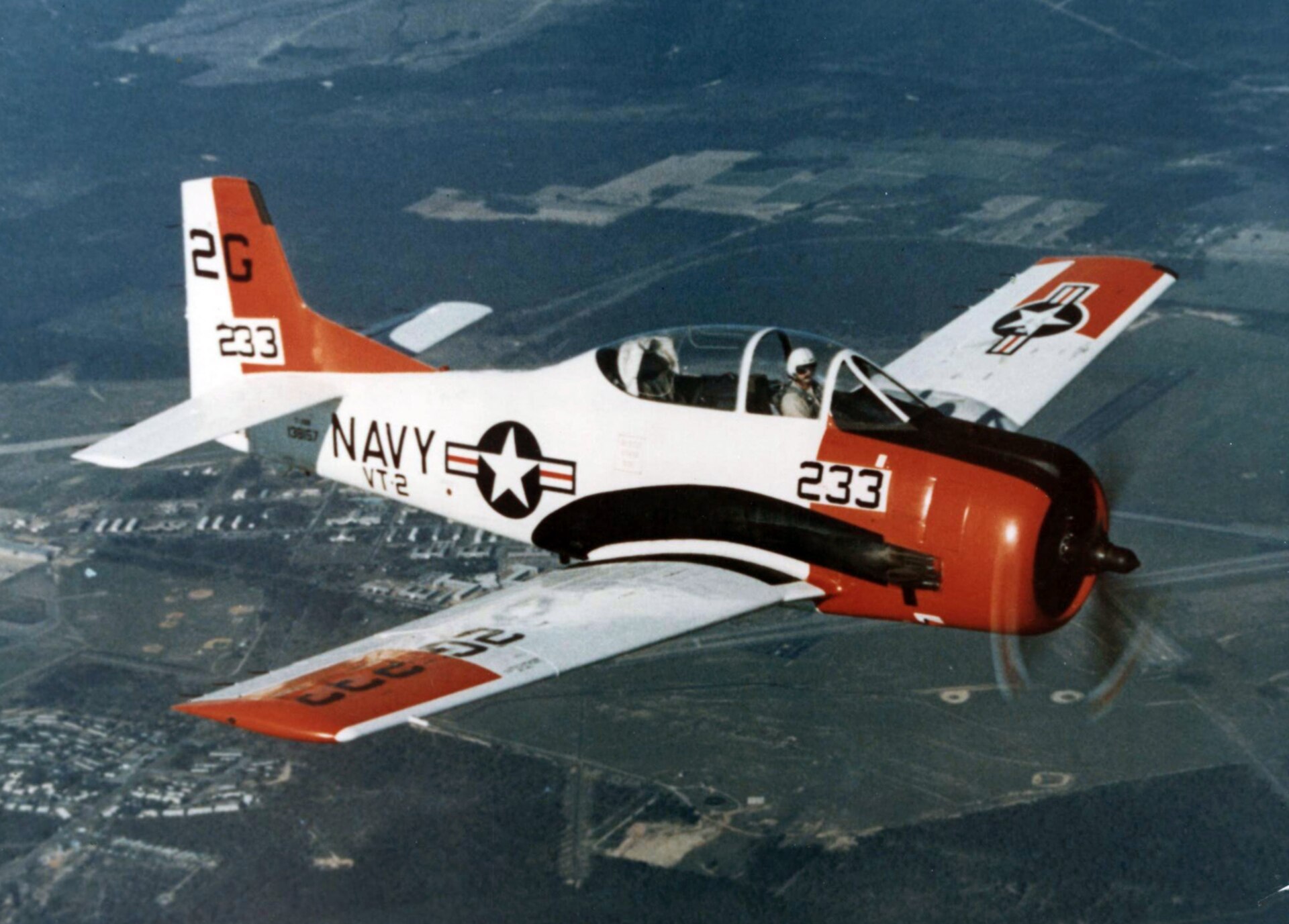
T-28B VT-2 over NAS Whiting Field c1973circa 1973 date QS:P,+1973-00-00T00:00:00Z/9,P1480,Q5727902 · U.S. NavyWikimedia Commons · Public domain · Accessed 29 August 2026VIEW ORIGINAL FILE & RIGHTS RECORD ↗
04 · ARCHIVAL FOOTAGE
THE AIRFRAME IN MOTION.
A short, rights-screened motion record adds sound, movement, and operational scale without autoplaying or delaying the interactive model.
Warbirds — T-28 Trojan00:59
An official heritage profile; despite the series title, the T-28 is a postwar trainer.
REUSE NOTE Embedded without modification. Commercial editorial reuse remains subject to the source record, non-endorsement, trademark, privacy/publicity, and third-party-rights limitations.
The appearance of U.S. Department of War (DoW) visual information does not imply or constitute DoW endorsement.
A short, attributed line restores a human voice to the technical record. Period statements and later recollections are identified by the date label and accompanied by a source link.
“It was a big, honest trainer with enough power to teach respect.”
Robert A. HooverTest and demonstration pilot
Hoover's description captures the T-28's role between elementary trainers and operational aircraft.
Focused facts connect the airframe's systems to the way it was built, flown, or used.
01
Radial presence
A large radial engine gave the trainer performance and handling closer to contemporary operational aircraft.
02
Training role
Students used the Trojan after basic training to learn heavier controls, retractable gear, and higher performance.
03
Carrier version
The T-28C added an arresting hook and structural changes for naval carrier qualification.
07 · HISTORICAL FIELD NOTE
WHY IT MATTERS.
The powerful Trojan bridged basic and advanced flight training and later adapted to forward-air-control and light-attack missions. Its large radial engine, tandem cockpit, and forgiving low-speed handling prepared students for heavier military aircraft, while armed variants proved useful in smaller conflicts and counterinsurgency operations. [1]
Reference figures vary by variant, payload, configuration, altitude, test method, and source. Values here are an editorial orientation—not operational or flight-planning data.
Each numbered citation links to an operator, national museum, manufacturer, or established research institution. The scope note tells you exactly what that source supports, and each entry includes its retrieval date.
Where the represented model and source variant differ, the scope is labelled rather than silently treated as an exact match. Read the editorial policy, report a correction through the legal notice, or review 3D-model provenance in the attribution directory.